(Photo: Iowa Soybean Association / Joclyn Kuboushek)
Protecting nitrogen pays
March 12, 2026 | Kriss Nelson
Securing nitrogen in the soil is becoming increasingly important for corn growers facing tight margins and rising fertilizer costs. Keeping applied nitrogen available for the crop rather than losing it to the environment can improve plant health and protect a farmer’s investment.
Nitrogen stabilizers are one tool designed to do just that, says Andrew Luzum, nitrogen stabilizer specialist with Corteva.
The use of nitrogen stabilizers, such as N-Serve, is often a common practice in the fall. But are there benefits to using a stabilizer for spring nitrogen applications?
Luzum says yes.
“It is common to use nitrogen stabilizers in the spring, not just fall,” Luzum says. “I always like to remind customers that, we use our fall stabilizer for spring conditions.”
The reason lies in how nitrogen behaves in the soil. Nitrification, which is the conversion of ammonium to nitrate, is a biological process driven by soil microbes and temperature. According to Luzum, stabilizers work by slowing the conversion of ammonium to nitrate, helping keep nitrogen in a form less susceptible to loss.
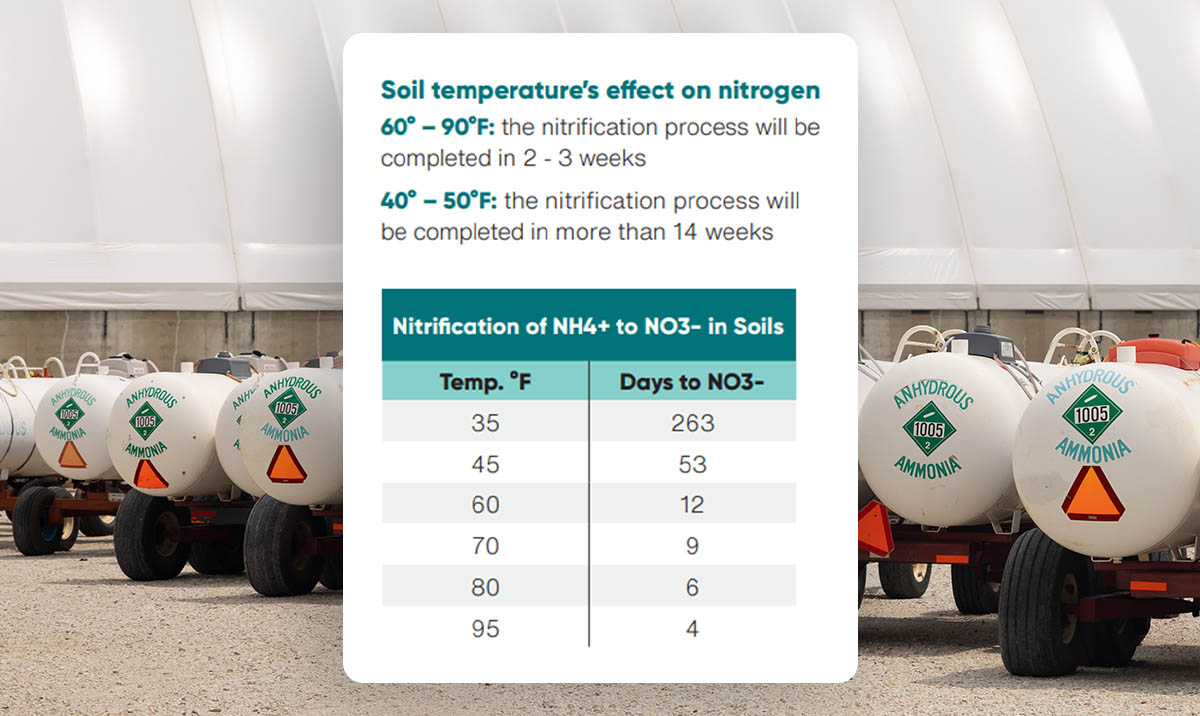
Nitrification is a temperature-sensitive process, so the warmer the soil temperature gets, the faster the conversion from ammonia to nitrate happens,” Luzum says.
Once nitrogen converts to nitrate, it becomes more vulnerable to losses through leaching and denitrification. That risk remains throughout the season.
“So even in sidedress applications we recommend the use of N-Serve and Instinct, as we can still lose applied nitrogen through leaching and denitrification,” he says.
Investment and environmental impacts
With nitrogen representing one of the largest input costs in corn production, protecting that investment has become even more important.
“Nitrogen is such an expensive investment in this 2026 corn crop,” Luzum says. “We really can’t afford to lose nitrogen with the break-evens we are seeing.”
Despite that, only about half of Iowa’s corn acres currently receive a nitrification inhibitor.
“The benefits of using N-Serve with anhydrous in the spring and Instinct NXTGEN with UAN and urea in the spring are numerous,” he says. “By keeping nitrogen in the ammonium form, we reduce leaching by 16% and greenhouse gas emissions by 51%.”
Those environmental benefits also tie directly into Iowa’s water quality goals.
“This is huge for our environment, especially water in the state of Iowa,” Luzum says.
Dispelling a myth
Some growers worry that stabilizers might tie up nitrogen and make it unavailable to the plant. Luzum says that concern is a common misconception.
“There isn’t any concern with tying up nitrogen,” he says. “Just because our nitrogen is in the ammonium form doesn’t mean corn can’t access it. Corn actually prefers ammonium as the source of nitrogen because it’s more plant efficient.”
Ammonium nitrogen behaves differently in the soil than nitrate. While nitrate moves with water, ammonium remains attached to soil particles and is taken up primarily through root interception.
Luzum recommends pairing stabilizers with the largest nitrogen applications, particularly early in the growing season. Split applications can also work well.
“There’s nothing wrong with split nitrogen rates and using split-shot Instinct NXTGEN rates,” he says. “Purdue University has actually done a couple years of study on this subject and this split application has been the best ROI.”
On-farm research
Beyond environmental benefits, long-term research also shows yield advantages.
Corteva is marking the 50th anniversary of N-Serve this year, backed by decades of field data.
“When you look at 50 years of data, we average a yield advantage of 7 bushels in the fall, 8 bushels in the spring and 4 at sidedress,” Luzum says. “Our products provide growers with peace of mind that their nitrogen will still be there for their corn crop, as well as providing a nice ROI.”
Recent field trials continue to support those results. In 2025, Luzum says 18 spring-applied trials across the Corn Belt showed an average yield advantage of 8 bushels per acre compared to untreated acres.
“At $4 corn, that’s $32 an acre more revenue over the untreated,” he says.
To continue building data around spring applications, Corteva is partnering with the Iowa Soybean Association (ISA) on new nitrogen inhibitor trials this season.
ISA research agronomy lead Alex Schaffer says the idea for the study grew directly out of earlier ISA research.
“ISA has done a couple of stabilizer trials in the fall, looking at stabilized ammonia with and without N-Serve, and we saw rather large yield responses from those trials,” Schaffer says. “As we were sharing those results, we started getting questions from farmers asking, ‘What about the spring?’ If they’re applying nitrogen in the spring, could they benefit as well?”
Those farmer questions ultimately helped shape the new research effort.
Schaffer says a key component of the study will be closely tracking how nitrogen changes in the soil following application.
“It’s really important that we’re sampling these trials for eight weeks, every other week after application,” he says. “What we’re really going to show is the conversion rate from ammonia to nitrate, which is one of the most important parts of the trial.”
By monitoring how quickly nitrogen converts to nitrate, researchers hope to give farmers a clearer picture of what is happening below the soil surface - information that is often difficult to see during the growing season.
“It’s hard for growers to always ‘see’ what’s happening with their nitrogen inhibitor,” Luzum says. “Hopefully, with the soil test work, they will be able to see what is happening below ground. This should hopefully show the why a lot more than just the yield increase when the combine rolls in the fall.”
Written by Kriss Nelson.
Back