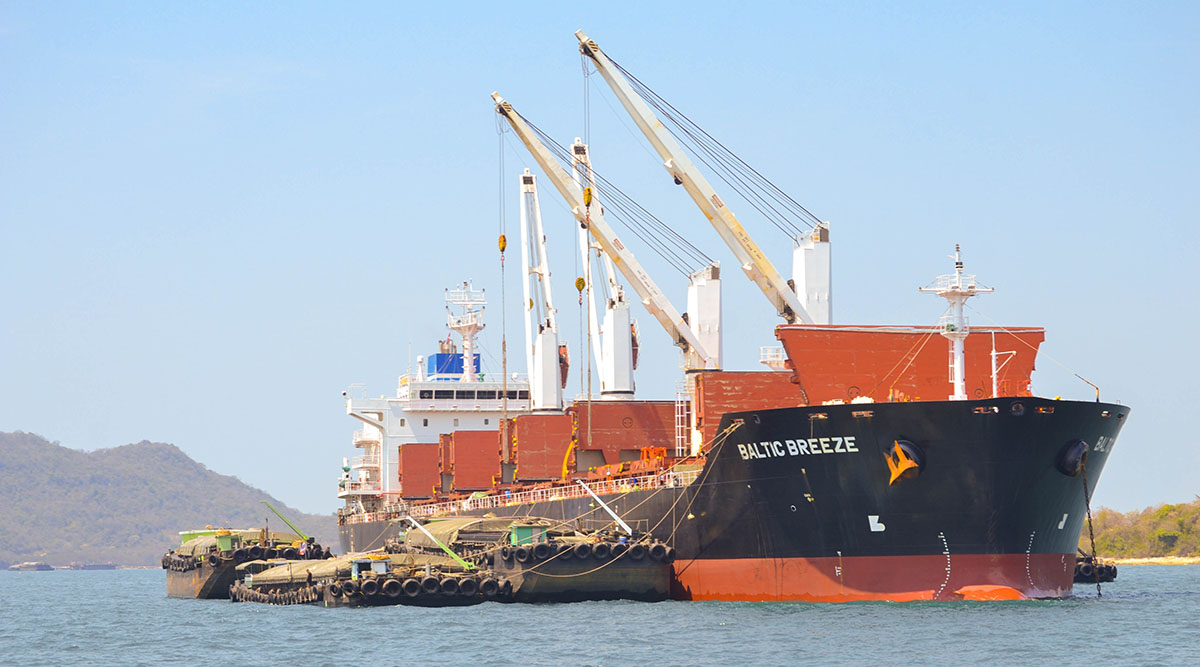
(Photo: Iowa Soybean Association / File Photo)
New Year’s crystal ball holds mixed bag for soy
January 8, 2026 | Aaron Putze, APR
As farmers flip the calendar and prepare for a new growing season, many of the challenges affecting their bottom line will follow right along.
Policy turmoil, trade disruptions, persistently high input costs and the expansion of row crop production in Brazil dominated the headlines in 2025. By all indications, they’ll continue to make front page news in 2026.
“No matter how you look at market data, it’s not good,” says Shawkat Muslimwal, director of economics for the United Soybean Board (USB). “Production break-evens remain well above market prices, trade disruptions and market volatility are at levels we haven’t seen in years, and Brazil’s structural cost advantages won’t slow down any time soon.”
Muslimwal’s assessment was one of several provided during an economics forum held during USB’s December meeting held in St. Charles, Mo. Joining him on stage were:
- Jonathan Kruse, managing principal of World Agricultural Economic and Environmental Services;
- Rosalind Leeck, U.S. Soybean Export Council (USSEC) managing director; and
- Scott Gerlt, chief economist for the American Soybean Association (ASA).
While there was broad agreement among the four that economic headwinds will continue to pressure farm profitability in 2026, several positive developments emerged that merit attention. Here’s a summary of their comments and observations.
Kruse: Focus on Biofuels
Where does growth come from for U.S. soybean and products? Kruse says look no further than the biofuels and feed sectors.
He urged farmers and the associations that represent them to keep up the pressure for action in these two critical demand areas.
For starters, this means keeping the record renewable fuels volume obligations as announced in 2025 by the Environmental Protection Agency “real.”
The Small Refinery Exemptions (SREs), adds Kruse, “could wipe out everything if they are not reallocated.”
A final rule on the SREs is expected in January.
Tied to the future of domestic biofuels demand is the carbon intensity scoring assigned to renewables. And this effort is alive and well in California, he says.
“We need to make sure to state that there is no definitive way to measure indirect land use change – you can’t measure everything with a satellite photo,” he says. “The debate around indirect land use
will continue and as it does, we must continue to defend our domestic farming practices and demonstrate that intentional land use change is going to happen with or without biofuels.”
He expects used cooking oil imports to continue, mostly from destinations other than China.
Soybean importers, says Kruse, have diversified their supply chains in response to U.S. tariffs. China, for example, has diverted its purchases to Brazil. This has resulted in a sharp increase in acres planted to row crops in the South America country.
“Tariffs create uncertainty, especially when they are on and off again in the marketplace. For agriculture, they are especially harmful as countries will look to our more sensitive industries when they retaliate.”
Kruse adds that while global commodity demand is growing, supply growth is outpacing demand, which results in falling prices.
“Thus are we back to farm income being driven by government payments?” he rhetorically asks.
Kruse says market growth opportunities exist. Examples include:
- Mexico, for both corn and soybeans.
- Southeast Asia – meat consumption/feed demand driven, particularly in Vietnam.
- India corn ethanol use growing strong, but it’s unclear if India will be willing to import corn.
- The India poultry and egg sectors are poised for growth in both production and consumption. There may even be an opportunity for soybean meal exports to India as the country transitions away from being a net exporter of the popular feed ingredient.
- Brazil corn ethanol use may reduce corn available for export, thus providing opportunities for U.S. farmers.
Long-term threats also loom, says Kruse. These include:
- Expansion of second crop corn in Brazil (much more land area that can be double cropped).
- Meat consumption saturation in some markets, including China.
- Growth in electric vehicles displacing liquid fuels demand. It will impact ethanol most in the short run but eventually catch up to biomass-based diesel, too.
- “And keep an eye on the Russia/Ukraine war. It’s been disruptive but Ukraine has been resilient in keeping production and exports moving,” says Kruse. “Ukraine has managed to continue exporting and even grow the production and export of oilseeds” during a time of great turmoil.
Kruse sees…
- The growth in land area planted to soybeans in Brazil leveling off. “May not be as much or as fast as we would like because they have China’s ear, but they eventually will face the same challenges we do during a low price environment.
- The only way to break the current low price scenario is a production lid created by a weather issue and to increase exports and feeding of soy to livestock, especially domestically as U.S. meat and poultry consumption continues to increase.
- Some interesting behavior if China tries to shift some of their corn acres to soybeans. “We likely won’t see the import growth in China as we once did so the U.S. diversification to other markets is probably a good thing.”
Muslimwal: USB as a strategic stabilizer
“External forces are turbulent, but USB is the strategic stabilizer,” says Muslimwal. “The board’s strategy is to compete on value, not just volume.
“Grow domestic demand, differentiate U.S. soy, create new demand channels and diversify export markets,” says Muslimwal. “These are just words on slides if you don’t have practices to underpin it.
“USB does.”
On the feed side, research proves higher meal inclusion boosts swine performance while high oleic increases income derived from milk production over feed costs.
On the food side, USB is working to improve soy’s reputation in defense of trending topics like the anti-seed oil movement and GLP-1 diets.
“And on the fuel side, we’re working on quality assurance, which can facilitate the approval of B20 to B30 blends among prominent equipment manufacturers.”
While you can’t predict the future, Muslimwal says you can prepare for it. USB is:
- Modeling for smarter decisions to better predict the return on investment behind new ideas. Scenario modeling undertaken by the USB can reveal how different investments affect the bottom line of farmers.
- Forecasting revenue to help plan ahead in three-year increments. “This ensures better budget planning and proactive strategy alignment,” he says.
- Also, communicating with “one soy voice” by collaborating with ASA, USSEC and other partners. This includes discussing and exchanging ideas that can lead to smarter decisions benefiting U.S. soybean farmers.
“External conditions are tough,” says Muslimwal. “USB can’t impact tariffs or currencies or commodity prices, but we can control where we focus and how we invest and that’s exactly what we’re doing.”
Leeck: U.S. soy expanding the export map
U.S. soybean exports are up 28% to countries other than China, she says. “It doesn’t make up for China but it helps.”
U.S. soybean sales to China have started as the world’s largest soy importer works to fulfill an announced commitment of 12 million metric tons (MMT) on way to 25 MMT during the next marketing year.
“When you put those numbers together, things start looking a little bit better. We’re confident in these sales happening. It seems like there are good intentions on both sides – U.S. and China – to fulfill obligations made during the recent round of trade talks.”
Opportunities for U.S. market diversification include:
- Clearing up trade impediments to create pathways to more markets.
- Many agreements have purchase commitments, particularly Bangladesh, Indonesia, Pakistan, and Thailand.
- Future global demand for soy expected to increase 7-10MMT annually, which is outpacing production increase (The USDA’s WASDE report puts next year’s global soy increase of around 1%).
- Increased demand in the Middle East and North Africa (often referenced as “MENA”) and Southeast Asia. “Think about Colombia up 65% the past three years. Pakistan and Turkey are increased double and triple digits from U.S. so there remains a lot of interest in U.S. soy from the rest of the world,” says Leeck.
- U.S. crush expansion has allowed the U.S. to increase exports of soybean meal.
- “We’re still producing enough whole soybeans to supply whole soybean markets including Mexico and Japan. We can complement and not compete against these markets with our strength in both whole soybeans and soybean meal exports.
“We’re in a pretty good position as U.S. soy has many global friends,” says Leeck. “And despite the challenges this past year, we’ve never ended up in a place where we weren’t able to have conversations with our trading partners in China. That speaks to the resiliency of our industry and the strong relationships built over decades of dialogue.
“We want our share of China’s soybean market but I don’t think we want to go back to 35% market share,” adds Leeck. “In some ways, this frees us up a bit to create market diversification and that bodes well long-term for U.S. soybean farmers.”
Leeck says the future of soy can be strengthened by:
- Taking advantage and capturing the value of the product you produce. This includes working with USB and international partners to truly capture the value of U.S. soy and its intrinsic value and
- Touting U.S. soy’s commitment to producing a product sustainability. “Some are sourcing only from U.S., which is an extrinsic value,” she says.
Gerlt: Creating a more vibrant U.S. soybean industry
It’s been a great year for biofuels, says Gerlt, as many of the industry’s stakeholders made a united ask on strong RVOs.
“On a separate track, cutting the tax credit 50% for imported feedstocks to add value to domestic soybean oil puts money directly into farmers’ pockets,” he adds.
The soy industry also had a victory on 45Z by removing the indirect land use penalty. “We were able to get that penalty taken out of federal law, which we hope sets a precedent for future policy efforts.”
To enhance U.S. soy’s global competitiveness, the industry must:
- Evaluate production costs. Brazil, he says, has higher interest, fertilizer and chemical costs while U.S. farmers have higher land and seed costs. The latter “put us at a disadvantage from a cost of doing business.”
- Getting the RVOs across the finish line by early 2026. “That’s doable and it builds demand and that supports prices,” he says. “Let’s get crush plants built which helps decrease basis.”
Written by Aaron Putze
Back