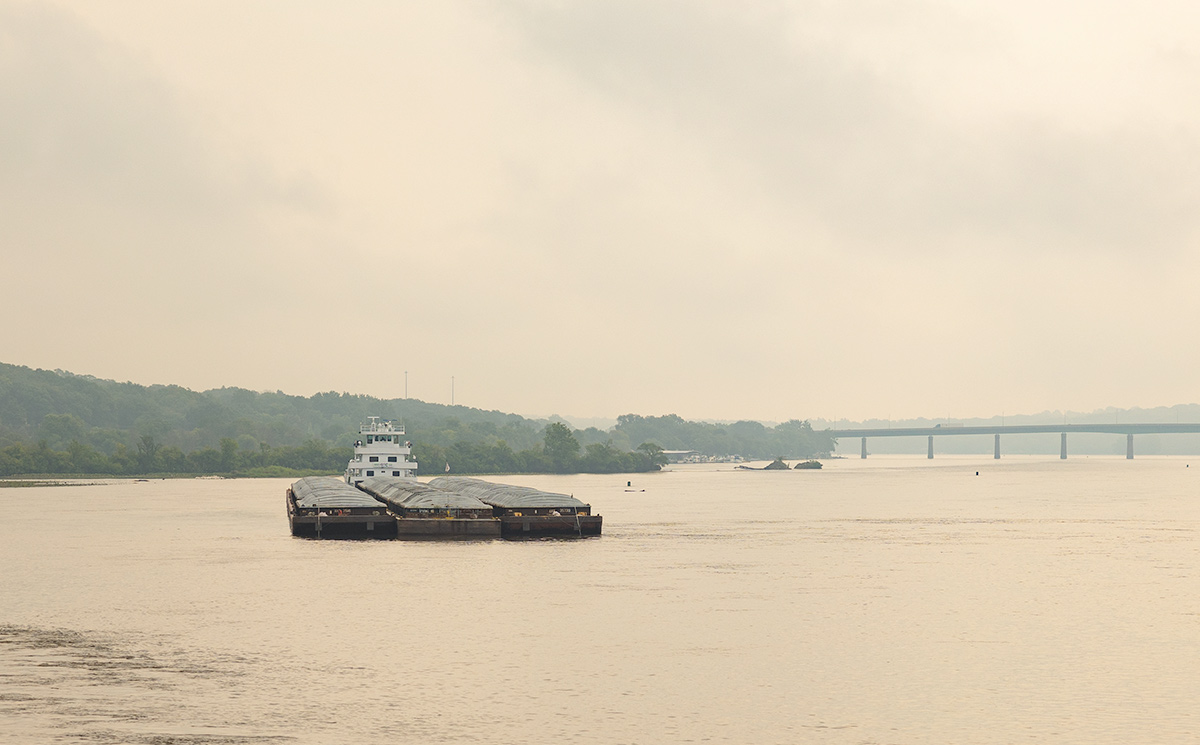
July 2024 traffic on the Mississippi River. Low water levels on the Mississippi River threaten soybean shipments just ahead of harvest. Nearly 60% of U.S. soybean exports reach their final destinations via the Mississippi River and Gulf ports. (Photo: Iowa Soybean Association / Joclyn Kuboushek)
Low water threatens Midwest soybean shipping
September 3, 2026 | Bethany Baratta
Water levels are top of shippers’ minds as harvest nears in the Midwest. It’s also a concern for the Soy Transportation Coalition, which has been monitoring water levels on one of the largest U.S. soybean shipping routes.
“The question among many agricultural shippers is whether 2026 will result in five consecutive years of low water conditions on the Mississippi River,” said Mike Steenhoek, executive director of the STC, which is powered by 14 state soybean boards, the American Soybean Association and the United Soybean Board.
Historically, late summer and fall provide less precipitation, and water levels on the river normally decline, Steenhoek noted.
“The key is to enter this season from a position of strength — with robust water levels — so that a shallow and narrow navigation channel will not materialize during the key export season in October, November and December,” he said. “If we enter this season with low water levels, there will be a reason for concern that the efficiency of barge transportation will be reduced.”
Water transportation
Current water levels near St. Louis and Memphis, Tennessee, are lower in 2026 than during several previous low-water years. As of 11 a.m. on Sept. 3, the water was 2.47 feet deep on the Mississippi River near St. Louis, according to the National Oceanic and Atmospheric Administration. NOAA reported water levels at 1.47 feet deep on the Mississippi River near Memphis.
Though much of the Midwest received significant rainfall earlier in August, water levels increased only momentarily. As the weeks proceed, many will monitor whether water levels revert to low conditions during the peak barge shipping season for soybeans and other agricultural products.
The Mississippi River is a critical link in the soybean supply chain, Steenhoek said. Nearly 60% of U.S. soybean exports reach their final destinations via the Mississippi River and Gulf ports.
Panama Canal water levels
Water levels aren’t just affecting traffic on the Mississippi River, but also the reservoir that supplies water to operate the locks on the Panama Canal, Steenhoek noted.
Rainfall at the canal has been 34% below the historical average since the rainy season started in May. The Panama Canal Authority recently instituted a draft reduction at the Neopanamax locks due to decreasing water levels at Lake Gatun — the man-made reservoir that supplies fresh water to operate the locks. On Aug. 5, the ACP notified customers that, as of Aug. 16, draft at the Neopanamax locks would be reduced to 48 feet from the maximum of 50 feet. Starting today, Sept. 3, the Panama Canal Authority reduced the number of vessels allowed to transit through the canal from 38 per day to 34 per day. It plans to further reduce transits to 32 starting Sept. 15.
The Neopanamax locks were completed in 2016 and accommodate large container vessels, LNG vessels and large cruise ships. Dry bulk vessels transporting soybeans, grain and other agricultural products overwhelmingly use the original Panamax locks completed in 1914. The ACP is maintaining the normal 39.5-foot draft at the Panamax locks. Therefore, dry bulk vessels transporting soybeans will not be impacted by the reduced draft unless conditions at the Panama Canal worsen, according to Steenhoek.
Since temperature variability in Panama is limited throughout the year, the country's two main seasons are the dry season (mid-December through late April) and the wet season (May through mid-December). Average monthly rainfall amounts during the dry season are 1 to 3 inches. During the wet season, average monthly rain totals are 10 inches or greater — usually culminating in over 20 inches of rain during November.
“While there is hope that a significant amount of precipitation will occur during the balance of this year’s wet season, current El Niño conditions have resulted in a significant reduction in rainfall throughout much of Central America, including Panama,” Steenhoek said.
Weather forecasts suggest these dry conditions will persist, prompting the ACP to announce draft reductions this summer. Water levels at Lake Gatun are currently at 84 feet compared with the five-year average of 85 feet, according to the Panama Canal Authority. While this may not appear significant, concerns over a severe and persistent El Niño are leading ACP leadership to institute conservation measures now before conditions worsen, Steenhoek said.
“The Panama Canal is a critical link in the supply chain for U.S. soybean exports,” he said. “As we witnessed during the most recent drought at the canal in late 2023 and early 2024, reductions in draft and number of allowed vessel transits will inhibit our ability to meet demand from our international customers.”
Historical estimates indicate the canal carries about 26% to 32% of U.S. soybean exports and about 17% to 18% of U.S. corn exports, according to RFD-TV.
Written by Bethany Baratta.
Back