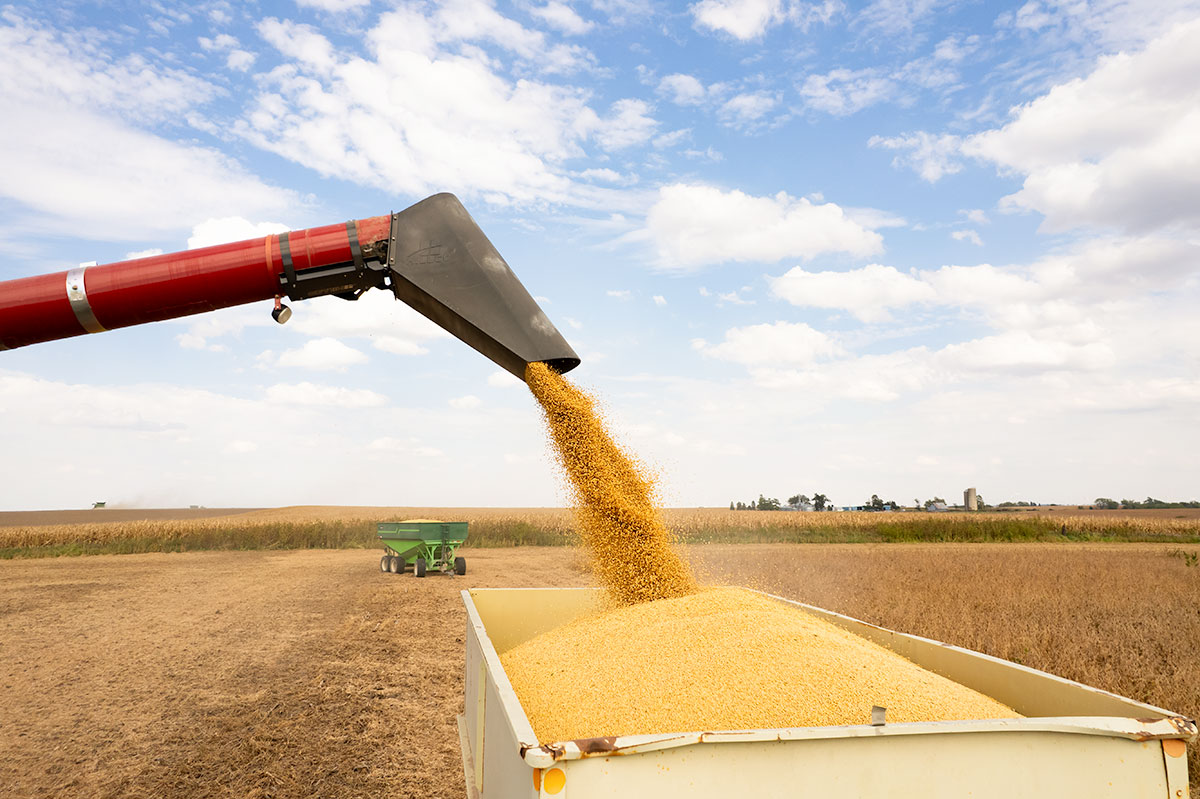
(Photo: Iowa Soybean Association / Joclyn Kuboushek)
Unpacking 45Z
September 1, 2026 | Bethany Baratta
The Section 45Z Clean Energy Production Tax Credit is moving toward implementation, with the U.S. Treasury targeting November 2026 for its official rule release. For soybean farmers, it will directly impact marketing, on-farm record keeping, and potentially your local grain basis. I asked Matt Herman, chief officer of demand and advocacy for the Iowa Soybean Association, to break down how 45Z applies to your soybean acres based on agency drafts and industry projections available as this issue went to print.
Q & A with Matt Herman
How did U.S. soybeans secure a seat at the 45Z table?
Originally, rules largely favored used cooking oil and animal fats, which were increasingly imported. Early models included an “indirect land use change” (ILUC) penalty that artificially inflated the carbon intensity (CI) score of domestic soybeans, threatening to exclude our soybean oil from the clean fuels market. Strong industry advocacy successfully removed that penalty, making U.S. soy highly competitive for biomass-based diesel.
Does a farmer file for the 45Z credit on their own tax return?
No. Individual farmers cannot directly claim the 45Z tax credit. The credit is claimed exclusively by registered biofuel producers. Your choice is whether to participate in potential regen ag programs offered by your buyers. Through intensive record-keeping you can prove a lower carbon footprint and gain leverage to negotiate a premium from the buyer — who uses your data to maximize their federal tax credit.
Most Iowa growers run a corn-soybean rotation. How does 45Z accounting handle a two-crop system?
This is where budgeting gets tricky. Because 45Z calculates carbon intensity scores annually by crop, your financial return will likely fluctuate from year to year. The models premium for the corn year is substantially larger, both due to corn’s yield, but also modeling decisions made by Department of Energy. If you cover crop both years, you might see a strong return on your corn acres, but your soybean return could drop to around $5 to $12 an acre — potentially below the actual cost of establishing the cover crop. Growers must evaluate the financial return of the entire rotation, rather than each crop year in a vacuum.
What do the models tell us about the best regen agricultural practices for Iowa soybeans?
The models show distinct regional variations based on soil geography. In Iowa's highly fertile soils, the model responds much more favorably to no-till practices than standalone cover crops on soybean acres. For farmers wanting to get value from their cover crops, the rule adds a high-value option: cover crop plus grazing, allowing livestock producers to graze the cover while retaining roughly 90% of the carbon credit.
What is the realistic financial payoff per bushel for soybeans?
The incentives are much smaller for soybean than they are for corn. Shifting from conventional tillage to no-till on soybeans generates an estimated premium of 10 to 30 cents per bushel, based on the latest modeling. On a typical Iowa yield, that translates to roughly $5 to $15 an acre. Crucially, the rules do not require additionality and these credits may apply to old crop still sitting in on-farm storage, provided your records are fully auditable.
What is the “mass balance” delivery system, and what should farmers do next?
AUnder a “book and claim” model, carbon attributes would be decoupled from physical grain, allowing you to sell a digital carbon certificate independently to any buyer. Instead, USDA opted for a “mass balance” system, requiring the low-carbon attribute to move with the physical bushel as it moves from farm to co-op, crusher, and fuel plant. Regenerative ag bushels do not need to maintain identity preservation.
There is concern that because processors and handlers are required to handle data, they will have considerable leverage, even discounting your physical grain basis to cover administrative costs. Moving forward, ISA is exploring what data it can collect from their members and the marketplace to help create transparency in contractual terms.
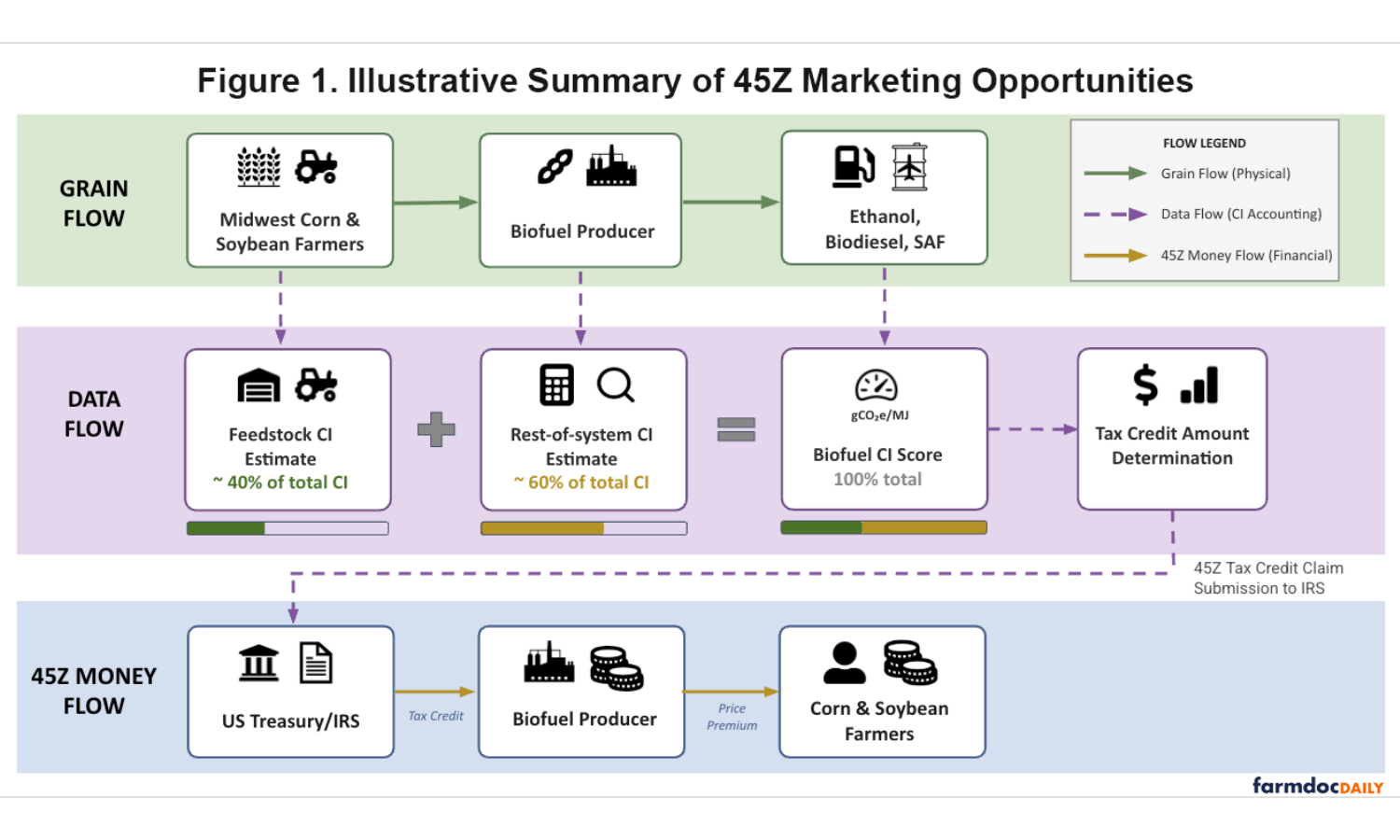
Image summarizes the relationship between physical grain movement, carbon-intensity accounting, and potential financial value under 45Z.
Sound off: What are you hearing?
As the 45Z tax credit moves from policy to the physical supply chain, we want to ensure soybean growers have the clearest possible picture of how this market is developing. To help us advocate effectively and track how these credits are being handled at the local level, we want to hear from you.
- Are your local co-ops or elevators talking about 45Z?
- Are they discussing custom tracking contracts or changes to basis?
- What data requirements are they asking you to prepare for?
Share your feedback with us. Email Matt Herman at mherman@iasoybeans.com.
Written by Bethany Baratta.
Back