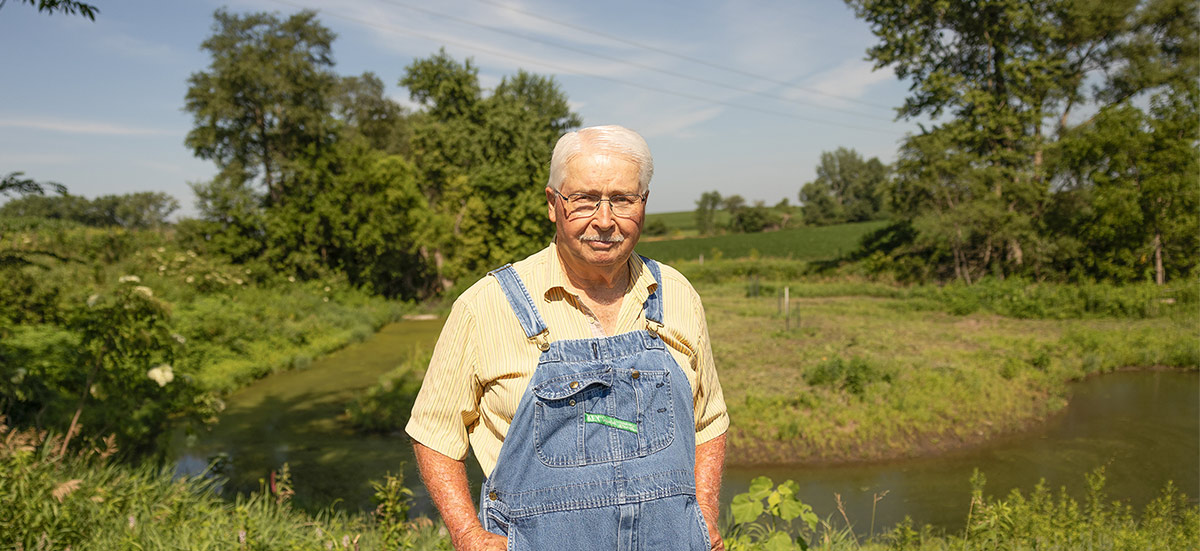
Ed Ulch in front of his Oxbow (Photo: Iowa Soybean Association / Joclyn Kuboushek)
Ed Ulch builds conservation through decades of on-farm practices
September 1, 2026 | Kriss Nelson
When Ed Ulch looks across his farm near Solon, he doesn’t point to a single conservation practice as the key to improving water quality and protecting soil.
Instead, he points to decades of work: terraces, no-till, cover crops, filter strips, trees, nutrient management and most recently, an oxbow restoration.
“All these things — you put them all together, and they all do a large part,” says Ulch, a past Iowa Soybean Association District 6 director.
That philosophy has guided conservation efforts on the farm for years and recently led to the restoration of an oxbow along a creek that ultimately drains into Lake Macbride.
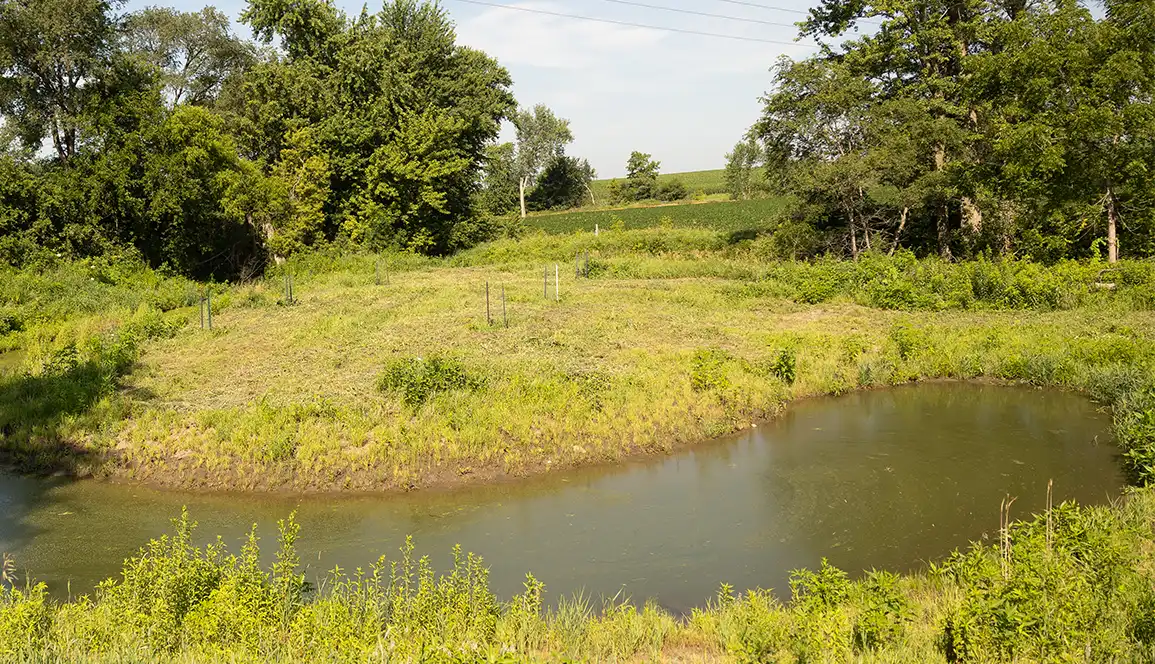
Completed after the 2025 harvest, the project transformed a former stream channel into a functioning oxbow designed to improve water quality and provide wildlife habitat.
“We finished it right before winter,” Ulch says. “It’s worked out pretty well. Everything seems to be functioning the way it was intended.”
Restoring an oxbow
The project had been on Ulch’s mind for two years. He identified the location because the cut-off creek channel was a natural fit, especially with two tile lines already draining into the site. After consulting with conservation partners, including Iowa Soybean Association Senior Conservation Services Manager Brandon Iddings, the channel was excavated and restored to its original shape. Today, the oxbow consistently holds water and is already attracting wildlife.
“There were seven deer and a blue heron wading in it the other day,” Ulch says.
He recently planted 11 trees near the oxbow to replace those removed during construction.
Protecting water quality
For Ulch, the project’s main priority is downstream impact. The creek connected to the oxbow eventually flows into Lake Macbride, a popular eastern Iowa recreation destination. “We’ve tried to protect the water going into Lake Macbride because it draws a lot of people to the area and helps the community,” Ulch says.
That focus extends across his entire operation. Over the years, Ulch has installed filter strips to slow runoff and catch sediment along the creek. He maintains approximately 42 terraces designed to reduce erosion and keep soil in place.
Additional acres have been enrolled in conservation programs, particularly in areas that are difficult to farm while also providing wildlife habitat.
He has also planted roughly 1,500 trees over the last three years through various conservation programs, including a University of Iowa project utilizing Carolina poplars to stabilize streambanks and reduce erosion.
“We plant trees every year,” he says. “This year we planted 41.”
Decades of practice
Perhaps the longest-running conservation practice on the farm is no-till, which Ulch started in the 1970s long before soil health became a mainstream topic in agriculture.
Cover crops eventually became part of the system, often broadcast-seeded in conjunction with fall applications of potash and calcium sulfate. He uses a variety of seeding approaches depending on the field and conditions.
Cover crops and no-till support his approach to nutrient management. While many farmers historically applied nitrogen in the fall, Ulch has shifted nitrogen applications to the spring in three precise windows: before planting, with the planter, and side-dressed later in the season.
“We put nitrogen on three different times in the spring to minimize loss,” Ulch says.
Every piece matters
Ulch is hesitant to point to any single conservation tool as the answer for every farm. Instead, he sees conservation as a collection of practices that work together over time.
The restored oxbow is the latest addition to a conservation system that’s decades in the making, aimed at leaving the farm better than he found it.
“All these things together do a large part to improve conservation,” he says.
Written by Kriss Nelson.
Back