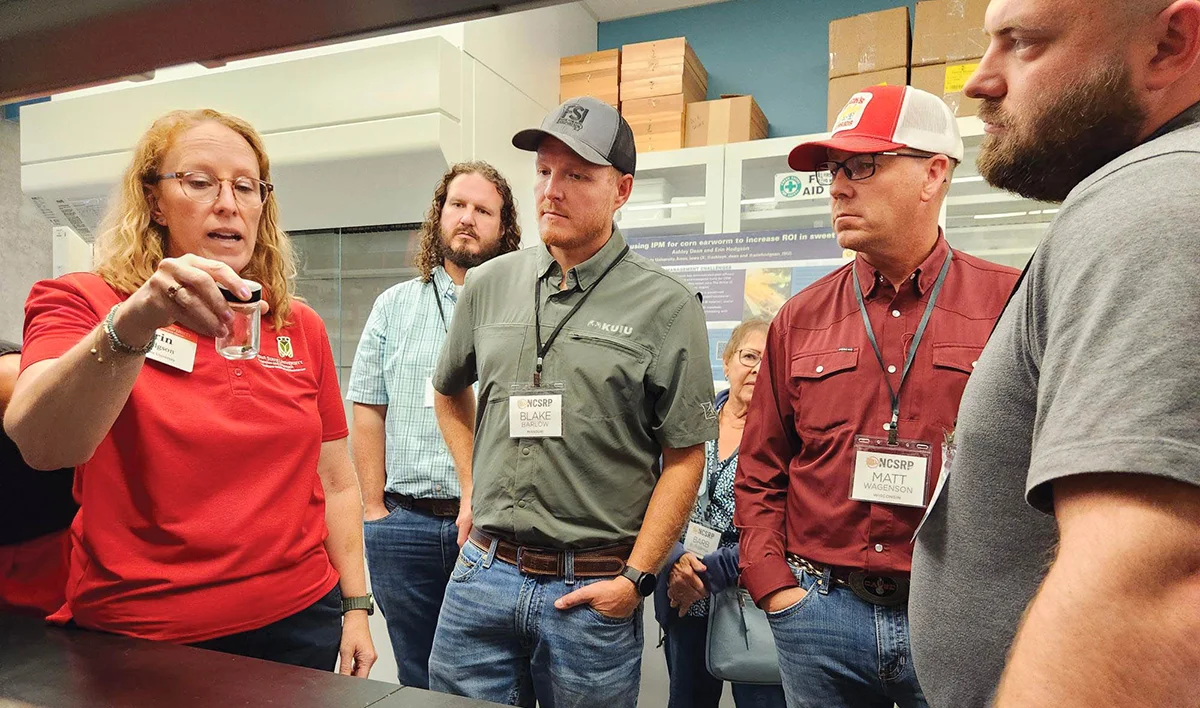
(Photo: Iowa Soybean Research Center / Kara Berg)
This research partnership tackles emerging threats
October 1, 2026 | Kriss Nelson
When Iowa soybean farmers invest checkoff dollars into research, they aren’t funding work that stops at the state’s borders.
Through the North Central Soybean Research Program, 13 soybean-producing states across the Midwest pool resources, expertise, and funding to tackle challenges that affect farmers throughout the region. The result is a collaborative approach that allows researchers to respond more quickly to emerging threats, leverage farmer investments and develop solutions that benefit soybean growers. More than 80% of U.S. soybeans are grown within the North Central region, making collaboration critical, says Joe McClure, NCSRP executive director and chief officer of the Iowa Soybean Association’s Research Center for Farming Innovation.
“North Central is really the heart of U.S. soybean production,” McClure says. “When we bring together researchers and experts from across the region, we’re able to address challenges faster and more effectively than any one state could on its own.”
Regional collaboration
Rather than funding individual projects within a single state, NCSRP focuses on bringing together researchers from multiple universities and disciplines to address common challenges facing soybean farmers.
For example, Iowa currently has limited concerns with red crown rot, a disease more commonly found farther south. But through regional partnerships, Iowa farmers benefit from research already being conducted by specialists in states where the disease is a more immediate threat.
“If that disease eventually moves into Iowa, we’re not starting from scratch,” McClure says. “We’re already benefiting from the knowledge and management strategies developed through collaborative research.”
By pooling funding from 13 state soybean checkoff organizations, NCSRP can support larger projects and attract expertise that would be difficult for any single state to fund independently.
“Our farmers are able to leverage their investment into research that has a much broader impact,” McClure says. “They’re getting access to projects and expertise that would be difficult to support individually.”
One example of that collaboration in action is soybean gall midge.
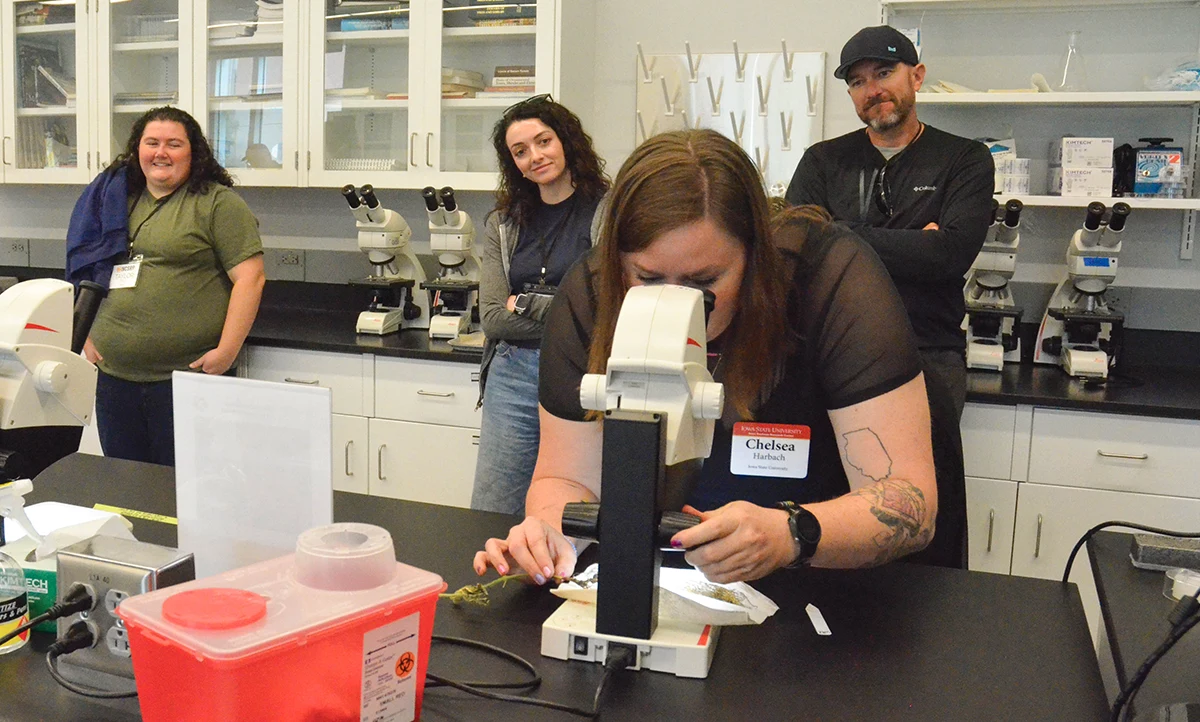
When the pest first emerged in western Iowa, Nebraska and neighboring states, little was known about its biology or management. Through NCSRP, entomologists from multiple states quickly came together to study the insect, identify its life cycle and begin developing management recommendations.
“It was a new pest, and nobody really knew much about it,” McClure says. “The organization was able to react quickly, bring experts together and accelerate the learning process.”
Tomorrow’s tools
While rapid response to emerging threats remains important, McClure is equally excited about projects that could shape the future of soybean production.
One initiative led by researchers in Wisconsin is using large datasets and artificial intelligence to better understand which management decisions consistently drive profitability and yield.
The project analyzes information collected across multiple states to determine whether long-held farming practices continue to deliver economic value.
“We all have things we do because that’s the way we’ve always done them,” McClure says. “The data doesn’t always support that, and this project is helping us identify which management decisions truly make a difference.”
Another long-term effort focuses on soybean cyst nematode, one of the most persistent yield-robbing pests in soybean production.
Researchers, including Thomas Baum, a plant pathology professor at Iowa State University, are working to identify new sources of resistance and future trait technologies that could provide farmers with additional tools to combat SCN.
While those solutions remain years away, McClure says they represent the type of foundational research needed to address future challenges.
Coordinated research
Ultimately, McClure views NCSRP as one piece of a broader research system that includes state soybean organizations and the national soybean checkoff.
Rather than competing for resources, he says the organizations work together to ensure farmer investments are being used strategically and efficiently.
“We’re not operating in isolation,” McClure says. “Our goal is to complement the work being done by the states and USB so farmers see a coordinated approach that delivers value from their checkoff investment.”
Borderless research
Although the Iowa Soybean Research Center does not receive direct funding from the North Central Soybean Research Program, its research priorities closely align with the organization’s mission.
Many of the production challenges facing soybean farmers—including insects, diseases and agronomic management—extend well beyond Iowa’s borders.
“A lot of our soybean challenges and opportunities are not just Iowa-centric,” says Mark Licht, co-director of the Iowa Soybean Research Center and Iowa State University Extension cropping systems specialist. “Whether we’re doing the research here in Iowa or it’s being conducted at another university, it’s all getting us newer research and information to make soybean management decisions.”
That collaboration begins long before research reaches the field, says Danny Singh, Iowa State University associate dean for research and discovery and agronomy professor.
“The partnership in defining problems, the partnership in figuring out solutions together,” Singh says. “We take learnings from the lab and the field and take them to the farmer so they can utilize them in their production system.”
Written by Kriss Nelson.
Back