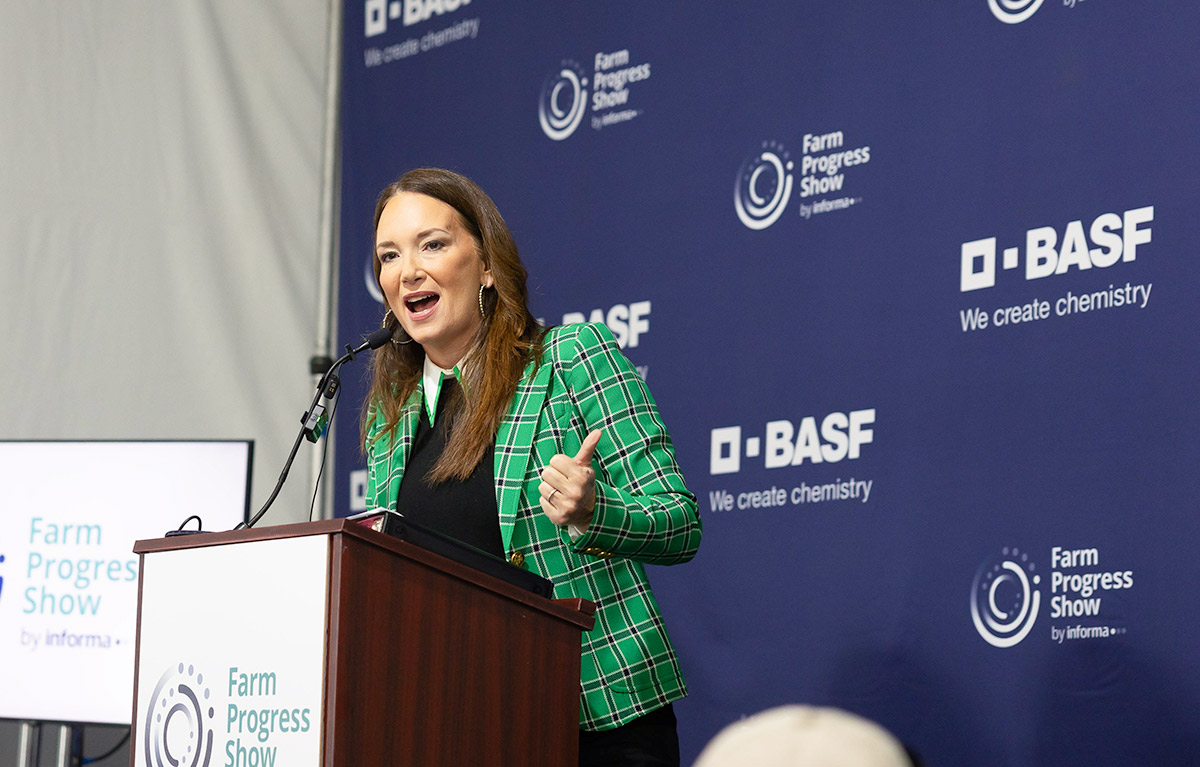
U.S. Secretary of Agriculture Brooke Rollins speaks to farmers and industry representatives during the 2026 Farm Progress Show in Boone. (Photo: Iowa Soybean Association/Joclyn Kuboushek)
Rollins’ road map for agriculture
September 3, 2026 | Kriss Nelson
Farmers are seeing signs of progress in parts of the agricultural economy, but U.S. Agriculture Secretary Brooke Rollins says there is plenty of work ahead to improve profitability and create opportunities for the next generation.
Speaking at the Farm Progress Show in Boone on Tuesday, Rollins pointed to gains in agricultural exports, biofuels and efforts to reduce input costs while outlining four areas USDA is prioritizing: data modernization, biofuels, fertilizer and cattle.
Her remarks came the same day she joined Pivot Bio CEO Chris Abbott for an announcement focused on another challenge facing agriculture: creating opportunities for the next generation to remain on the farm and in rural communities.
Measuring progress
Rollins acknowledged the difficult farm economy but says several indicators are moving in a positive direction.
She says the agricultural trade deficit, which she placed at about $50 billion when the administration took office, has been cut roughly in half. She also cited soybean oil exports up 129%, dairy exports up 15%, corn exports up 35% and ethanol exports up 21%.
She also pointed to changes to the farm safety net, including higher reference prices that provide greater protection when commodity prices decline, enhanced crop insurance support and the addition of up to 30 million base acres eligible for commodity programs.
Modernizing USDA data
The first of Rollins' four priorities focused on something farmers regularly use to make marketing and management decisions: USDA data.
Rollins announced a modernization effort aimed at improving how USDA collects information from farmers and produces acreage, yield and other agricultural estimates.
The plan has four components: modernizing the producer reporting experience, improving acreage and yield estimates, integrating USDA data and technology platforms and increasing trust and transparency.
USDA plans to expand mobile access to surveys, use administrative data to reduce duplicate requests and explore pre-filled information where appropriate.
The department also plans to pilot improved satellite imagery and incorporate geospatial tools, crop models and other technologies alongside information reported by farmers.
Artificial intelligence and machine learning could also eventually play a role.
Rollins says farmers have been directly involved in developing the changes, providing feedback about repetitive surveys, outdated systems and difficulties getting answers about why information is being requested.
“Our farmers, you deserve administrative support that makes your lives simpler, more rewarding and easier, not harder,” she says.
Building biofuel demand
For Iowa corn and soybean farmers, Rollins' second priority was especially relevant: biofuels.
She pointed to the administration's proposed Renewable Fuel Standard volumes and continued support for year-round E15.
Rollins says June and July were the two strongest months on record for biomass-based diesel production and says production has increased by 150 million gallons annually, or about 10,000 barrels per day, since the beginning of the administration.
Ethanol exports, she says, are up 21%, or approximately $475 million, compared with the previous year.
“American corn and soybean growers want more domestic market opportunities so that you do not have to rely on foreign adversaries to buy your grain,” Rollins says.
She also highlighted USDA's Feedstock Carbon Intensity Calculator. This calculator designed to help farmers determine opportunities associated with qualifying practices.
Tackling fertilizer costs
Rollins' third priority was lowering farm input costs, particularly fertilizer.
She says fertilizer affordability and domestic production are not only farm economy issues but national security concerns.
Although fertilizer prices remain elevated, Rollins says prices for several products have declined considerably from 2022 levels, citing urea down 57%, potash down 53% and ammonia down 50%.
The longer-term goal, she says, is reducing U.S. dependence on foreign fertilizer production by expanding manufacturing at home.
“We've got to drive down the cost of our inputs, and we've got to get to the point where we're not relying on foreign countries for fertilizer,” Rollins says.
Rollins pointed to federal investments in new fertilizer production facilities and efforts to accelerate permitting. She also cited two large-scale composting facilities in Iowa supported by USDA funding that she says are expected to process 72,000 tons of organic material annually.
Innovation tackles inputs
That focus on fertilizer carried into Rollins' appearance with Pivot Bio earlier in the day.
Abbott says agricultural biotechnology can help reduce farmers' production costs while maintaining productivity.
Pivot Bio engineers microbes that fix nitrogen from the atmosphere and make it available to crops, providing an alternative source of nitrogen. Abbott says the company has focused on product performance and helping farmers manage fertilizer price volatility.
Following volatility in global fertilizer markets, Abbott says Pivot Bio lowered prices and later offered growers multi-year price protection.
“We wanted to prove that American technology can actually be cost deflationary for U.S. farmers,” Abbott says. “They need that now more than ever.”
Rollins praised the company's approach, saying agricultural innovation and domestic fertilizer alternatives can help provide farmers with greater certainty when global markets become volatile.
Rebuilding the cattle herd
Rollins' fourth priority focused on U.S. cattle production.
She says the nation's cattle herd is at its lowest level in 75 years and pointed to drought, grazing availability and other economic pressures as contributing factors. She cited efforts to increase federal purchases of American beef through school meals and other government food procurement programs.
USDA is working to expand grazing opportunities, support small and midsize processors and encourage heifer retention, she says. Rollins framed the focus on the U.S. cattle inventory as part of the same larger objective: rebuilding domestic agricultural production and creating an environment in which farmers and ranchers can remain profitable.
Investing in what's next
Abbott and Rollins used their joint appearance to turn the conversation from today's farm economy toward its next generation.
Pivot Bio announced Pivot Pathways, a grant program that Abbott says will extend to the company's employees and customers. Depending on eligibility, participating farm families could receive $1,000 to $5,000 annually to support a child, grandchild or another young person connected to the farm.
Abbott says the idea developed from conversations with farmers concerned about whether their children could afford to return to the farm, start a business or pursue careers while remaining in rural communities.
He says Pivot Bio expects to invest several million dollars annually in the effort.
Rollins connected that investment to the larger challenge of keeping farms and rural communities viable.
“Agriculture has never been just about an acre of land or a balance sheet,” Rollins says. “Farming is an inheritance. It is knowledge, it is responsibility. It is faith, it is family and a way of life passed from one generation to the next.”
Written by Kriss Nelson.
Back