(Photo: Iowa Soybean Association / Aaron Putze)
Soy strategy in a Brazil-led world
May 1, 2026 | Bethany Baratta
For 80 years, American soybean farmers had a simple mission: Produce more, export the surplus, and let U.S. diplomacy handle the rest.
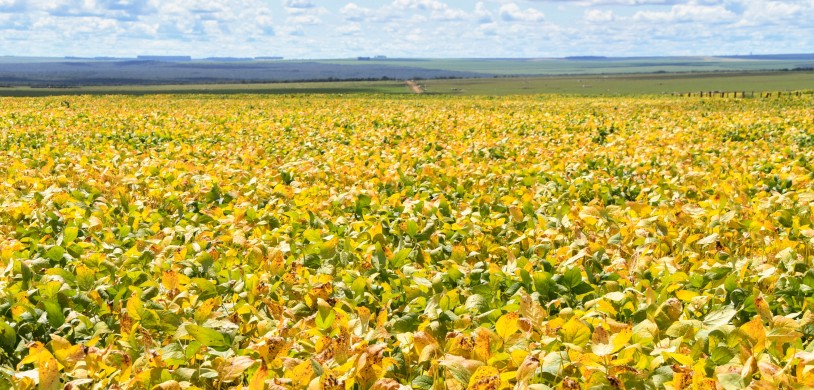
But as we expect U.S. soybean farmers to produce 4.45 billion bushels of soybeans this year, that “volumetric game” — the race to the top of production — has a new leader. Brazil isn’t just a competitor anymore, experts say. They are the “180-million-metric-ton gorilla” in the room, poised to grow 180 million metric tons, or nearly 6.6 billion bushels of soybeans this year. They’ve been leading world soybean production since 2018.
Land and cost
Brazil’s greatest advantage lies in its ability to bring more land into production more economically. They also have a climate advantage in its ability to double-crop. Recent investment in inland transportation has also helped bring down costs, notes Allen Johnson, the former chief agricultural negotiator in the Office of the U.S. Trade Representative (USTR) for the George W. Bush administration.
Since 2010, their cost to grow an acre of soybeans has stayed lower than that of American farmers, often by 20% or more, according to the U.S. Department of Agriculture (USDA) Economic Research Service data.
For decades, the U.S. won on logistics, notes Mac Marshall, a strategic advisor in the agriculture space. The U.S. had the Mississippi River; Brazil had mud roads. But recent investments in Brazil's “Northern Quarter” have created new terminals and shorter shipping lanes to major markets, narrowing that historical advantage.
Because Brazil has built the resilience and versatility to handle the higher scale, the U.S. can no longer rely on being the more efficient shipper to win the market, Marshall says. Some of those infrastructure gains have been made with China’s investment in Brazil infrastructure during the U.S.-China trade impasse of 2018.
The fertilizer trap
While Brazil’s rise in soybean production may be impressive, it’s not without its challenges. There’s a price to pay for taking marginal land and converting it into productive cropland.
To make their land as productive as an Iowa field, they have to apply 4.6 times more potash, around 3.8 times more phosphate, and about 1.6 times more nitrogen than farmers here.
“These heavier applications of inputs needed to make Brazilian farms productive will become a problem unless they are paying close attention to soil fertility,” Johnson says. “If we hit any economic bumps globally like a recession or high inflation, this could harm Brazilian growers more than U.S. growers who are less dependent on inputs.”
While the U.S. sources potash from a stable partner in Canada, Brazil imports over 90% of its nitrogen and potash, and 75% of its phosphate. This is a precarious position, Johnson notes, particularly since suppliers like Russia, China, and Iran come with significant geopolitical risk.
“The Brazilian government recognizes this, and they have created tax incentives to push domestic production of farm inputs — they want to reduce reliance on fertilizer imports from 85% to 45% by 2050. But this takes money, and the Brazilian economy, as many nations are, is showing weakness,” he says. “How realistic is it that they can reduce imports? Many of these targets go unmet, so cost and sourcing of inputs is a limitation.”
The China factor
In 2025, the U.S. provided only 15% of China’s soybean needs — a massive drop from the 40% market share the U.S. held a decade ago. And while the United States and China go back and forth on trade and tariffs, Brazil is ready to capture the market share the U.S. once held.
Johnson says that China, while an important customer, is a question mark in the long run, noting major demographic and economic headwinds: a quickly aging population, population declining, low household consumption, reliant on exports for economic growth, and a property crisis that won’t go away.
Still, no one country can supply China with all its soybean needs, Marshall notes. It’ll take soybeans from Brazil and the U.S. to meet the demands.
Control the controllables
So, what does this mean for Iowa soybean farmers? Portfolio and market diversification, the experts say.
“Supporting efforts to open new markets is key for Iowa farmers,” Johnson says. He says the experience with China over the last five or so years showed the danger of being reliant on one customer.
“Iowa farmers should support the Iowa Soybean Association’s efforts to grow our export opportunities and advocate for trade deals with their representatives,” Johnson says.
He’s optimistic about the growth potential of soybean products in Southeast Asia, Africa, Latin America, and Central Asia, noting the forecasted increase in meat consumption domestically, further increasing the use of soybean products.
While the proverbial playing field may be tilted, Marshall argues that success comes down to a dual strategy of amping up domestic demand and de-risking the individual farm portfolio.
“U.S. farmers can’t control how loud the Brazilian “crowd” is or how they tilt the pitch,” Marshall says. “U.S. farmers can only control their game: diversifying revenue, amping up domestic demand, and de-risking their own operations.”
Diversifying the farm portfolio with off-season revenue crops like pennycress or adopting sustainable practices isn't just about conservation; it's about gaining an edge in value-added markets.
“A major growth opportunity in the future will be biofuels, and we are seeing buyers requiring tightening lifecycle GHG requirements,” Johnson says. “If we already have these practices in place or can pivot quickly, we can seize these opportunities.”
Watch Item: The EUDR Factor
While Brazil can legally convert more land to soybeans, a new European Union Deforestation Regulation (EUDR) is casting a shadow over that growth. The law bans imports linked to forest destruction, potentially locking Brazilian soybeans out of the world’s second-largest import market.
For Iowa farmers already operating on established farms, this regulatory shift could create a premium for U.S. soybeans in low-carbon and high-value fuel markets like sustainable aviation fuel (SAF).
Written by Bethany Baratta.
Back