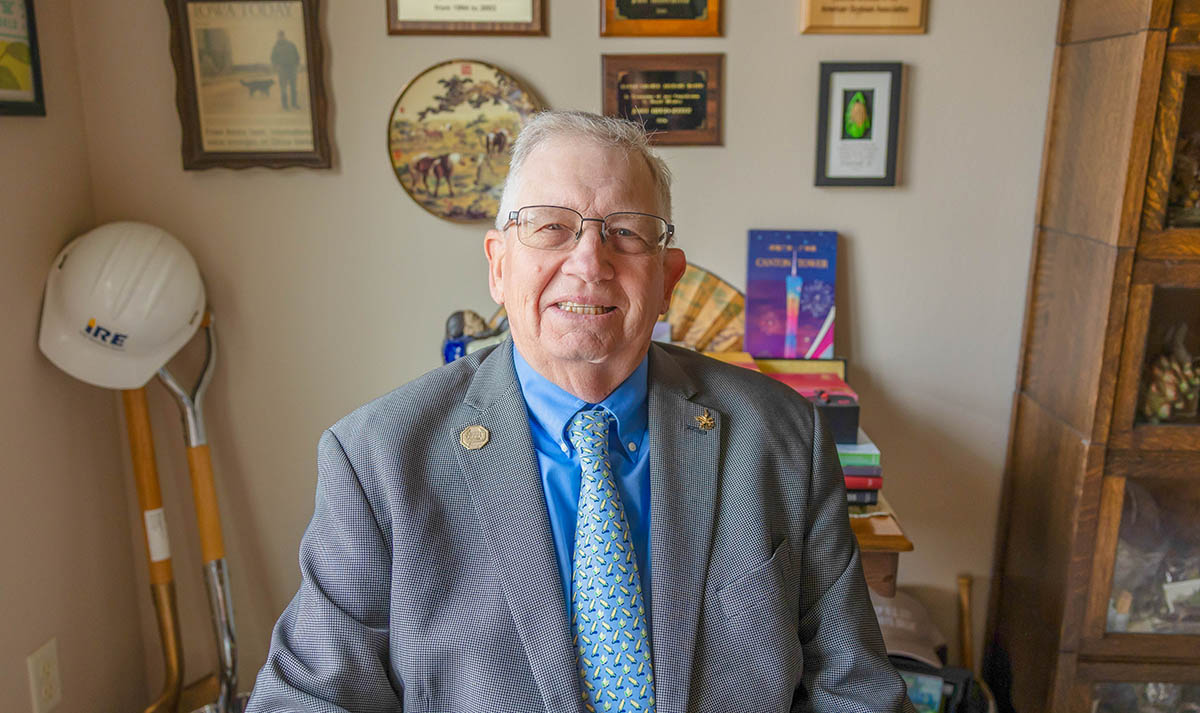
(Photo: Iowa Soybean Association / Joclyn Kuboushek)
From the cab to global impact
June 1, 2026 | Kriss Nelson
John Heisdorffer has never viewed leadership as a title.
For the Keota farmer, it has always been about responsibility to the land, to fellow farmers and to an industry that depends on strong voices willing to step forward. That mindset was front and center as he was recognized with the Iowa Soybean Association’s Legacy of Leadership Award, an honor that reflects decades of service. But for Heisdorffer, the focus remains on the work, not the recognition.
“I’ve always believed if you’re going to be part of something, you need to be willing to contribute,” he says. “Agriculture doesn’t stand still, and neither can we.”
Big picture
Heisdorffer farms in southeast Iowa, where day-to-day decisions in the tractor cab are shaped by more than weather or markets. They are tied to a broader view of where the soybean industry is headed and what it takes to keep it strong.
“When I’m in the tractor, I think about the big picture,” he says. “Are we building demand? Are we telling our story? Are we making sure farmers have a seat at the table when decisions are made?”
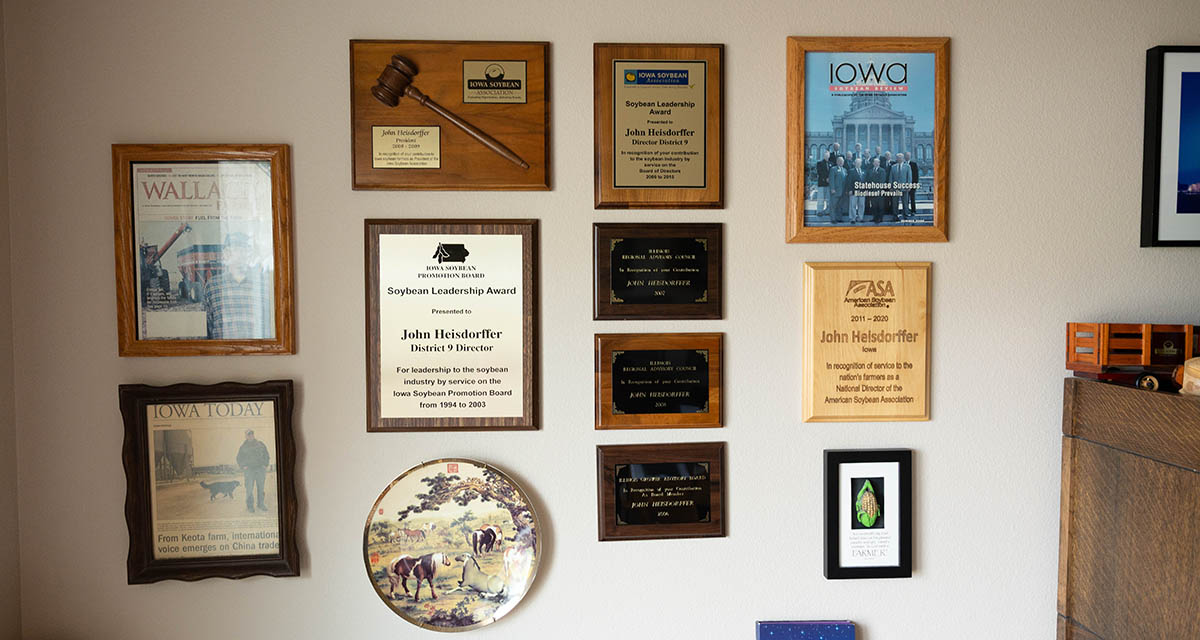
That perspective carried him through leadership roles at both the state and national levels. As president of the unified ISA board in 2008, Heisdorffer played a significant role in the strategic planning that led to the merger of the Iowa Soybean Promotion Board and the association. He led the charge to unify the checkoff and non-checkoff sides of the organization to better serve Iowa farmers.
“The merger was about alignment,” he says. “Farmers don’t think in terms of programs or funding buckets. They think about outcomes. We needed to make sure everything we were doing worked together.”
Steady voice
His leadership extended beyond Iowa. As president of the American Soybean Association during the onset of the U.S.-China trade war, Heisdorffer became a steady voice during uncertain times, fielding media calls, engaging policymakers and advocating for farmers, often from the cab of his tractor.
“There were a lot of tough conversations,” he says. “But that’s when it matters most that farmers are part of the discussion. If we’re not speaking up, someone else is speaking for us.”
Throughout his career, Heisdorffer has remained focused on impact, from developing international markets through the U.S. Soybean Export Council to supporting biodiesel growth and global food initiatives through the American Soybean Association’s World Initiative for Soy in Human Health.
He points to those efforts as examples of where farmer leadership can make a difference.
“Market expansion doesn’t happen overnight,” he says. “It takes relationships, persistence and a willingness to invest for the long term. But that’s how we create opportunities for the next generation.”
Future focus
That next generation is something Heisdorffer thinks about often. He encourages young farmers to get involved, not just on their farms but in organizations that shape the future of agriculture.
“There’s always more work to do,” he says. “Whether it’s policy, sustainability, demand or technology, the industry is changing fast. We need people who are willing to step up and help guide that change.”
Heisdorffer also points to the importance of staying grounded in the realities farmers face every day. While his leadership reached global markets and national policy discussions, it was always rooted in what was happening back home.
“You can’t lose sight of the farm,” he says. “Everything we talk about, whether it’s trade, biofuels or sustainability, has to come back to whether it works for farmers on the ground.”
Real-world impact
That connection helped guide his approach to some of the industry’s biggest challenges. During the trade war, uncertainty weighed heavily on markets and farm operations alike. Heisdorffer worked to ensure farmers’ perspectives were clearly understood by decision-makers, emphasizing the real-world impacts of policy.
“Those weren’t abstract conversations,” he says. “They affected prices, planning and livelihoods. It was important that policymakers understood what that meant for farmers and rural communities.”
He also believes one of the industry’s greatest strengths is its ability to adapt. From advancements in technology to evolving expectations around sustainability, Heisdorffer sees opportunity in change if farmers are part of shaping it.
“Farmers have always been innovators,” he says. “We just need to make sure we’re part of the conversations driving those innovations forward.”
Looking ahead, he sees continued investment in demand as critical, along with telling agriculture’s story more effectively to consumers and global partners.
“We grow a great product,” he says. “But we can’t assume people understand that. We have to be willing to engage, educate and build trust.”
For Heisdorffer, the legacy is not defined by awards or positions held. It is measured by progress, by stronger markets, a more unified industry, and farmers who are better positioned for the future.
“It’s about leaving things better than you found them,” he says. “That’s what leadership is all about.”
About the legacy of leadership award
Presented by Stine Seed, this award is presented to an ISA member who has established a history of leadership and has taken an active role in advancing the goals of ISA.
Written by Kriss Nelson.
Back