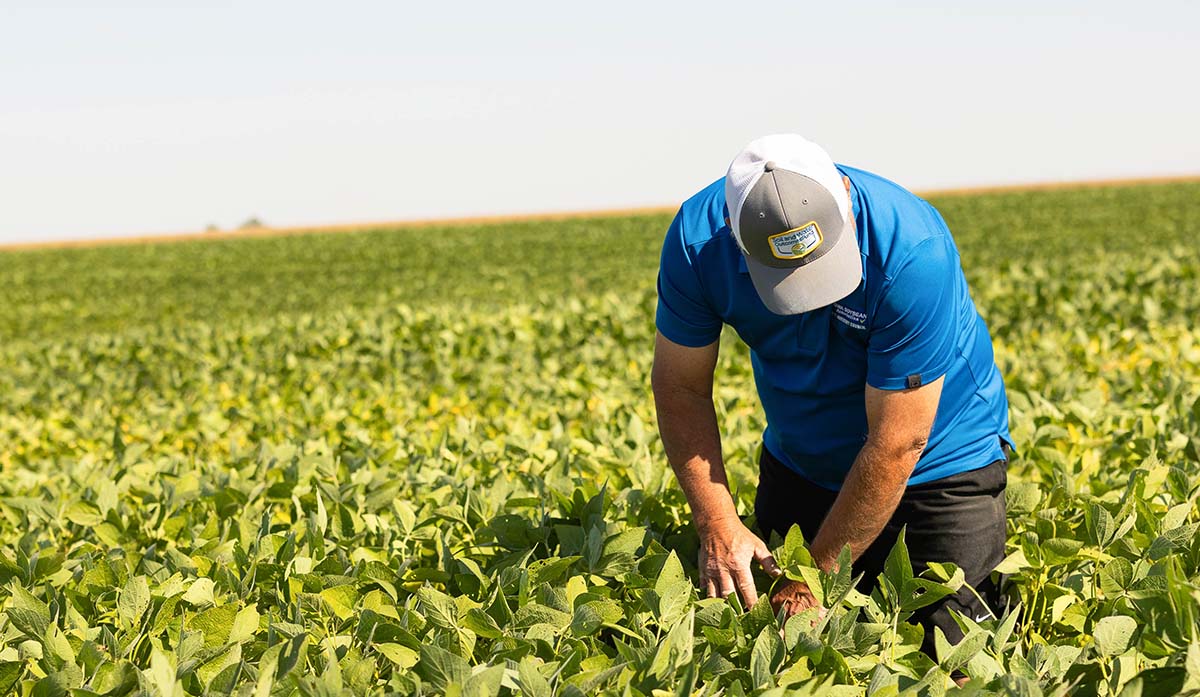
(Photo: Iowa Soybean Association / Joclyn Kuboushek)
Why crop scouting pays off
July 1, 2026 | Kriss Nelson
Get out there. Walk your fields. If you’re scouting from the road, you’re already behind. The most important issues start where the windshield can’t see.
It sounds simple, but Iowa Soybean Association Research Agronomist Shane Beck says it may be one of the most overlooked tools in a farmer’s operation.
“You’ve just got to be out there,” Beck says.
In a time of tight margins, scouting is less about checking a box and more about making informed decisions that defend the bottom line.
By midseason, especially in July, Beck says soybean fields should be on a regular scouting rotation.
Diseases like frogeye leaf spot and white mold are top of mind, with sudden death syndrome sometimes beginning to show later in the season. Soybean aphids and Japanese beetles are the most common insect concerns.
While some issues, like SDS, have limited in-season treatment options, identifying them still matters for future management decisions.
Scouting also gives farmers a chance to track late-season weed pressure. Even if control options are limited at that stage, knowing where problem areas exist can influence future herbicide programs or harvest strategies.
Beyond this season
Scouting is not just about what can be fixed this season.
It is also about identifying patterns.
Wet spots that show up year after year may point to drainage needs. Nutrient deficiencies may not be correctable in-season but can guide future fertility decisions. Weed escapes can shape next year’s herbicide plan.
“It might not be something you can fix this year, but it’s something you can fix going forward,” Beck says.
That long-term view can be just as valuable as any in-season decision.
Look beyond your windshield
One of the biggest mistakes Beck sees is relying too heavily on what can be observed from the cab of a pickup.
By the time issues are visible from the road, yield loss has often already occurred.
“Generally, a lot of these things start on the edge of the field and work their way in,” he says.
That means boots on the ground matter.
Getting into the canopy, checking lower leaves and looking across different areas of a field provides a more accurate picture than a quick pass from the headland.
Scouting checklist
Get out of the cab and into the canopy. Use this checklist when walking soybean fields:
- Walk multiple areas of the field, not just edges
- Check lower canopy for early disease development
- Look for insects on stems and undersides of leaves
- Scan for weed escapes or late-season pressure
- Watch for pattern areas (wet spots, nutrient deficiencies)
- Note growth stage to time decisions correctly
- Record what you see to track changes over time
- Scout every 10–14 days, more often during high-risk periods
Written by Kriss Nelson.
Back