(Photo: Iowa Soybean Association / Joclyn Kuboushek)
Decades of dedication to defeating SCN
January 5, 2026 | Kriss Nelson
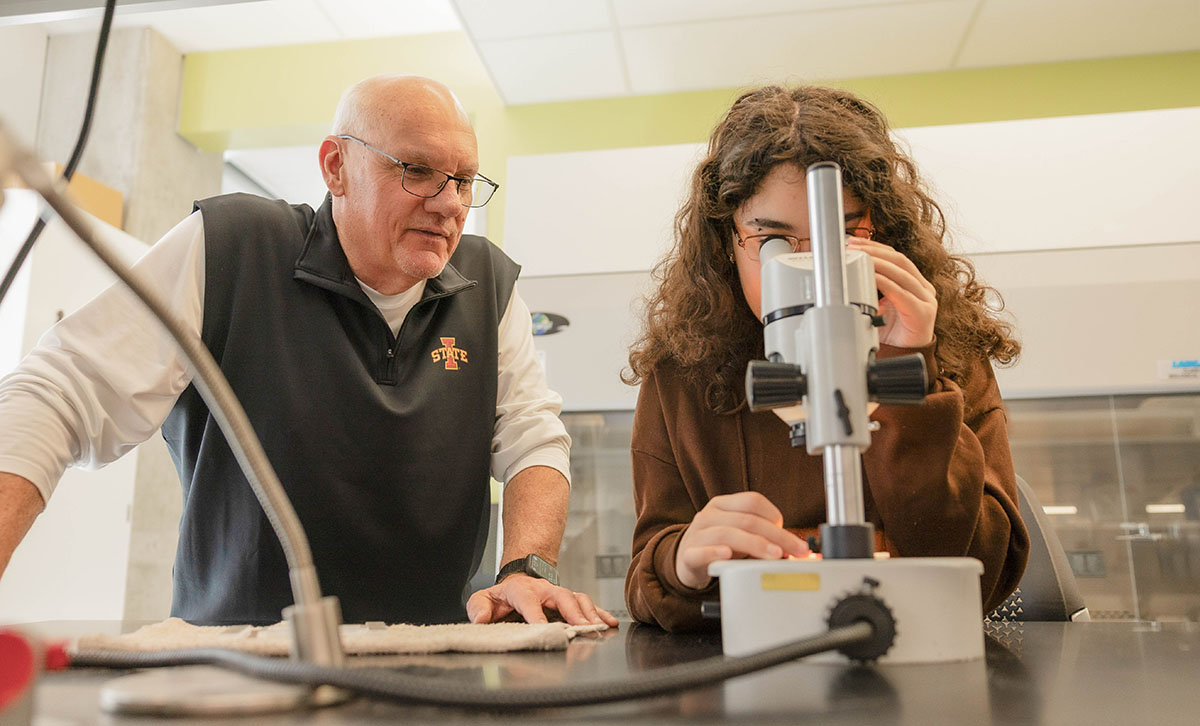
After stepping down as director of the Iowa Soybean Research Center (ISRC), Greg Tylka, Morrill Professor and nematologist at Iowa State University is once again making soybean cyst nematode (SCN) his top priority — a pest he set out to defeat more than 30 years ago.
While maintaining his role as a nematologist at Iowa State University, Tylka devoted much of his recent years to leading the ISRC as its founding director.
"I’m fortunate to have four research staff with nearly 75 years of combined experience in our lab," he says. "They kept things running smoothly while I served as director, continuing the most important work we do, which is generating practical information for farmers on how varieties and seed treatments perform for yield and nematode control."
The year 2026 brings a new yet familiar start for Tylka.
"I’ll only be doing that (nematology) research and extension work, no longer serving as center director, and will begin mentoring graduate and postdoctoral students again," he says. "I plan to do more non-field research while always keeping an eye toward generating information that helps Iowa farmers."
Decades of discovery
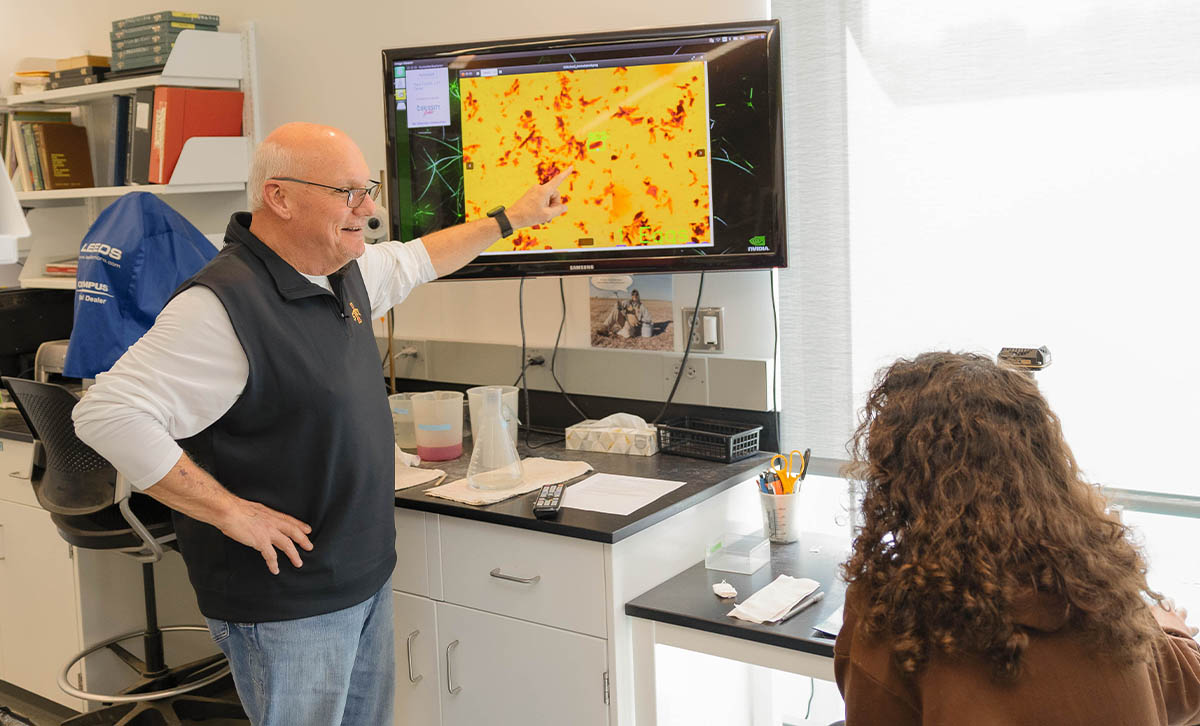
Nearly 36 years ago, Tylka started a leading SCN research program.
"I started my SCN research program at Iowa State in February 1990," says Tylka. "That first year, I had one or two field studies. It really grew progressively for the next 10 to 15 years, and today we’re operating at full capacity."
Tylka says his work connects his love of biology with real-world farming challenges.
"I’m a biologist at heart," he says. "I earned my bachelor’s and master’s degrees in biology, and almost all of that happened in the classroom. In my job, I now get to see what I was taught in the classroom happening out in the field."
Tylka explains that almost every farmer who grows corn and soybeans in Iowa has seen weeds adapt and become herbicide-resistant. He says the same is happening with SCN resistance. For decades, nearly all SCN-resistant soybean varieties relied on a single genetic source called PI 88788.
"Soybean cyst nematode populations in many Iowa fields have developed the ability to reproduce almost unfazed by PI 88788 resistance," says Tylka. "Now we’ve got a second source of resistance available, called Peking, and it’s showing powerful results."
There have been yield increases of up to 22 bushels per acre by switching from PI 88788 to Peking varieties.
While the success of Peking-resistant soybeans is encouraging, Tylka offers a word of caution. With a 20-plus-bushel advantage, farmers may be tempted to plant Peking-resistant varieties year after year.
"To be honest, I might be tempted to do that if I were a farmer," he says. "But if Peking SCN resistance is used continually, we’ll end up right back where we were with PI 88788. Every farmer dealing with SCN should try Peking; it’s a great source of resistance. But it shouldn’t be grown continuously. We can’t abandon what got us here: the PI 88788 resistance. In fact, PI 88788 resistance will perform better once Peking is part of the rotation."
Continuing the work
Tylka says his focus remains on questions that matter most to farmers.
"The questions I want to answer in the lab, and with the data we already have, are still very farmer-oriented," he says. "For example, a new twist in the seed world is the blending, or physical mixing, of Peking and PI 88788 varieties. Farmers and agronomists are curious about that and want to know if it’s better than growing straight Peking or straight PI 88788. Right now, we don’t have any experiments designed specifically to answer that question."
He says those studies will begin soon at Iowa State’s controlled environment plant growth facility.
Tylka says his team has already conducted hundreds of field experiments evaluating seed treatments across Iowa, and the results continue to raise new questions.
Since 2014, researchers have conducted experiments with several nematode-protectant seed treatments at nine locations each season in farmers’ fields across the state. Funding from ISA allows these types of experiments to use three different nematode seed treatments each year.
Findings show that across certain seed treatments and growing seasons, at least half of the experiments yielded higher yields with nematode seed treatments. However, no seed treatment has ever produced a consistent yield increase across every experiment in a single season.
"In about a third to half of the studies, there's either no yield increase or the seed without the anti-nematode component performs better," Tylka says. "We don’t yet know why that happens. I want to figure out why a nematode seed treatment increases yields when it does, and why it doesn’t in some trials. I plan on doing this by looking closely at various soil and environmental conditions in the experimental locations."
He wants to know what’s behind those mixed results.
"I’ve got a lot of existing data, and we’ll continue collecting more," he says. "We want to take a deep dive into the data in hopes of being able to give farmers better guidance on which seed treatments work best under what conditions."
Exploring the why
Tylka says much of his work has focused on helping farmers understand what happens in their fields, but not always why.
"We conduct experiments and report yields and nematode control, but we rarely get to answer the why," he says. "Why did these results happen? Or why do the results not happen all the time? What I’m really looking forward to is trying to answer some of those why questions."
This has led to a new collaboration opportunity within Iowa State University’s nematology program.
"Iowa State is kind of a unicorn," Tylka says. "We’re one of only two state universities I know of in the nation that has two nematologists on staff."
His nematologist counterpart is Dr. Thomas Baum, Charles F. Curtiss Distinguished Professor at Iowa State University, whose research focuses on the molecular side of SCN.
"We’re completely complementary. He’s looking at ways to disrupt the nematode molecularly. Now I want to see if we can take some of those ideas and test them in the field," he says.
It fits perfectly with Tylka’s career-long mission to provide farmers with information to help them be more productive in their fields.
"I have always aimed my research at getting answers farmers can use."
Furthering research
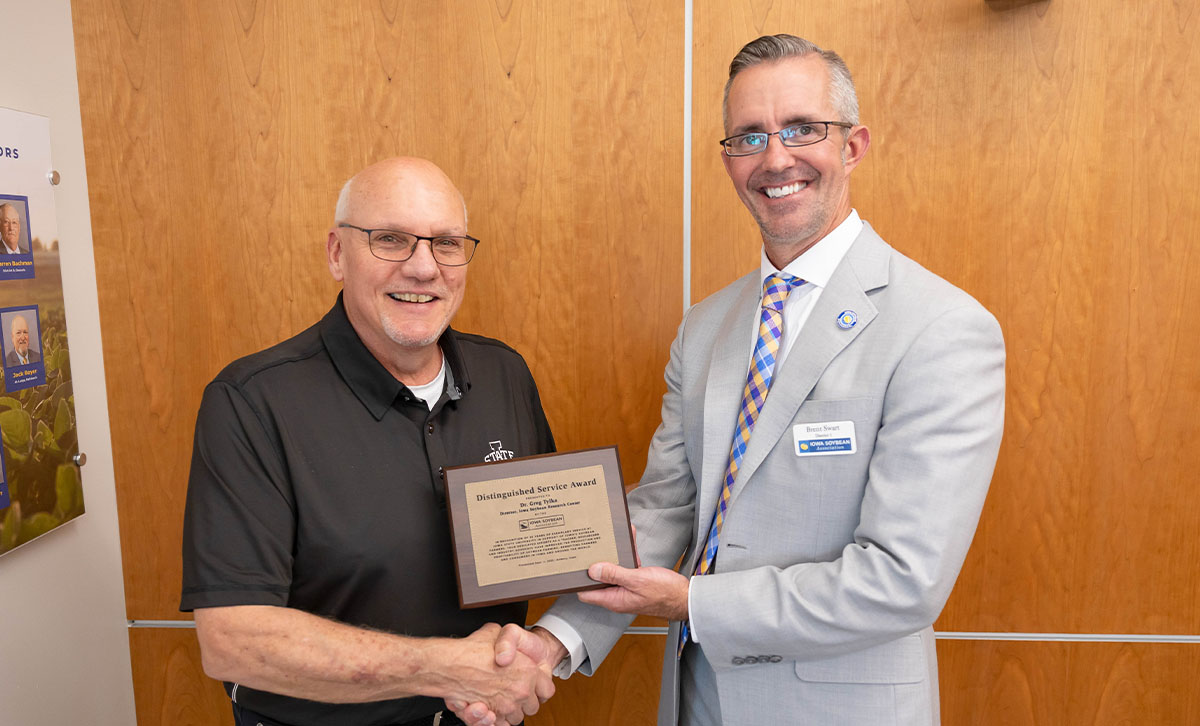
In 2025, the Iowa Soybean Association matched Iowa State University’s $50,000 commitment to further continue Greg Tylka’s groundbreaking efforts in soybean cyst nematode research.
For Tylka, being recognized by both the Iowa Soybean Association and Iowa State University is more than an award; it’s a reflection of his lifelong commitment to farmers.
"I’m just very humbled," Tylka says. "It’s very rewarding. I’ve always been employed by ISU, but I casually say I work for farmers. When I say that, people ask, ‘Don’t you work for Iowa State?’ and I say, ‘Yes! It’s the same thing, at least in my eyes.’ To be recognized jointly like this by the university and the association, the farmer board members and the staff, I’m getting goosebumps just talking about it now. I’m very humbled, honored and completely surprised."
Written by Kriss Nelson.
Back