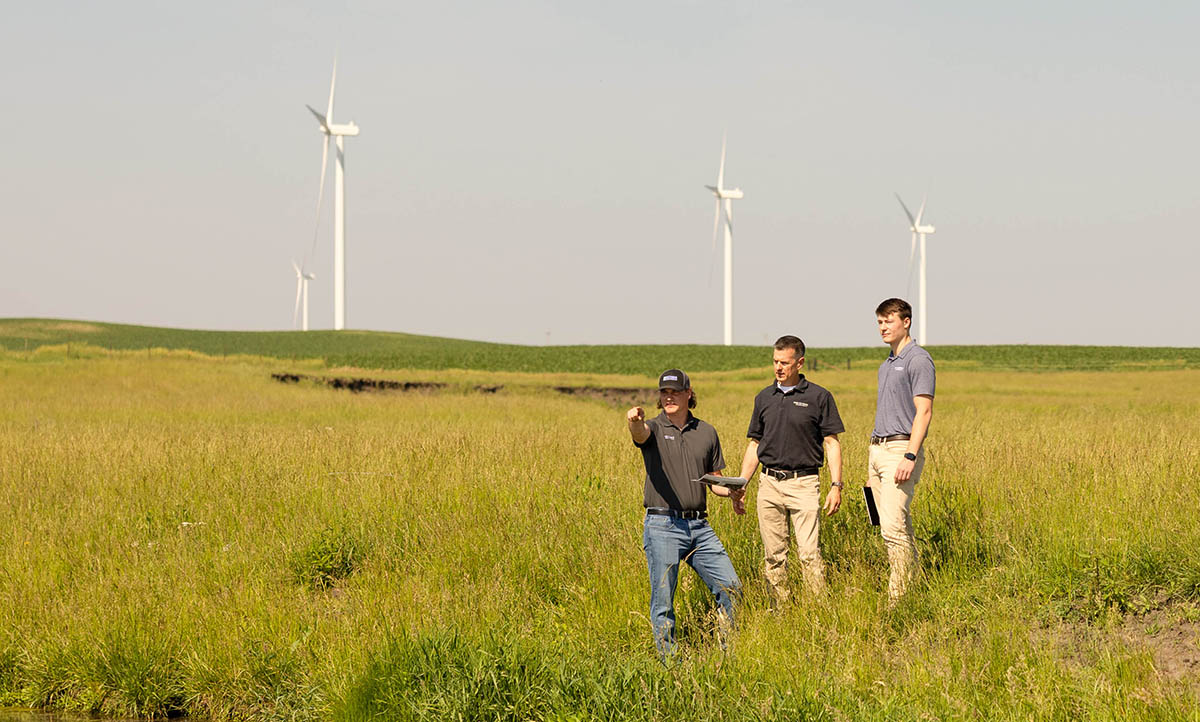
(Photo: Iowa Soybean Association / Joclyn Kuboushek)
Why conservation?
February 5, 2026 | Todd Sutphin
Key insights
- Conservation is not an either/or proposition. It’s about improving efficiency, profitability
and sustainability together.
- Conservation agronomy helps farmers get practical, field-tested guidance from trusted advisers they already work with.
- Data shows you can achieve measurable ROI while utilizing conservation practices, such as cover crops and nutrient management, tailored to your farm’s unique needs.
As an Iowa soybean farmer, you know that keeping your farm productive and profitable is non-negotiable. But the pressure to conserve soil, reduce nutrient loss and adapt to changing weather is growing. That’s why I see conservation not as a trade-off, but as an opportunity. It’s not production or conservation. It’s production and conservation. The best strategies are those that match your land, goals and bottom line.
These stacked benefits became clear to Jeff Pudenz, an Iowa Soybean Association (ISA) farmer member who farms in central Iowa between Carroll and Sac City, after he adopted no-till 20 years ago. The impact showed up in an unexpected way during a conversation with his diesel supplier, who was surprised to learn Pudenz had not needed his typical 3,000 gallons of diesel for planting.
“The light went off in my head,” Pudenz says. “Three thousand gallons back then was $6,000 saved.”
ISA President Tom Adam, who farms in southeast Iowa, has seen numerous benefits since implementing cover crops in 2010 and easing into a four-year crop rotation in 2012, including one year of double-cropping soybeans behind wheat.
“Surprisingly, the extended crop rotation with double cropping has been the most satisfying in terms of financial return,” Adam says. “In addition to producing an extra crop in one of the four years, I consistently see increased yields with soybeans following the double-crop year.”
Tailored practices and support
Every field is different. That’s why when we show up at a farm, the first thing we do is listen. As conservation services and programs lead for the Research Center for Farming Innovation (RCFI) at ISA, I’m not there to pitch a product or push a regulation. Our job is to represent your interests and support long-term profitability.
I lead a team of seven experts, including conservation professionals and conservation agronomists across the state. They provide in-field and edge-of-field conservation services, including bioreactor design, nutrient planning and water monitoring.
We’re also focused on your conservation success through ISA’s Conservation Agronomy Network. Most farmers already turn to their ag retailers for agronomy. So why not turn to them for conservation insights, too? We’re placing conservation agronomists in co-ops and ag retailers across Iowa, so when you’re asking about inputs, nutrient efficiency or edge-of-field practices, you get answers from someone trained in both agronomy and sustainability. Because every retailer’s different, we’re looking at developing a shared training curriculum to ensure every conservation agronomist works from the same playbook.
Start with in-field efficiency
Good nutrient management is the foundation of any farmer’s conservation pyramid, and it is often the low-hanging fruit for those looking to take the next step in adopting voluntary conservation practices. For example, you might ask whether nitrogen rates can be fine-tuned or if more manure can be incorporated to reduce synthetic input costs without compromising yield. In many cases, the answer is yes.
“We put some nitrogen on when we plant, but the bulk of the nitrogen is applied when the plant needs it, just before the crop covers the ground,” Pudenz says. “This has saved us an immense amount of money.”
Similarly, cover crops planted in soybean fields can often help reduce erosion and suppress weeds, among other benefits.
“Over time, I’ve learned to let the cover crops grow as long as possible to gain greater benefit. Better soil structure and water infiltration are obvious benefits,” says Adam.
Marginal to meaningful
Farmers fear conservation could reduce yields, remove land from farming, or both. Yet there are proven strategies for optimizing sustainability and maintaining (or even growing) yields. If you’re losing money on a low-performing corner, maybe it’s time to ask: Could that ground deliver more value as a buffer or be enrolled in a conservation program that pays you for implementing specific practices?
Meanwhile, edge-of-field practices such as bioreactors, oxbows and saturated buffers treat water without touching your best soil. They don’t deliver an economic return in the same way that no-till or nutrient management can. But they deliver another kind of ROI in the form of legacy and resilience.
Data illustrates benefits
Fifteen years ago, ISA began working with farmers to restore oxbows, which are old river bends that have been pinched off. One acre of oxbow can store more than 1 million gallons of water and reduce nitrate levels by approximately 40% to 60%. Every restored oxbow we survey is now home to the federally protected Topeka shiner fish, so much so that the U.S. Fish and Wildlife Service is considering downlisting the species from endangered to threatened. That’s a win for water, wildlife and farmers.
Across Iowa, more farmers are seeing the potential of expanded conservation practices. And the numbers speak for themselves. In 2025 alone, ISA’s team helped farmers in these ways:
- Cover crops: 60,000+ acres established
- Oxbows: 18 completed, 39 ongoing projects
- Blind inlets: 15 completed, 9 ongoing
- Saturated buffers and bioreactors: 13 ongoing
- Pollinator sites: 9 completed, 8 ongoing
- Wetlands: 8 ongoing
These aren’t random acts of conservation. They’re part of an overarching strategy that recognizes voluntary conservation on and around Iowa soybean farms doesn’t work in isolation. That’s why we prefer a watershed-based approach that begins with grouping similar soils and resource concerns. This enables farmers, advisers and partners to engage in smarter conservation.
It’s also why we’re supporting “batch-and-build” efforts in which 10 to 15 edge-of-field conservation projects are packaged, then bid out, funded, designed and installed. This approach is faster, cheaper and more attractive to contractors compared to past methods that focused on single projects. We’re seeing an expansion of batch-and-build in counties such as Benton, Linn and Sac.
Top outcomes with trusted support
Every farmer I’ve worked with wants to do the right thing. But they also need the right information to take that first step.
You shouldn’t have to roll the dice with conservation. You already face enough challenges, whether from volatile markets or changing climate conditions. We’re here to help you get the guidance you need so you can implement conservation strategically, managing risks and maximizing rewards with proven practices, science-backed tools and farmer-led results.
ISA has access to technical and financial resources that can help your farm operation. To get started, call our team at 515-251-8640.
Back