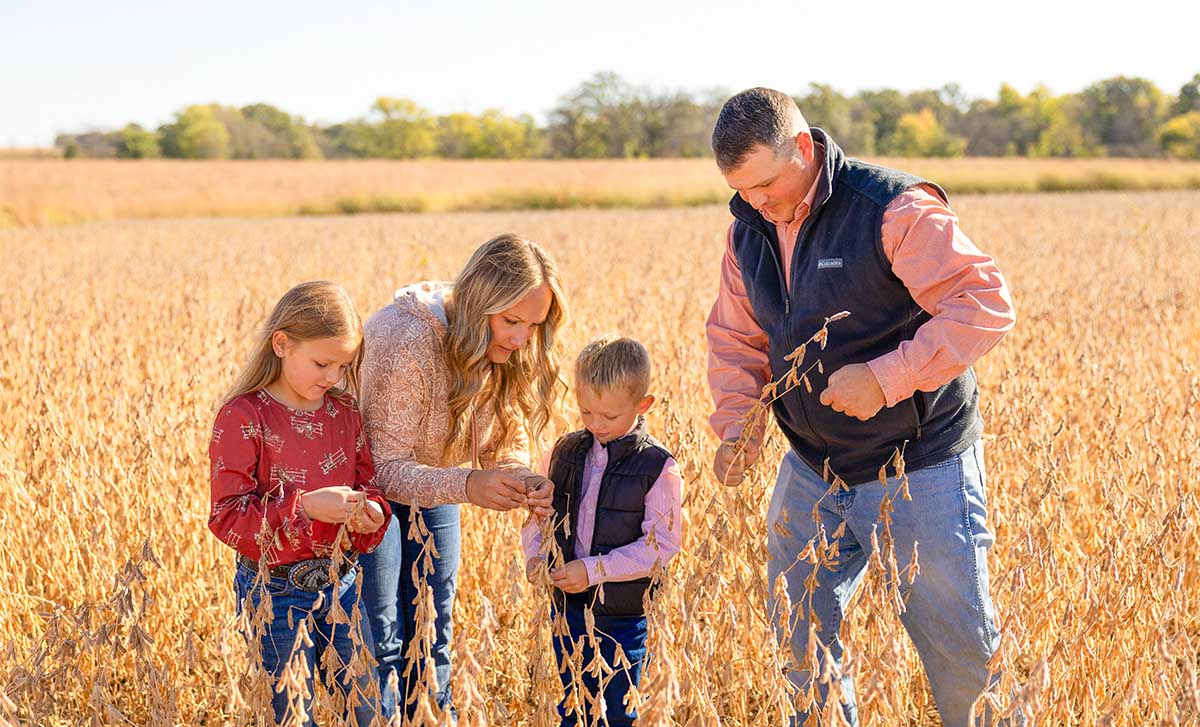
Tony Schwarck and his family near Riceville (Photo: Iowa Soybean Association / Joclyn Kuboushek)
Iowa farmers turn 2025 lessons into 2026 decisions
December 1, 2025 | Kriss Nelson
Iowa farmers experienced a spring of extremes, with an early start, weather disruptions and difficulties after planting.
Some growers could hit the fields ahead of Easter, getting corn and soybeans planted early. However, cold weather and frequent rains quickly stalled those gains, delaying progress and creating wide gaps in planting dates.
After Easter, cold soils hurt soybean stands, particularly in no-till fields. Replanting was needed in several areas, and some corn acres were also replanted due to poor emergence.
As the season progressed, excess moisture became a challenge. Heavy rains caused ponding that drowned out crops in low-lying areas. The frequent rains also made it challenging to apply herbicides on time, adding to weed pressure in some fields.
Sudden death syndrome (SDS) proved to be one of the toughest challenges for soybean yields. Fields with heavy SDS pressure lost the most yields, and in some cases, seed treatments didn’t protect the plants. The disease took hold early in the cool, wet spring, serving as a reminder that while treatments help, selecting varieties with strong SDS tolerance remains one of the most reliable defenses.
By mid-summer, corn faced additional stress. Southern rust showed up early and spread quickly, becoming the season’s most notable disease pressure. That, combined with earlier wind and hail damage in some areas, made for highly variable yields.
With another growing season behind them, farmers are now looking back on the highs and lows of 2025. The lessons learned this year are shaping conversations about what worked, what didn’t, and what adjustments will be made heading into 2026. Their firsthand experiences tell the story of a season defined by weather swings, replant decisions and yield variability.
Ryan Schwyn, Hubbard
ISA farmer member and owner of Homeview Agronomy
Looking into 2026, disease management is top of mind, especially coming off a year with the impact sudden death syndrome (SDS) in soybeans and southern rust in corn made on yields.
SDS was more prevalent in soybeans than in recent years and its impact was noticeable at harvest. Going into next year, growers will be evaluating varieties and seed treatments with stronger tolerance. Seed treatments like ILeVO and Saltro remain strong options, and variety selection will be key.
The severity of southern rust was a stark reminder of how quickly a disease can change a crop’s trajectory. Southern rust doesn’t overwinter here; it blows up from the south, which is why it’s a rare disease for this area. But this year, it was the worst southern rust pressure most growers had ever seen.
Before it hit, optimism was high. Many farmers thought this would be one of the best crops in recent memory. But southern rust came in early, during the later vegetative and early reproductive stages, and it took off fast. It regenerates every seven days if conditions are favorable, making the disease very aggressive.
There was a big difference in how hybrids responded to the disease. Early-maturity hybrids seemed to struggle the most. That pressure caused some fields to die off prematurely. Fungicides were applied with some making a second pass after scouting showed continued pressure.
Harvest results showed favorable responses to fungicide. In trials, a single pass provided up to 35 bushels per acre more than untreated areas. In fields where a second pass was applied, responses ranged from 5 to 15 bushels an acre.
Next year, scouting and in-season responsiveness will be critical. Many growers will lean on trusted advisors to help make timely decisions and ensure dollars are well-placed. Hybrid selection and fungicide timing will be big decisions. With lower commodity prices, every input dollar has to work harder.
Nitrogen management was a challenge with moisture. Much of the area saw substantial leaching and denitrification. Growers who split-applied nitrogen saw the best results. Those who did a single application saw the consequences in yield.
Fertilizer pricing is another issue. Phosphorus has gone up the most in price, and growers are focusing on efficiency. Soil test data, yield maps and variable rate technology are being used to stretch fertility dollars and maximize ROI.
Weed management in soybeans will be a hot topic this winter. Farmers will need to weigh the cost of clean fields against the reality of weed escapes and seed bank buildup.
Frequent rains delayed spraying, tightened application windows and created an environment where weeds could thrive. Adding in some wind challenges, the weeds had the competitive advantage.
Soybean growers widely discussed weed escapes in the post-emergence window. Spot spraying was required for many farmers to address problem areas. Growers who invested in premium herbicide programs with multiple modes of action had better results, while those who cut costs and stuck with a single mode of action struggled. This is something farmers will likely reconsider heading into next year.
A focus is also shifting to overall plant and soil health. Farmers are working to build stronger plants that can withstand disease pressure. Some are looking at foliar feeding applications, alternative products such as biostimulants and mixes with sugars to promote biology and create a healthier plant.
Drainage is another consideration for many farmers in 2026. Excess moisture in 2025 reinforced the value of tile drainage, and many farmers are now evaluating which acres could benefit from improvements.
Tony Schwarck, Riceville
ISA farmer member
Planting preparation for the 2025 growing season began with widespread concern over dry weather conditions. Fortunately, the spring planting window was characterized by warm temperatures and minimal rainfall, creating nearly ideal conditions for seeding.
While these favorable conditions benefitted growers, the marketplace took notice, and the combination of timely planting and sufficient acres helped to temper any early-season rally by keeping bullish trends in check.
With June, heavy rainfall resumed, quickly erasing drought concerns. Focus shifted toward herbicide applications. Integrating new chemistries with various crop traits proved highly effective against resilient weed species. As a result, discussions about record yields circulated, and market expectations adjusted accordingly.
Timely late-season rains helped maintain yields above average. In some cases, late-season disease pressure prevented achieving record yields, but the combination of adequate moisture and late-season warmth ensured a satisfactory harvest.
As harvest approached, a recurring question surfaced: would rainfall delay a timely start to the harvest? Ultimately, conditions allowed the soybean harvest to begin at the end of September and conclude in early October. Unusually warm temperatures and excellent ground conditions marked the period, enabling a swift and efficient soybean harvest.
With the 2026 season on the horizon, efforts are underway to analyze financials and navigate the challenge of high input costs relative to current commodity prices. The cyclical nature of production agriculture continues to shape expectations, and optimism remains that industry leaders and organizations will persist in their efforts to support farmers. The hope is for improved markets and better prices in the coming year.
Looking toward spring 2026, one thing we have observed over the last two growing seasons is that the dry April conditions have allowed us to plant into dry soil with minimal tillage and have yielded our best soybeans.
We are still tweaking our herbicide program to combat early-season weed pressure without the tillage and have found new chemistry to be very effective for post-season applications.
With the tight margins, we will continue our efforts to reduce tillage. Achieving high yields with less time and money spent on the process makes the challenge rewarding. We have learned some things the hard way, but with the addition of tile, fertility and a willing attitude we’re headed in the right direction.
Alex Schaffer
ISA research agronomy lead
Research agronomist support for 2026
Alex Schaffer, Iowa Soybean Association (ISA) research agronomy lead, provides insight on lessons learned from the 2025 growing season and how ISA’s Research Center for Farming Innovation’s (RCFI) team of research agronomists can assist Iowa soybean farmers in 2026 and beyond.
2025 in review, 2026 ahead
"I think it’s a good time to look at expenses on the input side," he says.
As they look ahead to 2026, farmers face tough choices on what to keep and what to cut. But he warns not to get rid of everything.
"It’s a good time for farmers to take a hard look at what’s paying and what’s not. There are ways to trim without cutting too deep,” he says.
Soybean seed and fungicide inputs are at the top of his input review.
On-farm trials
ISA’s team of research agronomists are available to help evaluate inputs. RCFI’s on-farm research blends agronomy, conservation and data so soybean growers can make improvements that fit their operation.
"Trials can look different for each farmer depending on location, planting date, soil temperature and other factors," says Schaffer. "That’s why it’s important to have trials happening across the state."
And, sometimes the results did not meet expectations. A fungicide and insecticide combination trial is a prime example.
"We put ten of them out in 2025. We thought that we’d surely see a response to the fungicide at these different locations, since the conditions have been right. And then when we got out there, we didn’t. Instead, we saw a bunch of sudden death, which is not affected by the fungicide that we were applying for the trial."
Schaffer and his team observe more than just how a field reacts to a control or treatment.
He recalled observing stand counts in a field participating in an ISA trial when when he spotted drift injury from a neighboring field. In addition to the stand counts, he made a note of the injury and alerted the farmer participating in the trial.
Schaffer was in a field scouting for a fungicide when he found SDS was beginning to show. He warned the farmer SDS was in the field so they would be aware of the potential yield loss while combining.
"The main thing about participating in a trial is it gets an agronomist in your field, looking at things, taking notes and giving you feedback you might not otherwise get," Schaffer says.
Support beyond trials
ISA’s research agronomists are available year-round to assist farmers.
"We field phone calls on problems or questions in soybean or corn fields," says Schaffer. "We are another point of assistance out there for a farmer."
Networking is also part of the value.
"We each have a large network of agronomy professionals,” he says. “If we don’t know the answer, there’s a good chance we can find the right person and make the connection. That could be academia, private industry, other farmers we work with or conservation professionals."
Farmer-submitted trials
If a farmer is curious about a product or practice,
ISA research agronomists can help. They work alongside farmers to design replicated strips, collect data and analyze the results so farmers can make decisions with confidence.
"If a farmer wants to try something on their farm, we can help set it up as a farmer-submitted trial," he says. "We’ll work with them to design the trial, track progress through the season, and provide unbiased feedback at the end. It’s about making sure the time and effort farmers put into testing something new really pays off."
Creative scouting
Southern rust surprised farmers when it robbed them of yields in 2025. Could proper scouting have helped to limit the impact?
Schaffer emphasizes scouting goes beyond walking local fields. It includes some creative thinking.
"Scouting isn’t just walking your own fields. You’ve got to look south to Arkansas, Missouri, or even just a few counties below you. If they’ve got frogeye or southern rust, chances are it’s coming to you next," he says.
This is the heads up to get on the list with the applicator or look at your product options, Schaffer says.
"This year a lot of farmers wanted fungicide but couldn’t get a ground rig in because it was too wet," he says. "They called applicators who used planes or drones, but by the time they got sprayed, it was two weeks late. Getting on the list early makes a difference."
Written by Kriss Nelson.
Back