Craig Woods, ISA Research Agronomist (Photo: Iowa Soybean Association / Joclyn Kuboushek)
Seeding Rate: More than a static expense
March 31, 2026 | Craig Woods
Key Insights
- Choosing the optimal seeding rate showed an average increase in profitability of $14.55 per acre.
- Current economic outlook shows 80,000 planted seeds per acre is the most profitable seeding rate in 49% of trials conducted by ISA.
- Yield isn’t the only factor when planting soybeans, consider profit per acre.
Of the many decisions you make prior to planting, the number of seeds you plant per acre has the opportunity to impact your overall field profitability.
Given soybean plant’s ability to take advantage of extra space by branching out to intercept more sunlight and create more pods, a question emerges. What is the seeding rate for soybeans that provides the best foundation for profitability?
For the past three years Iowa Soybean Association’s (ISA) Research Center for Farming Innovation (RCFI) has worked with farmers to determine the best seeding rates through on farm replicated strip trials.
In total, we have implemented 48 locations of on-farm research trials with this question in mind. We asked farmers to plant their soybeans in strips across the field with varied seeding rates. The on-farm strip trials had seeding rates of 80,000, 110,000, 140,000, and 170,000 seeds per acre.
Throughout the years, average yields varied with average yields in 2023 being 60 bushels per acre and average yield in 2025 being 70. The difference from the top yielding treatment(170K) to the lowest yielding treatment(80K) only varied by 3 bushels in 2023 and 1.3 bushels in 2025 (see Figure 1).
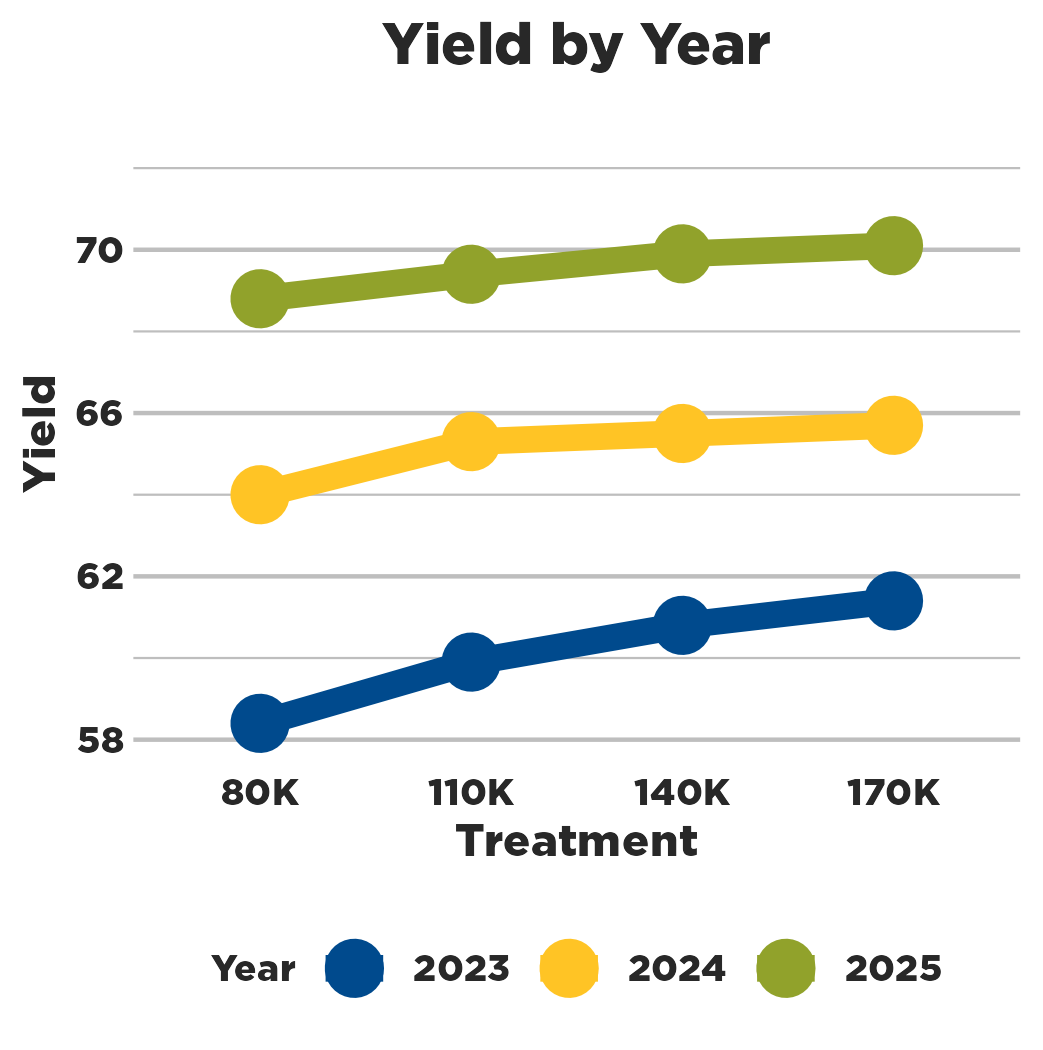
Figure 1: Average yield by seeding rate and year. The yield differences between the highest and lowest seeding rates for each year ranged from a minimum of 1.3 bushels per acre to a maximum of 3 bushels per acre.
Over the three years, the 80,000 seeds per acre rate averaged 63.7 bushels per acre.
The strips with 110,000 seeds per acre averaged 64.9 bushels per acre. At 140,000 seeds per acre, the yield averaged 65.4 bushels per acre. The 170,000 seeding rate averaged 65.7 bushels per acre.
The 80,000 seeds per acre seeding rate was the only rate that had a significant, although marginally lower, yield on average compared to the other three rates (Figure 1).
While 80,000 seeds per acre yielded lower than the other three rates, considering the average seed cost and soybean sale price often resulted in 80,000 seeds per acre being the most profitable seeding rate. As the cost of seed decreases and the final sale price increases, it allows for a seeding rate higher than 80,000 to have a better return on investment. On the opposite side of the coin, as seed costs increase, this causes the reduced investment of lower seeding rates to shine (Figure 2).
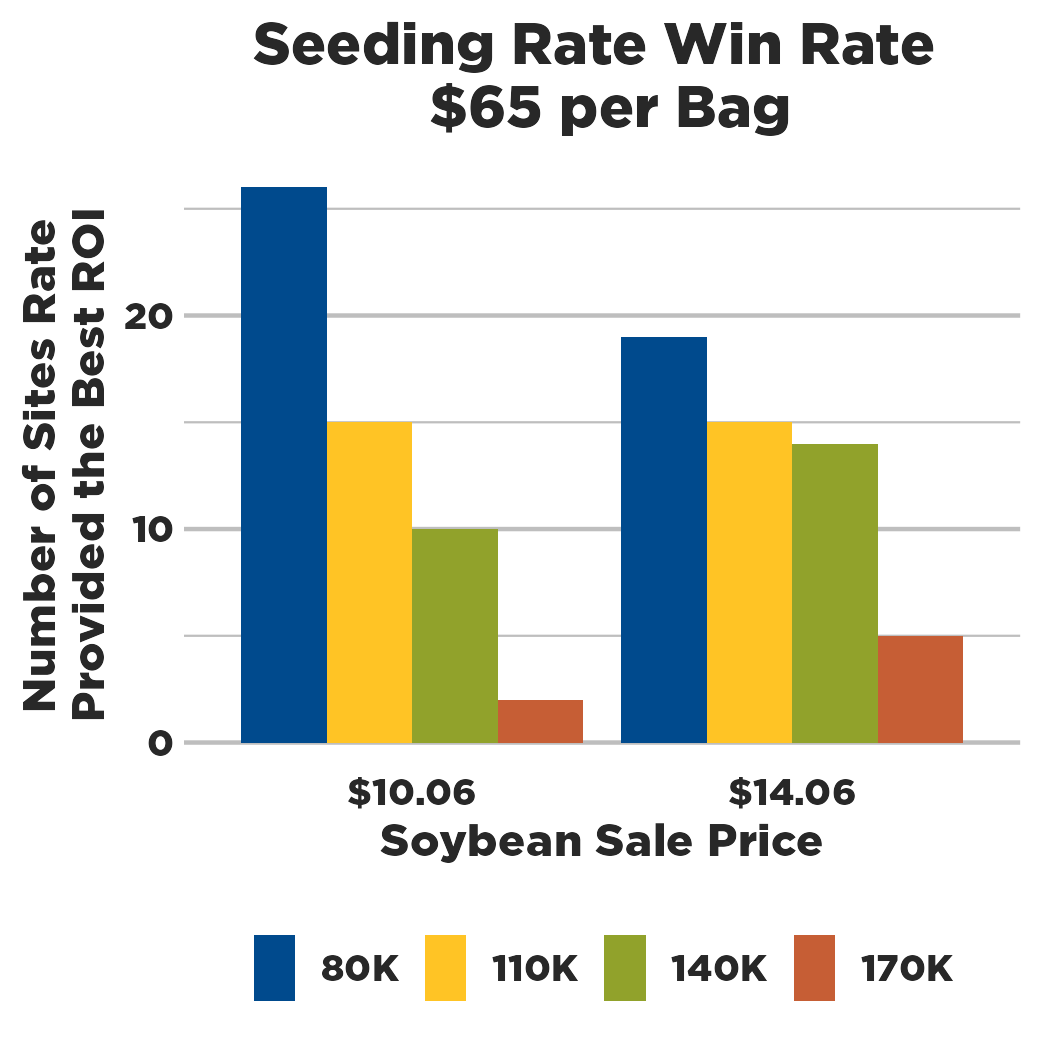
Figure 2: Seeding rate profitability win rate at 2025 ($10.06) and 2023 ($14.06) soybean sale prices. In nearly half of the trials, the 80,000 seeds per acre rate was the most profitable based on 2025 sale price and 36% of trials based on 2023 sale price.
ISA has seen an average increase in profitability by selecting the optimal seeding rate by $14.55 per acre in low commodity prices such as 2025, showing real value in choosing the optimal seeding rate for your field. Across 49% of the trials, 80,000 seeds per acre was the most profitable rate considering a seed bag cost of $65 and a sale price of $10.06 per bushel. Using those same prices, the 110,000 seeding rate was the most profitable in 28% of the trials. The frequency of higher seeding rates being the most profitable was reduced with 140,000 at 19% of the trials and 170,000 at 4%.
Planting fundamentals
Managing seeding rates is an important tool for determining input cost; however, it cannot overcome planting fundamentals. It is unlikely that you should increase seeding rate to make up for possible reduction in stand from poor conditions. Our data suggests that April soybeans still yield better at all seeding rates in comparison to their May planted counterparts.
There has been increased interest in taking advantage of technology when it comes to planting. The ability to plant variable rates designed for each field is seen as the next logical step to take full advantage of soybeans’ ability to adjust to their environment.
In addition to our work in targeting placement of seeding rates, we are also investigating how genetics might also impact population density decisions, and how including this in variable rate seeding recommendations can improve farm profitability.
Return on investment is more than just planting more soybeans with the hopes that the markets turn more favorable for soybean farmers. It also requires management of the inputs driving said yield.
For growers closely managing their input costs this spring, adjusting your soybean seeding rate could prove beneficial. RCFI is always looking for more participants to assist in making our research robust and locally relevant to the farmers we serve.
If you are interested in participating in on-farm research trials with ISA, please contact the agronomist for your region.
Written by Craig Woods.
Back