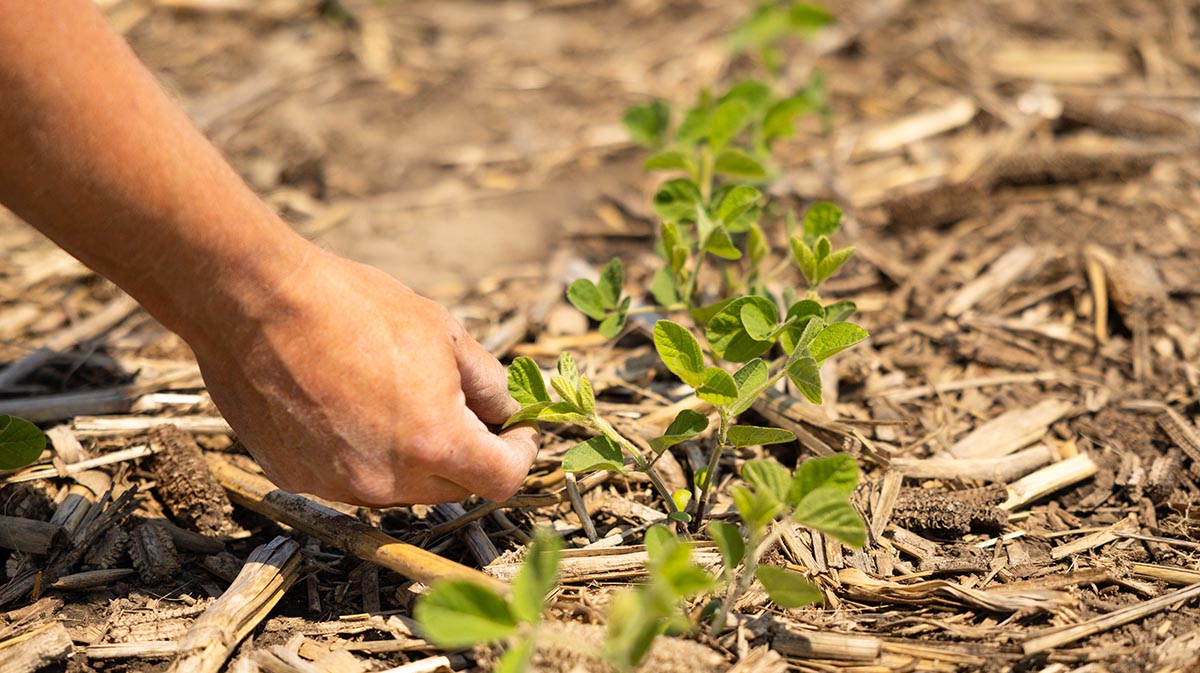
(Photo: Iowa Soybean Association / Joclyn Kuboushek)
How cropping systems can mitigate drought effects
March 31, 2026 | Bethany Baratta
Every growing season, farmers roll imaginary dice. Will there be too much rain at planting, a mid-summer drought, or the lucky Goldilocks rain — just the right amount at just the right time?
While you can’t control the rain, farmers have some control over how the soil handles it. New research from Iowa State University (ISU), supported by the soybean checkoff, shows that changing how farmers rotate crops can improve water use efficiency in the soil.
Since 2002, the Marsden Agricultural Diversification Experiment (MADE) near Boone, has evaluated outcomes in farm profitability, yields and soil health under various management controls. More recently, researchers focused on two treatments in this long-term experiment to determine how the management affects soybean resilience to drought: 1) a business-as-usual, two-year corn-soybean rotation with synthetic fertilizer; and 2) a diversified four-year rotation with oats and alfalfa and most of the nutrients coming from composted cattle manure.
Over the 20-year study, the experiment showed an increase of 1400% in water infiltration rates, a 16% increase in soil water storage and an 8% reduction in resistance to root growth (compaction) in the diverse rotation compared to the standard two-year rotation.
Changing the weather
A team of agronomists, led by ISU Agronomy Associate Professor Marshall McDaniel and Postdoc Research Associate Ashani Thilakarathne (now assistant professor of soil conservation at University of Wisconsin-River Falls), expanded the experiment to simulate future climate changes.
Using irrigation and rainout shelters, researchers imposed future climate conditions on both experiments: wetter springs and droughtier summers. They wanted to test if these improvements in soil health under a four-year rotation would lead to greater crop yields under drought stress compared to the two-year rotation.
Results
When the rain was steady, the soybean yields were nearly identical. The two-year and four-year rotations yielded 1.1 bushels and 0.6 bushels per acre more than the trial average, respectively.
Under simulated drought conditions, the two-year rotation yielded 3.8 bushels per acre less than the trial average and the four-year rotation had a 2.1 bushel-per-acre-yield increase over the trial average.
Barriers to implementation
If the four-year rotation is more resilient, why isn't everyone doing it? McDaniel acknowledges that the biggest hurdles aren't agronomic — they’re economic.
“The two most important barriers are time and money,” he says. “Not all farmers can or want to integrate grazing animals into their operations. For the small grains and forage crop, there needs to be markets that pay for them and they’ll be adopted.”
But farmers may not need to overhaul their cropping systems to see progress, says Matt Carroll Ph.D., Iowa Soybean Association’s (ISA) science and analytics lead.
ISA’s long-term cover crop experiments showed a similar reduction in soil compaction to soil that was treated with cover crops from six to eight years, with an average reduction of 6% in the first two feet of the soil horizon.
“As farmers look to minimize the risk of soybean yield losses under future drought conditions, it's important to think about what practices can be implemented that help the soil increase water infiltration and water holding capacity,” Carroll says.
McDaniel says the programs that incentivize changes to improve soil health could make these systems more appealing to farmers, and in turn, improve productivity during drought.
“Water is the most widespread limiting factor for soybean productivity. In Iowa and many other nearby states, we have too much in the spring and many years with too little in the summer,” he says. “Using management practices that increase soil health — particularly those that improve soil’s ability to both drain and hold on to water — can help improve soybean resilience to drought.”
Too much water?
This research, supported by soybean checkoff dollars, further posed the question: Can improvements in soil health also help with excess water in the spring?
“We hear this all the time from farmers that they can get out in the fields earlier due to using cover crops, diversified rotations, reduced tillage, and other soil health improving practices,” McDaniel says. “So, we’re also looking at how soybean roots might respond to excess water and then drought conditions.”
As researchers wrap up the data processing from the simulated wetter conditions experiment, McDaniel notes the relationship between science and agriculture.
“Our research is often informed by observations we hear from farmers, and then we put it to the test, and this is one of those examples,” he says. “Agriculture research is best when farmers and scientists are working together and learning from each other.”
Written by Bethany Baratta.
Back