(Photo: Iowa Soybean Association / Joclyn Kuboushek)
How agronomy and conservation work together
March 31, 2026 | Kriss Nelson
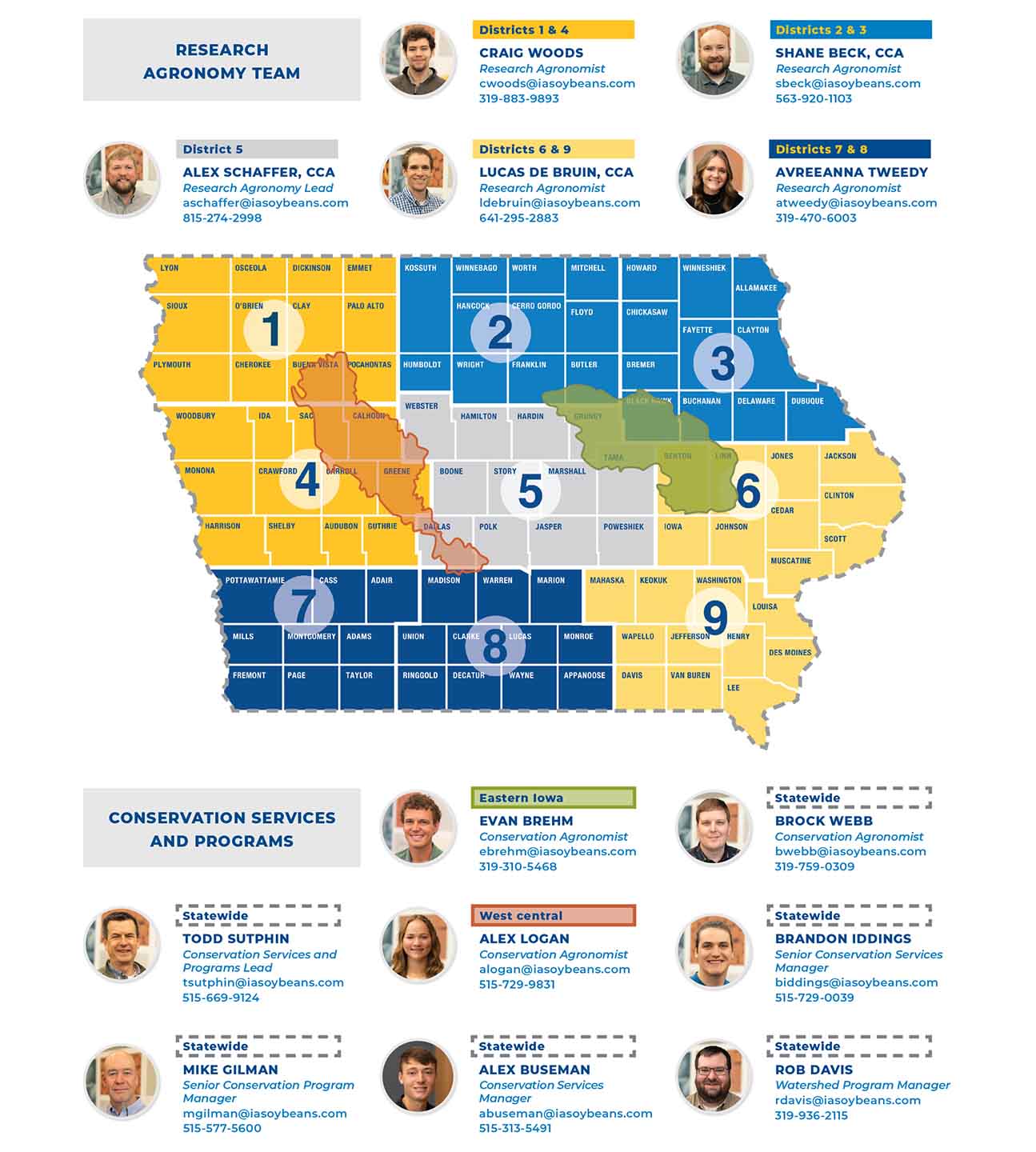
Helping farmers be both productive and conservation-minded takes a team approach. At the Iowa Soybean Association’s (ISA) Research Center for Farming Innovation (RCFI), it comes from research agronomists, conservation agronomists and conservation team members working together to turn data into practical, on-farm decisions.
Research driven
Alex Schaffer, ISA research agronomy lead, says collaboration begins with research grounded in real-world management questions. That work is supported by long-term, conservation-based trials that help move conversations beyond theory.
“For example, we have data that shows nitrate sequestration as a positive impact of cover crop implementation,” Schaffer says. “We are able to support what we are saying with data.”
As farmers experiment with conservation practices, research results are paired with hands-on agronomic support.
“As we have farmers in these trials experimenting with conservation practices for the first time, we are able to get best management practices from our conservation agronomists such as herbicide rates and timing, planter setup and cover crop seeding methods,” Schaffer says.
Shared focus
Todd Sutphin, ISA conservation services program lead, says that blending agronomy and conservation has become a strength of ISA’s approach.
“Yes, conservation and agronomy can coexist,” Sutphin says. “ISA’s RCFI team is focused on production, profitability and sustainability. Farmers want to be good stewards of the land and be profitable.”
He says conservation agronomists are uniquely positioned to connect those goals.
“A key advantage to bringing on conservation agronomists is their ability to have the conversation that spans both agronomy and conservation,” Sutphin says. “It’s not just one or the other. The focus is a full cropping systems approach to a farmer’s operation.”
That systems-level thinking often leads to better management, Schaffer adds.
“A lot of conservation implementation is being really in tune with your acres,” he says. “Knowing field conditions, pest pressures and productivity levels helps farmers place products and practices appropriately. Many times, farmers implementing conservation have to pay much closer attention to what is going on in the field, and that leads to profitability.”
Farmer perspective
For Corey Goodhue, ISA district 5 director from Carlisle, that integrated expertise matters because farming already demands constant decision-making.
“I have a hard enough time being a good grain marketer, running a good business and managing everything I have to manage,” Goodhue says. “Anytime I can find someone whose interests align with mine and I can access their expertise, that means a lot.”
Goodhue’s first hands-on experience working with ISA came through a drainage improvement project he learned about at an ISA conference.
“I call it a modified French drain,” he says. “Instead of a surface intake, you use underground tubing with gravel or pea gravel and essentially eliminate that riser next to a terrace.”
The project required technical support he would not have had on his own.
“I needed help figuring out how big the rock collection basin needed to be for the size of the terraces,” Goodhue says. “That’s real expertise I wouldn’t have had otherwise.”
Those conversations expanded into discussions about acres on his farm that struggle to pencil out.
“We have some ground in the river bottom that barely produces, even in times of good margins,” Goodhue says. “In a time of bad margins, it really forces you to figure out what the best option is.”
Rather than continuing to farm unproductive acres, Goodhue is working with ISA’s conservation and research teams to explore alternatives, including an oxbow restoration project paired with Conservation Reserve Program (CRP) or habitat improvements.
“Some of these more unproductive acres could be doing something that benefits a lot of people,” he says. “I’m trying to learn from RCFI as best I can.”
Beyond trials
Schaffer says that kind of work reflects the broader scope of RCFI, much of which farmers may not realize is happening.
“I think about the wide range of activities we have going on at RCFI,” he says. “Everything from helping farmers establish a cover crop business to oxbow restorations creating habitat for the Topeka shiner and working with the U.S. Fish and Wildlife Service. Agronomy trials and cost-share opportunities for conservation practices just begin to scratch the surface.”
Meeting farmers
Sutphin says ISA’s statewide footprint allows the organization to meet farmers where they are.
“Every farm operation is different,” he says. “We are here to help farmers navigate questions on both agronomy and conservation and help them achieve their production and profitability goals while being good stewards of their natural resources.”
Looking ahead, Schaffer says that collaboration will continue to shape ISA’s research priorities.
“As we hear from farmers across the state, we take those struggles and ideas and think about ways to make meaningful research projects based on what farmers are thinking about,” he says.
Farmer first
For Goodhue, that farmer-driven focus is what makes ISA’s work valuable.
“It’s pretty awesome to have a group of experts that work for us,” he says. “As farmers, we pool our resources through the checkoff dollar, and that’s who they work for: the Iowa soybean farmer.”
Written by Kriss Nelson.
Back