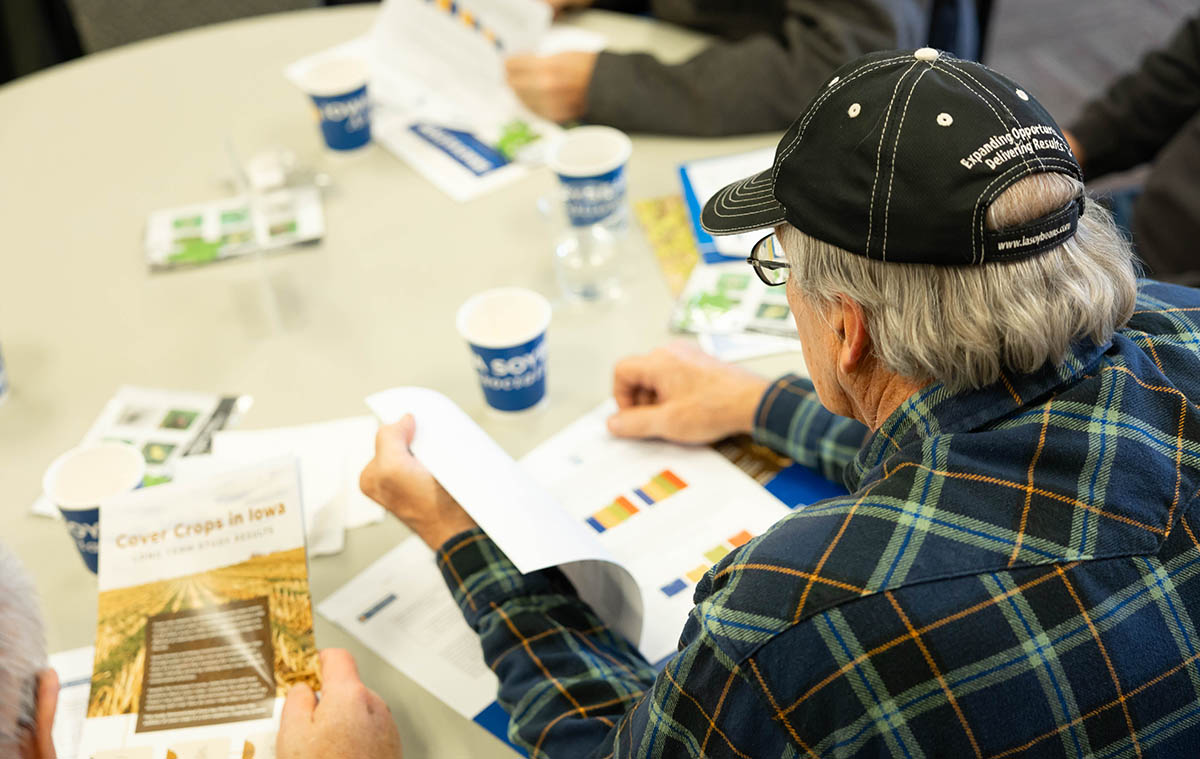
(Photo: Iowa Soybean Association / Joclyn Kuboushek)
Farmers compare what works in conservation
February 26, 2026 | Kriss Nelson
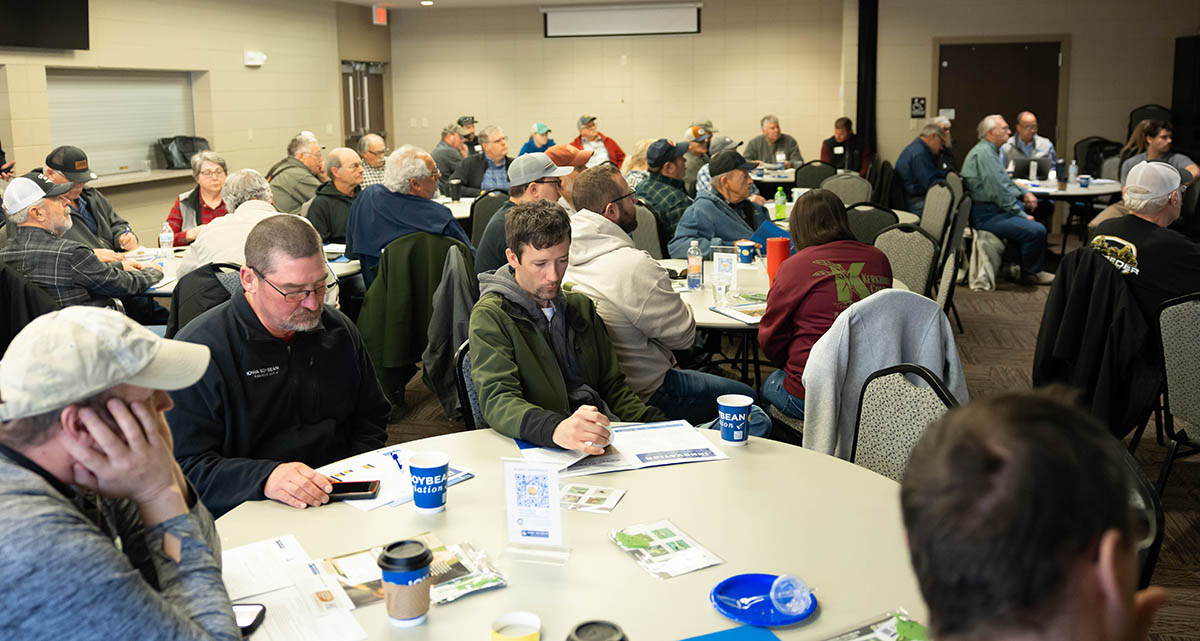
Real-world experience took center stage at the Iowa Soybean Association’s (ISA) Innovation to Profit meeting in Templeton, where a farmer panel compared notes on what conservation looks like in practice.
The discussion was moderated by Aaron Putze, ISA chief officer of brand management and engagement, who pressed the group with tough, practical questions.
Panelists included:
- Tim Bardole of Rippey. Past ISA board director currently serving on the United Soybean Board and U.S. Soybean Export Council boards
- James Holz, farmer and co-owner of Iowa Cover Crop in Jefferson
- Kris Langgaard, an ISA Research Center for Farming Innovation (RCFI) on-farm trial participant from Guthrie Center
- Kevin McGrain, a long-time no-till farmer from Hornick.
Questions for the panelists
Q: Tim, you represent soybean farmers around the world. How does conservation fit into demand for U.S. soybeans?
Bardole: About 15 years ago, I hated the word “sustainability.” It felt like something that was going to be put on farmers, whether we wanted it or not. As I’ve traveled, it’s been eye-opening how much that word matters in other parts of the world. I don’t go to the fancy places. The places I’ve been are third-world countries, like Pakistan, Bangladesh, Cambodia and Vietnam. Climate change, whether people believe it’s man-made or natural, is affecting those countries. And they look at how U.S. farmers grow crops and see it as an advantage, not just for us, but for their livelihoods.
We’re growing crops on prairie ground for the most part. Compare that to parts of South America, where they keep expanding acreage by clearing native vegetation, trees and shrubs. Sustainability used to feel like a way to gouge farmers. Now I see it as a way to market our product, to show an advantage and a superiority we have to the rest of the world.
Q: James, what got you into the conservation and regenerative ag space?
Holz: The first conservation practice we put in was cover crops in 2012, and that year was very dry. We feed cattle, so we chopped silage early and seeded oats after chopping. At first, I did it because I wanted to see if I could grow a crop and use it.
What we found over time is cover crops went from something we tried once to something we use on all our acres. Today we strip-till all our acres and no-till our soybeans into cover crops. I’d say conservation is almost a byproduct of why we’re doing it. We’re doing it because it saves us money and saves us time. Anytime you can improve your soil and add more soil organic carbon, you make a more productive a more productive farm.
The key for us is how we can save time and how we can keep using the sun for more days of the year, not just 100 or 120. We watched what Tim’s family had been doing for years and copied it. When we went to strip-till, it blew our mind. We used to rip every corn crop and spend weeks doing it. With strip-till, we could do 200 acres a day with a lower horsepower tractor, and we didn’t really see yield loss. It became a no-brainer: use these practices to make more money, and the byproduct is water quality and soil health.
Q: Kris what was your catalyst for getting into this space, and what’s your journey been like so far?
Langgaard: I started farming in 2008 with my dad and my uncle. At the same time, I was working at John Deere testing precision ag equipment. I liked to test what I was working on at home to see if it really did what it was supposed to do. That led me into Iowa Soybean Association trials.
To be honest, the cover crop trials have been hit or miss. I haven’t had a successful cover crop trial yet. It didn’t really click until a meeting in January when someone said we have to get out of the mindset of treating cover crops like a weed. That’s what I’ve been doing, treating it like a weed. The fields I used didn’t have fences, so I couldn’t graze it. Some were too far away to manage early enough in the spring.
So going forward, I’m trying to change my mindset from cover crop as a weed to cover crop as an asset. I don’t know exactly what that will look like yet, but I’m going to find it. Everybody farms differently. There is no one-size-fits-all. The ISA trials help me not reinvent the wheel. I get to lean on their knowledge and see what happens.
Q: Kevin, how did you get started, and how do you look at conservation from a business perspective, especially when margins are tight?
McGrain: For us, everything’s got to pay for itself. If we’re going to do something, it has to have a return on investment. I’ve learned a lot through trial and error, what worked and what didn’t. We track a lot with FieldView so we can figure out what works best on our farm.
And honestly, sometimes you can’t look to the neighbor for ideas because in my area, a lot of them aren’t doing anything different. My dad is 84, and he’s a hard guy to influence. He’s always asking why we’re doing something. But I’m trying things all the time.
Q: What’s one thing you tried that failed miserably, and one thing that exceeded expectations?
McGrain: My failure was taking on too much too fast. The success has been lowering soybean populations and variable rating. Dad always wanted higher populations because we drilled beans. I’ve moved down, and sometimes I’m planting 100,000. It has still yielded well. Variable rate has helped too.
Holz: My biggest failures have also been my biggest successes. Early on with cover crops, I got greedy. We planted rye, chopped it in the spring, then planted corn after chopping around June 1. A couple years it worked great, then for three years it was a disaster. Cover crops are so weather dependent, especially in double-crop situations.
A big success has been planting soybeans green into cereal rye or wheat. When we first did it around 2017 or 2018, we thought we were crazy. Now it’s standard for us. We’re planting green on 100% of our soybeans. We’re not seeing yield reductions. It looks different than the neighbor’s, but we won’t plant soybeans unless it’s green.
We’re also excited about hairy vetch. We’ve got about 240 acres and we’re going to plant corn into it. Planting green has cut herbicide passes for us, and now the question is can hairy vetch reduce synthetic nitrogen substantially, maybe even to the point of limiting nitrogen? That’s something we’re watching over the next few years.
Bardole: Our struggles were often knowing what we wanted to do before the technology caught up. We started no-till in 1993 before Roundup Ready soybeans. We fought weeds early. Roundup helped for a while. We also struggled with no-tilling corn before strip-till bars were common. We could see where anhydrous knives ran because corn was bigger and greener. The first strip-till unit we tried fell apart. The next year we found one that held together and worked.
A big success was a confirmation moment about cover crops. We switched sprayers and ended up with a pattern where 90 feet had cover crop and 30 feet didn’t. The next fall, there was a clear yield pattern. Where there had been cover crop, corn was about 20 bushels per acre better. We couldn’t say exactly why. But we always run turnips in the mix, and that year there was a lot of snow cover, so the turnips didn’t really die. They got big. When they decomposed later, we think they provided a nutrient boost you can’t really get any other way. It made us more believers.
Langgaard: My failure was precision ag prescriptions based on the wrong year. In 2012, we had drought. I took that yield map and built a prescription for 2013, and 2013 turned into a wet year. My prescription was basically upside down. I had high populations where I shouldn’t and low populations where I shouldn’t. I told my agronomist I was going straight rate forever because I was going to guarantee I’d screw it up.
On the success side, experiences that show where products go have been huge. Seeing the process and trying to figure out how to benefit yourself and those along the way changes how you think.
Q: James, you work with a lot of farmers in the cover crop space. What trends are you seeing? What are farmers asking for?
Holz: We’ve seen a lot of money dumped into cover crops the last five years through cost-share and incentives, so farmers often start simple, with oats, radish, maybe turnips. Now more of them are moving into complex blends, three to five species across different plant families. They see value in the synergy for soil biology and the next crop.
What’s going to be really interesting is how 45Z affects cover crops once the rules are out. Cover crops are expected to be a big factor in carbon intensity scoring. If there’s a financial benefit tied to it, that will drive a lot of adoption. My advice to people, even if they’ve been anti-cover crop, is to at least get your toe in the water so you learn what works on your farm.
Q: Why aren’t more farmers adopting these practices? What’s the barrier, and how do we overcome it?
McGrain: I don’t know if it’s ease or just how people have done it for years. A lot of farms got rid of livestock, and that changed the whole system. I also think time is a factor. A lot of smaller farms have someone working off-farm, and then bigger farms come in and maybe don’t want to deal with the added management.
For me, part of why I started cover crops was I felt like sooner or later it could become mandatory. I didn’t want someone showing up someday saying, ‘you’re doing this now,’ and I’ve never done it. I wanted it as a tool in the toolbox before that day ever comes.
I’m the guy the neighbors drive by slow to watch, and then they text asking what I’m doing. I’ve probably been coffee shop talk more than once. But I keep trying things, and if you can pay a couple bucks an acre to have a co-op spread seed on dry fertilizer, that can be a lot cheaper than buying more equipment. You adapt how you do it.
Langgaard: For me, one barrier is the equipment cost and the complexity, especially in a diversified operation. Hay equipment is for hay, cow equipment is for cows, combine for row crops. My uncle and I have to share equipment and coordinate timing. Precision and timing matter more now than ever, and it can be hard for co-ops and shared systems to keep up with the demand. I’d like to try strip-till, but it’s another investment and another change.
Holz: I think a big barrier is social pressure. Cover crops tend to show up in pockets. You’ll see areas with near 100% cover crops and then huge swaths with none. It’s hard to be the lone person doing it. And farmers like equipment and passes, too. Conventional systems feed that. We see how threatening this feels to some people, even online. The negativity toward change is surprising.
Bardole: We had social pressure for 20 years. People were critical of how we farmed, but we did what we thought was best for the soil and for carrying the farm forward. Today, cost-share and programs make it easier to take the step, and you’re not reinventing the wheel. There are neighbors, and groups like ISA, who can help you avoid stubbing your toe. But farmers don’t like change. It’s an uphill battle.
Written by Kriss Nelson.
Back