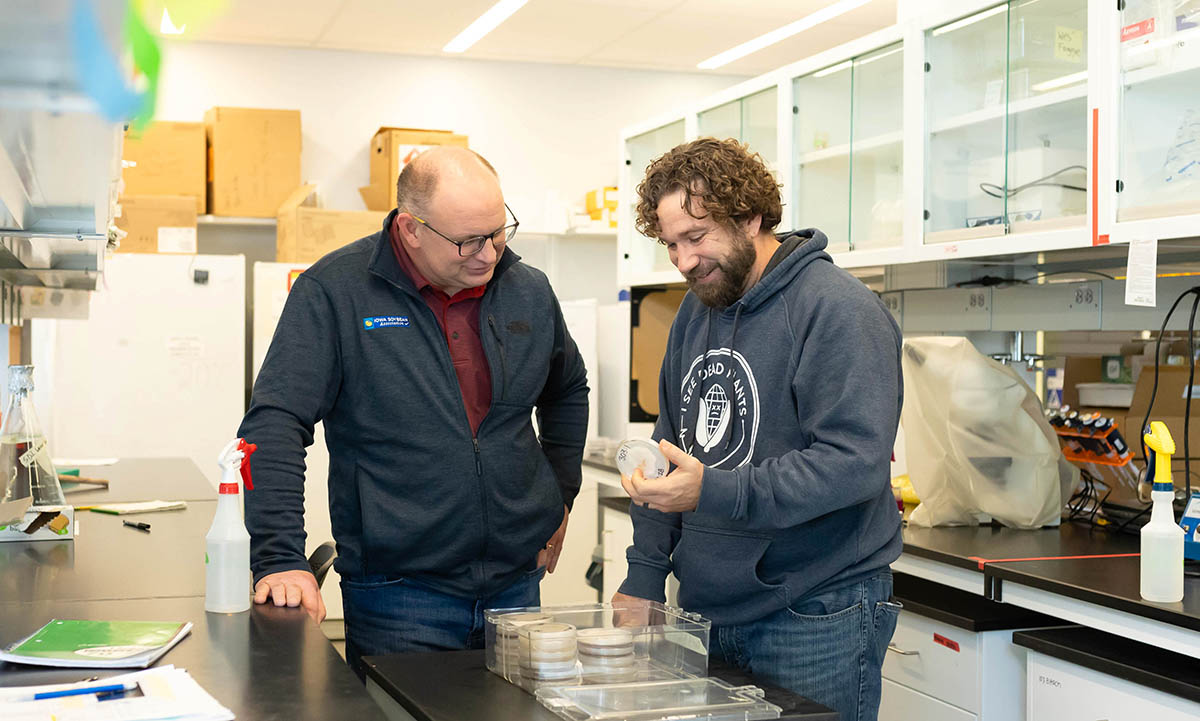
(Photo: Iowa Soybean Association / Joclyn Kuboushek)
Fungicide research and resistance monitoring
March 17, 2026
Key takeaways
- Disease pressure matters: only 20% of the trials over the past five years returned a positive ROI for the fungicide application.
- A tool for disease risk has been developed to aid in fungicide spraying decisions.
- The right timing (R3 growth stage) is critical for maximizing return on investment.
For more than a decade, Iowa soybean farmers have invested checkoff dollars into soybean disease management research at Iowa State University. These investments have provided answers on how fungicides work in Iowa fields, how resistance is developing, and how to make informed decisions that protect yield and profitability.
Why fungicide research matters
Soybean foliar diseases such as frogeye leaf spot, brown spot, and Cercospora leaf blight can reduce yield potential. Foliar fungicides remain one of the few management options available, but their effectiveness depends on disease severity, application timing, product choice, and weather conditions. Iowa Soybean Association’s support of statewide fungicide trials ensures that farmers have locally-relevant data each year to guide fungicide decisions.
Between 2021 and 2024, 32 trial locations across Iowa were evaluated. These trials compared commercially available and experimental fungicides under both natural infection and inoculated conditions.
Results show:
- Fungicides do not always produce yield responses — disease pressure matters (Figure 1).
- Responses vary across products, locations, and years.
- The right timing (R3 growth stage) is critical for maximizing return on investment.
- Across five years of research in Iowa, fungicides returned a positive ROI in roughly 20% of trials when disease was present.
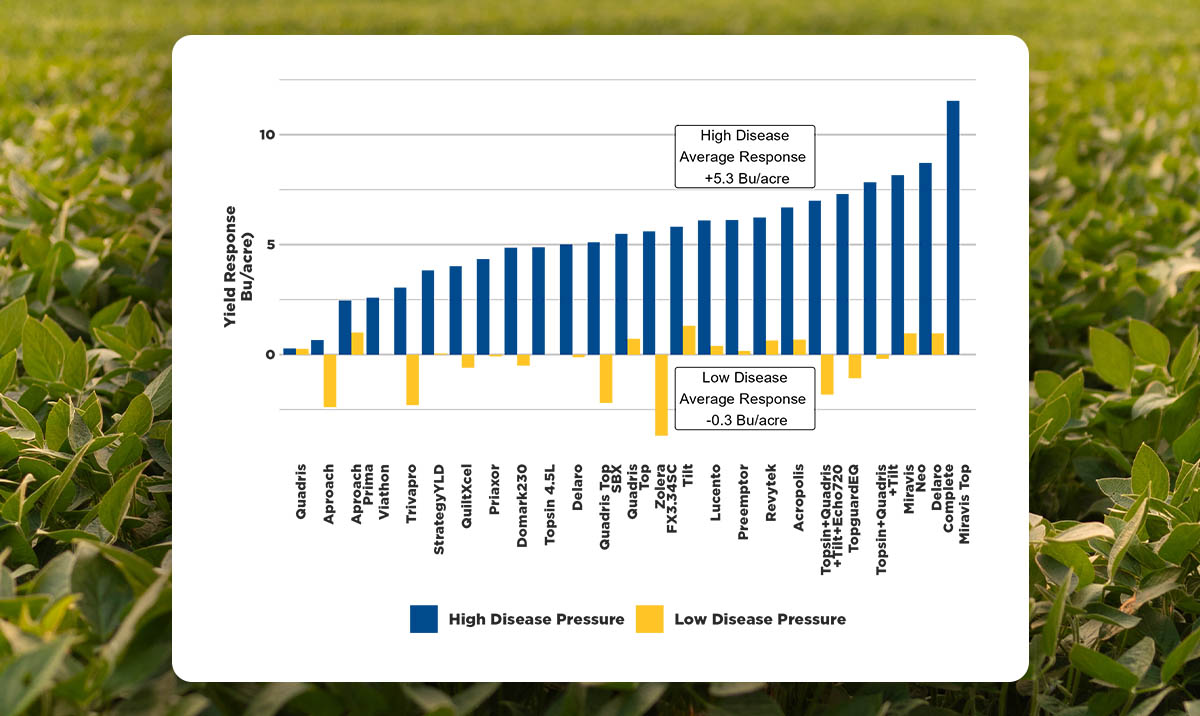
Figure 1: Yield responses of fungicides in six locations with frogeye leaf spot (blue bars) and 26 locations with no frogeye leaf spot (yellow bars) in Iowa, showing ineffectiveness when disease is not present.
Using weather and forecasting to improve decisions
Low disease pressure is unlikely to result in a positive ROI for fungicides in soybeans, and knowing if a product should be used to protect yield is usually based on minimal data. Research shows that disease risk for foliar diseases such as frogeye leaf spot increases with extended periods of high relative humidity and/or leaf wetness. These findings contribute to the Crop Protection Network (CPN) Crop Risk Tool, which farmers can use to anticipate outbreaks and evaluate fungicide needs before disease becomes widespread.
By connecting fungicide efficacy with weather-based forecasting, Iowa farmers have access to decision tools that help them use fungicides more efficiently, protecting yield potential while saving unnecessary input costs.
Keeping ahead of fungicide resistance
One of the most concerning trends in soybean disease management is the buildup of fungicide resistance. Supported by soybean checkoff funding, researchers confirmed that fungicide-resistant strains of the frogeye leaf spot pathogen (Cercospora sojina) are now present in nearly every county sampled in Iowa. Resistance has also been documented in the Septoria brown spot pathogen (Septoria glycines), and monitoring is ongoing for other pathogens such as the pathogen that causes Cercospora leaf blight (Cercospora spp.).
This information is critical for fungicide stewardship. Using fungicides with a single active ingredient increases the risk of resistance. Mixing or rotating products with different modes of action provides a better chance of managing disease while slowing resistance. Iowa State University’s work, supported by farmer dollars, directly informs national tools such as the CPN fungicide efficacy tables and stewardship guidelines.
As fungicide resistance becomes more common, stewardship is essential. Farmers are encouraged to:
- Use fungicide mixtures with multiple effective modes of action.
- Apply fungicides only when disease risk is high.
- Limit applications to preserve product life.
- Continue scouting and using decision tools such as the CPN forecasting and fungicide efficacy tables.
Checkoff powered research
Checkoff dollars have established protocols and long-term monitoring systems that serve both Iowa and the Midwest. Investments have led to:
- Contributions to multistate papers on fungicide performance.
- Predictive models for frogeye leaf spot.
- Improved fungicide timing and spray coverage recommendations.
- National collaboration through CPN.
These efforts stretch every farmer dollar by building knowledge, national tools and training future scientists. The takeaway is clear: Fungicides are valuable but must be used wisely to stay effective. Checkoff investments give farmers the latest data on fungicide performance, resistance and weather-based decision tools — protecting yields today while preparing for tomorrow.
Written by Daren Mueller, Ph.D., Iowa State University.
Back