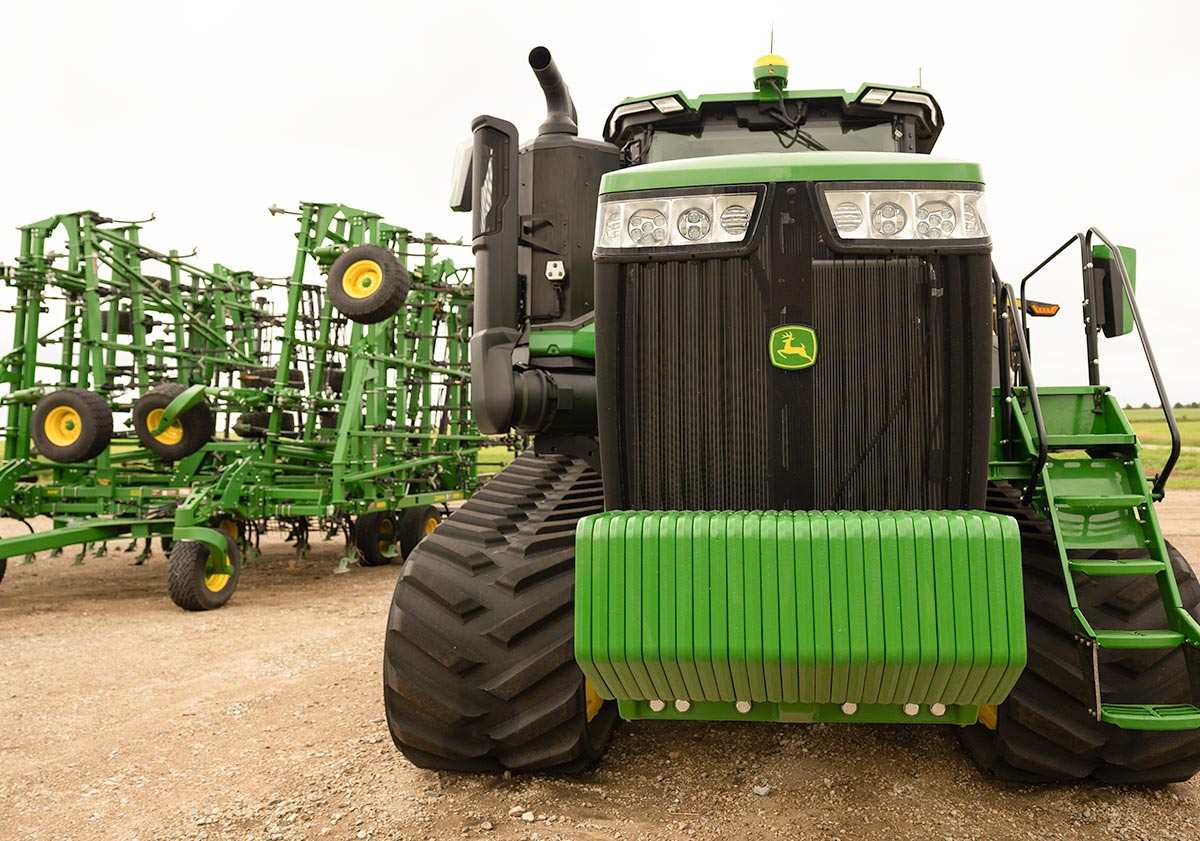
(Photo: Iowa Soybean Association / Joclyn Kuboushek)
Running a farm fleet on soybeans
September 1, 2026 | Kriss Nelson
When John Deere approved the use of B30 biodiesel in its Tier 4 engines in 2025, laboratory testing had already demonstrated the fuel’s performance. The next step was proving B30 — consisting of 30% biodiesel and 70% petroleum diesel — worked under real farming conditions.
Through the Powered by B30 project, the fuel was deployed on four Iowa farms during the 2026 planting season. The goal wasn’t just to monitor engine performance, but to see how higher blends fit into daily operations.
“We wanted to demonstrate the use of B30 in Deere equipment during planting season on the farm,” says Nate Green, director of biofuels for John Deere. “Ultimately, we wanted to tell the story of farmers using B30 and their overall experience. We wanted to demonstrate that B30 would act just like regular diesel in the engine.”
Preparing for success
Before the first gallons of B30 reached participating farms, New Century FS inspected and tested on-farm fuel storage tanks.
“We wanted to make sure we weren’t bringing problems with us,” says Jay Christie, energy manager for New Century FS.
Because biodiesel is an effective solvent, Green says it can loosen rust, sediment and other deposits that have accumulated in older fuel tanks.
“That can affect fuel performance if not treated and is one of the factors to watch out for when implementing higher biodiesel blends, especially with older farm tanks,” he says.
John Deere worked with local dealerships to ensure replacement fuel filters were readily available if needed.
While one participating farmer replaced several filters during planting, Green says the planning prevented downtime during a season when narrow planting windows made every hour in the field important.
Temperatures fell into the upper teens shortly after fuel delivery, but seasonal additives prevented any cold-weather complications.
Christie says inconsistent fuel quality years ago created many misconceptions about biodiesel.
“That’s probably what’s given biodiesel a bad name,” he says. “There was good-quality biodiesel, and there was not-so-good-quality biodiesel.”
Today, New Century FS purchases only biodiesel that meets strict quality standards.
“We’re not buying cheap biodiesel,” Christie says. “We’re going to get good-quality biodiesel that passes inspections.”
He encourages farmers interested in higher biodiesel blends to begin with clean storage tanks, quality fuel and an open mind.
Built on experience
For Iowa Soybean Association Farmer Member Alic Mohni of Hartley, participating in the project was an opportunity to evaluate biodiesel under the same conditions he farms every day.
“I was interested in biodiesel and wanted to compare it to the normal fuel that I’ve been running,” Mohni says. “If it worked, I definitely would use it in the future.”
After comparing fuel records, Mohni noticed no meaningful difference between B30 and his regular diesel.
“As far as my fuel usage so far, the numbers I’ve run, there’s really no difference from the regular fuel that I was running,” he says.
He’s interested in seeing how B30 performs in the combine this fall.
Chris Swanson, an ISA farmer member from Linn Grove, came away with a similar impression.
“If you had not told me I was running B30, I would have never known it,” he says.
Swanson began using B30 in March, running it in equipment ranging from cattle feeding tractors to planters and other field equipment.
He agreed to participate because he already operated John Deere equipment and purchased fuel through New Century FS.
“For me, it was kind of a no-brainer,” Swanson says. “It’s our product. If we can’t get on board using it, who will?”
Although a few filters were replaced during the season, Swanson says it wasn’t outside the ordinary.
Both farmers say seeing B30 perform under everyday farming conditions helps build confidence in higher biodiesel blends.
“They help make people comfortable using it,” Mohni says.
Growing demand
John Deere continues analyzing machine performance and fuel use through the John Deere Operations Center, but early feedback has been consistent.
“We’ve gotten qualitative feedback from our farmers that they didn’t notice a difference,” Green says.
Perhaps the strongest endorsement came after planting.
Every participating farmer asked to continue using B30 through the remainder of the growing season, and interest has spread beyond Iowa as soybean organizations and farmers from other states have contacted John Deere about future demonstrations.
Broader adoption will ultimately depend on farmers asking fuel suppliers for B30, Green says. Expanding biodiesel use benefits both farmers and rural communities, Christie says.
“If all the diesel fuel used on Iowa farms was B30, that’s going to make a big impact,” Christie says. “It’s diesel fuel that farmers grow. The more we can use it, the less dependent we are on petroleum, and it creates another market for soybeans.”
Swanson also sees biodiesel as another opportunity to strengthen soybean demand.
“We need other products,” he says. “We can’t just count on foreign markets to help us out with our products.”
For Green, that’s ultimately what the Powered by B30 project is about: giving farmers confidence that the fuel made from the crops they grow can perform reliably in the equipment they depend on every day.
“I would encourage folks to think about how they can use the soybean oil they’re producing as biodiesel on their own farm,” Green says. “If it saves money on the fuel bill, that’s a win-win.”
Back