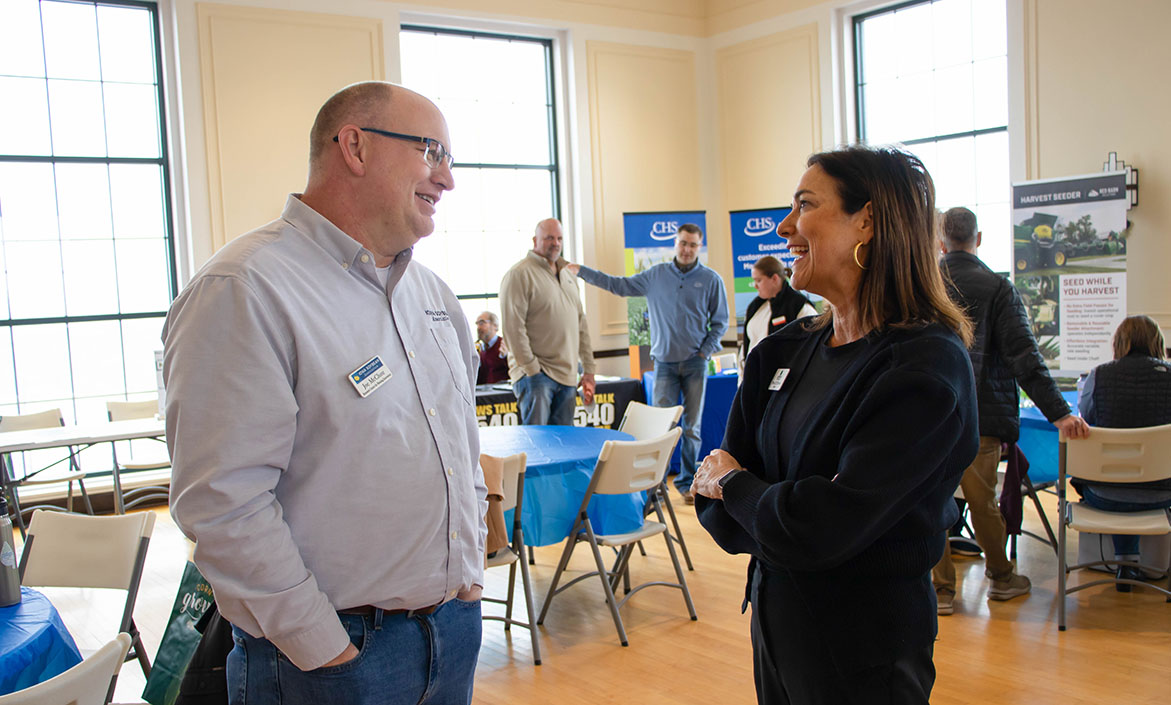
Joe McClure, Iowa Soybean Association chief officer for the Research Center for Farming Innovation, talks with Cedar Rapids Mayor Tiffany O’Donnell during Brewing Conservation on the Cedar, where partnerships and water quality were front and center.(Photo: Iowa Soybean Association / Kriss Nelson)
Brewing Conservation on the Cedar highlights partnership power
March 19, 2026 | Kriss Nelson
Brewing Conservation on the Cedar brought farmers, partners and community leaders to the Veteran’s Memorial Building on May’s Island, right in the middle of the Cedar River in Cedar Rapids. It was a fitting place to talk water quality and the partnerships shaping it.
For Evan Brehm, conservation agronomist with the Iowa Soybean Association, that collaboration is exactly what makes events like this valuable.
“This event brings together our immediate partners in the Middle Cedar Watershed, along with organizations supporting farmer profitability and environmental stewardship,” Brehm says.
Brehm added the event was about connecting rural and urban partners; a collaboration that is critical to making progress on both water quality and farm sustainability.
“What’s happening here is a tremendous partnership,” says Iowa Secretary of Agriculture Mike Naig. “It’s such an important model for how things can be done in other parts of the state, and really across the country.”
Naig pointed to the collaboration between farmers, utilities, city leaders, agribusiness and researchers as a blueprint for progress, crediting local leadership for helping drive that momentum.
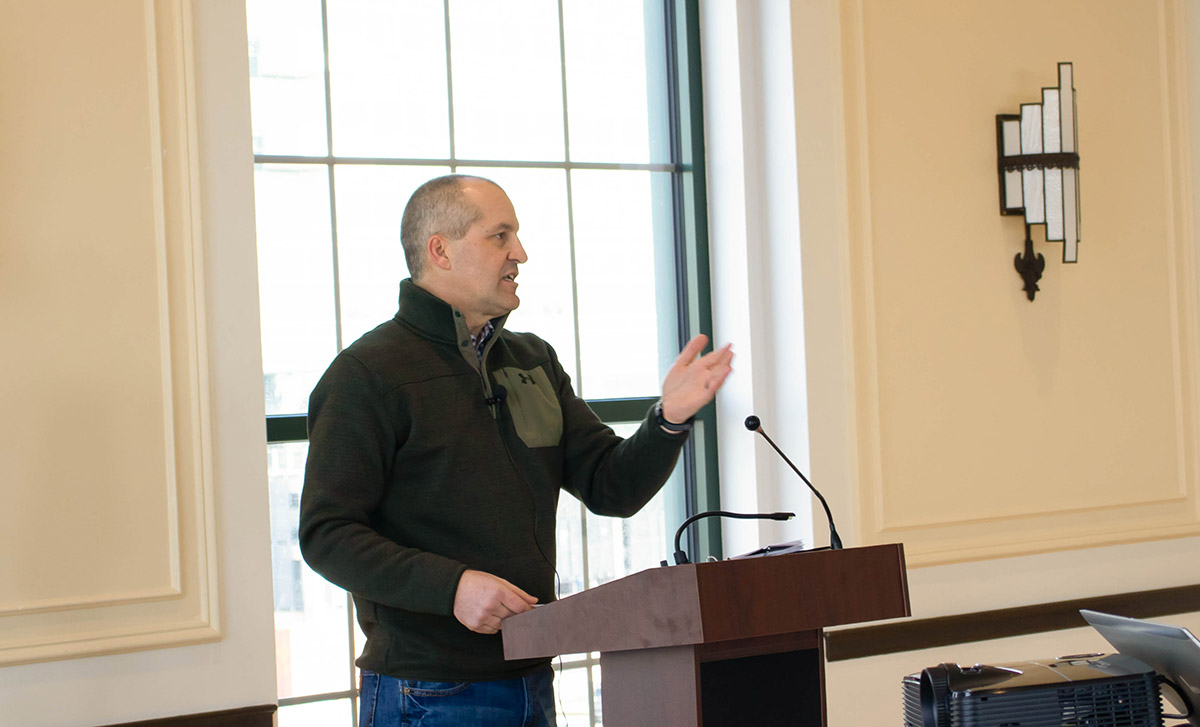
“I just want to thank the city of Cedar Rapids and Mayor Tiffany O’Donnell,” Naig says. “The passion, the energy and the willingness to make things happen is what makes partnerships like this work.”
For Naig, the strength of the effort lies in action.
“This is about getting things done,” he says. “Not just talking about it, not just planning it, but actually implementing practices and working together to make progress.”
That collaboration, he added, is what allows progress to accelerate.
“When you unlock partnerships, incredible things can happen,” Naig says. “We’re no longer working alone, we’re working together and accelerating results.”
Standing in a community closely tied to the river, Naig emphasized that the connection between land and water is easy to see.
“You don’t have to look any farther than out the window to understand the importance of this work,” he says. “This community is closely connected to the river, whether it’s drinking water, economic activity or flood management.”
He also made clear that clean water remains a shared priority.
“Clean water is not negotiable,” Naig says. “It’s essential for life, and every Iowan deserves access to it.”
Shared responsibility
Cedar Rapids Mayor Tiffany O’Donnell echoed that message, emphasizing that partnerships are what turn ideas into real outcomes.
“We can have ideas all day long, but if we don’t have leaders in the community, especially in our farming communities, those ideas don’t become reality,” O’Donnell says. “That’s why these partnerships matter so much.”
For O’Donnell, water is central to everything the community depends on.
“Water supports our neighborhoods, our industries and our future growth,” she says. “It’s one of the first things businesses ask about when they’re considering locating here.”
That reality ties the entire watershed together.
“What happens upstream ultimately ends up downstream,” O’Donnell says. “The choices we make together define the health of our watershed and the strength of our communities.”
She notes the Cedar River watershed effort shows how urban and rural partners can work toward shared goals.
“Water doesn’t recognize city or county lines,” O’Donnell says. “We have to work together, and when we do, we can build a stronger, more resilient community.”
Watershed ties
That connection between agriculture and water was emphasized by Mary Beth Stevenson, water resources manager for the City of Cedar Rapids, who asked attendees a simple question.
“Raise your hand if you’re a farmer,” Stevenson says. “Now if you grew up on a farm, or have family who farms.”
Hands went up across the room.
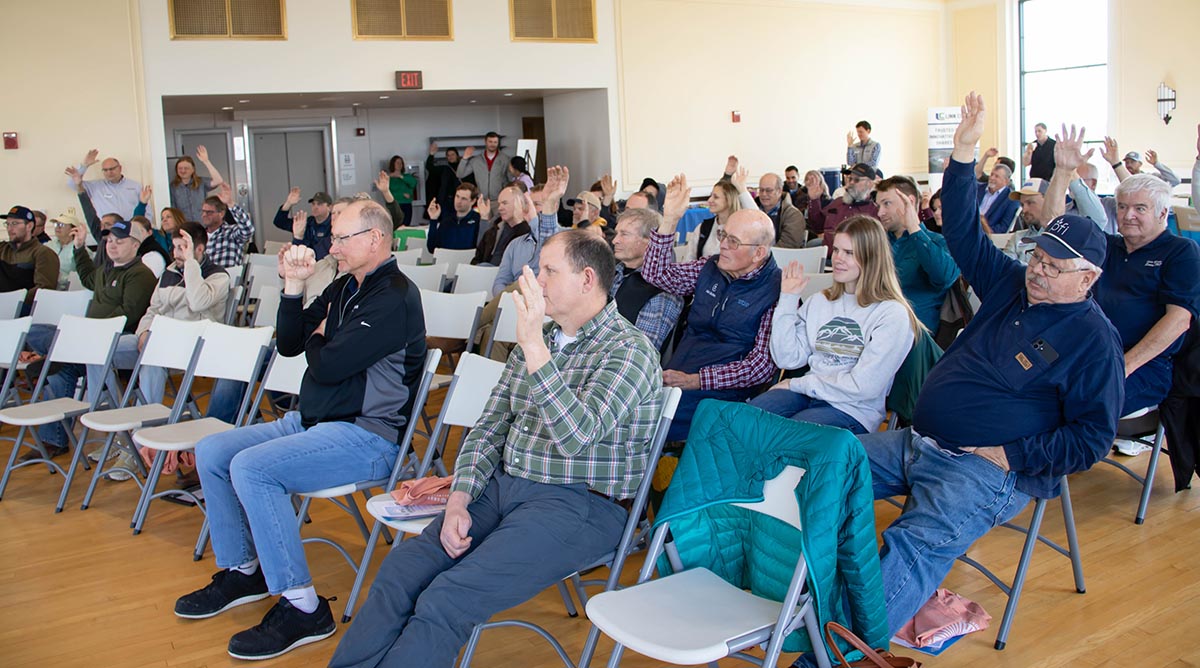
“That’s almost everyone,” she says. “Now raise your hand if you care about agriculture. And I think every one of us cares about clean water.”
For Stevenson, that shared connection is the foundation of the work.
“We’re all here because we care about agriculture and we care about clean water,” she says. “And we care about finding ways to balance those two things.”
She pointed to the role of Cedar Rapids Utilities and the behind-the-scenes work required to deliver safe drinking water every day.
“These are the folks working 24/7 to deliver clean, safe and great-tasting drinking water,” Stevenson says. “It’s something we all rely on, but it takes a lot of work behind the scenes.”
That responsibility, she added, extends well beyond city limits.
“Clean water isn’t just something the just city is responsible for,” Stevenson says. “It’s something we all have a role in across the watershed.”
Through the Middle Cedar Partnership Project, launched in 2021 with support from USDA’s Regional Conservation Partnership Program, that shared responsibility is turning into measurable progress.
“We’ve been able to impact more than 300,000 acres through this partnership,” Stevenson says. “That’s the power of working together.”
She pointed to rapid growth in practices such as saturated buffers and bioreactors, along with expanded water monitoring efforts across more than 60 sites in the watershed.
“It’s not always an easy story to tell,” Stevenson says. “Weather plays a big role in what we see, but we know the practices are working at the field scale.”
That ability to connect on-the-ground practices with measurable outcomes is key.
“When we look at it at the field level, we can clearly see the impact,” Stevenson says. “That gives us confidence that what we’re doing is making a difference.”
Equally important is continued engagement with farmers.
“We've hosted more than 20 farmer-focused events as part of this project," she says. “And what we’ve found is farmers want to understand what’s happening and how they can be part of the solution.”
Collaboration at Work
The event also served as a platform to highlight conservation practices already being implemented across the watershed.
“We’re able to showcase the work happening on the ground and the research behind it,” Brehm says. “That includes reducing soil erosion, lowering nitrate levels and demonstrating the profitability of these practices.”
Just as important, he says, is helping farmers take the next step.
“This is a place to not only encourage farmers and landowners, but also connect them with resources and programs that can help them get started,” Brehm says.
Now in its fifth year, the Middle Cedar Regional Conservation Partnership Program (RCPP) continues to build momentum, with events like this helping to move ideas into action.
“Having organizers, partners and farmers all in the same room allows for real conversations and the ability to take next steps right away,” Brehm says. “That’s something attendees really value.”
That collaboration was evident throughout the day, from formal presentations to informal conversations and connections that continued beyond the program.
“It’s about building relationships and helping people see how everything ties together,” Brehm says. “From what’s happening on the farm to the impact on water quality, it’s all connected.”
Those connections continued after the program, as attendees gathered at Big Grove Brewery. There, the head brewer highlighted a beer created with a purpose: “Beer for Water,” a brew dedicated to Iowa water quality and agriculture. The concept ties the conversation full circle, connecting an end product to the natural resources and stewardship efforts shared by farmers and the Cedar Rapids community.
In Cedar Rapids, that connection is easy to see. It is visible in the river, in the land surrounding it and in the partnerships working to protect both.
And as Naig put it, it offers a clear path forward.
“This is how we should be doing things,” says Naig. “Farmer-led, science-based and partnership-driven. That’s how we create lasting change.”
Written by Kriss Nelson.
Back