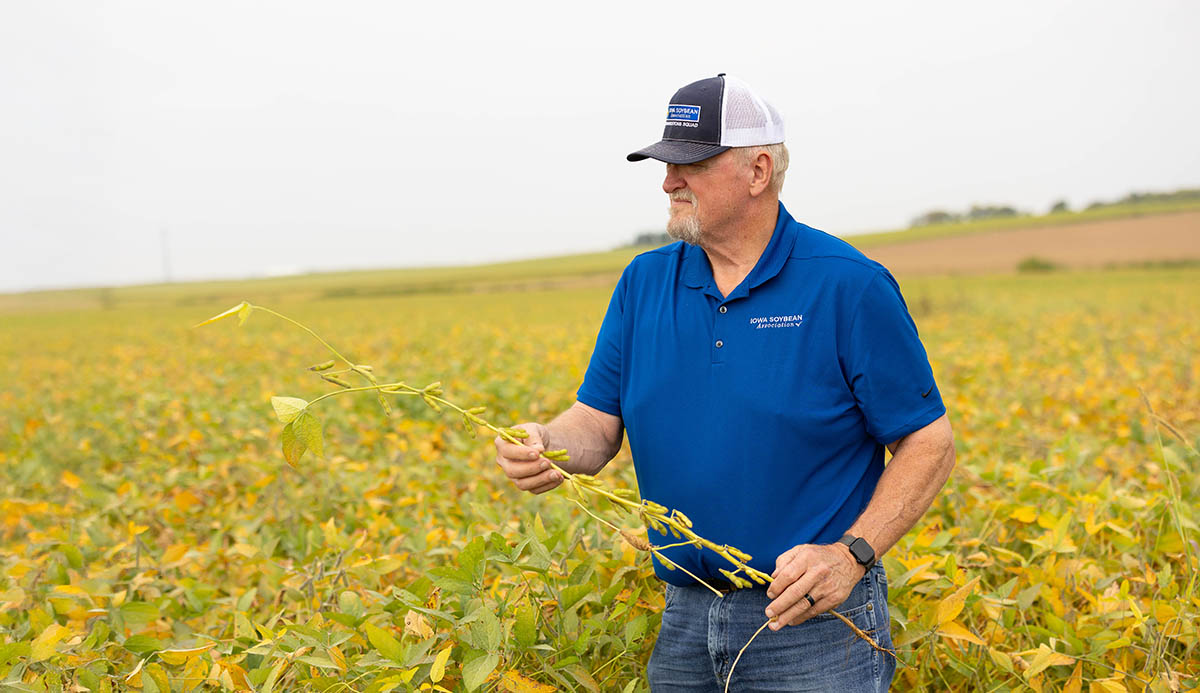
(Photo: Iowa Soybean Association / Joclyn Kuboushek)
Breaking down big challenges in soybeans
February 6, 2026 | Kriss Nelson
From battling soybean cyst nematode to improving seed treatments and soil health, Iowa soybean farmers are helping drive the next wave of research to solve their toughest production challenges. Guided by farmer and industry input, the Iowa Soybean Research Center (ISRC) has invested $380,000 in four research projects selected during its annual advisory council meeting.
ISRC co-director Mark Licht, associate professor and extension cropping systems specialist at Iowa State University (ISU), says the research portfolio reflects both immediate production concerns and long-term strategic challenges.
Licht says the Industry Advisory Council (IAC) ensures ISRC’s research stays grounded in real-world needs.
“The council brings together farmers, agronomists, industry partners and researchers,” he says. “Their input helps us focus on work that’s not just scientifically interesting, but truly valuable to soybean production.”
Licht notes that the funding choices this year confirm the center's pledge to boost soybean resilience, improve agronomy and encourage innovation.
“These projects are designed to give farmers new tools and better information,” he says. “Whether it’s understanding soil amendments, improving seed treatments or managing pests like SCN, we want to move the science forward in ways that matter on the farm.”
As an at-large director for the Iowa Soybean Association and a member of the ISRC’s Industry Advisory Council, Jack Boyer of Reinbeck helps review research proposals, provide feedback and recommend which projects should move forward for potential funding.
Boyer believes having farmers at the table is essential to keeping the work grounded in real-world application.
“I think it’s great to have farmer input because it keeps one foot in the soil so you stay closer to the practical application,” he says. “It helps make sure things don’t get too analytical or hypothetical and keeps some real-world perspective in the concepts.”
Optimizing Cover Crop Termination Timing to Manage Waterhemp and Minimize Shade Avoidance in Soybean
ISU weed specialist and assistant professor Wesley Everman, working with Licht, is studying how cereal rye termination timing affects early-season light competition, waterhemp pressure, soybean growth and yield. The project aims to help farmers determine how long cereal rye can stay in the field to boost soil health and weed suppression without reducing soybean productivity.
Q: Farmers often struggle with when to terminate cereal rye before planting soybeans. How will your research help clarify the best timing to manage weeds like waterhemp without hurting yield?
Our research will look at a range of termination dates for cereal rye prior to and after soybean planting and we will measure a range of growth characteristics of soybeans during the season while also measuring waterhemp suppression. We should have enough parameters to help dial in where we minimize effects on soybeans while still receiving weed suppression benefits.
Q: Where will this research take place?
This research will be conducted on research farms, primarily near Ames, to better ensure
the waterhemp population is at a level we can evaluate consistently.
Q: You’re studying how cereal rye affects light and competition early in the season. What should farmers understand about how this influences soybean growth and weed control?
The cereal rye (any plant that is growing with soybean in reality) causes a shift in the red to far red light ratio due in part to light interception occurring early in the season. This change in the red:far red ratio leads to a growth response in soybean that puts greater energy into vegetative growth which affects the reproductive growth later in the season.
Farmer perspective
This research aligns closely with what Boyer has observed in his on-farm trials.
“There are opportunities with cover crops to improve weed management, but you have to find the balance. Hopefully, this research can help broaden that guidance or at least tell us what to look for so we can apply it the best we can,” Boyer says. “That would certainly be helpful.”
Using AI to Decode SCN Effector Functions and Build Durable Soybean Resistance
ISU’s Thomas Baum, Charles F. Curtiss Distinguished Professor, and Steve Whitham, co-principal investigator and co-director of the Iowa Soybean Research Center, are leading research to better understand soybean cyst nematode (SCN) effector functions and use that knowledge to build more durable resistance.
Q: What are SCN effector functions, and why are they key to improving soybean resistance?
SCN is a sophisticated pathogen that engages in close relationships with its host, the soybean plant. As part of the SCN attacking and parasitizing the soybean plant, this parasite delivers a very large number of secretions into the plant to enable parasitism. These secretions are called effectors.
They have many functions, ranging from opening entry avenues for the SCN to inactivating soybean alarm and defense systems to enabling feeding, among others. In other words, effectors are the critical tools that the SCN uses to be a pathogen.
Consequently, if we know how certain tools, i.e., effectors, function, we can then think of strategies to inactivate these tools and weaken the SCN. For example, if an SCN effector targets a soybean protein to shut down a defense response, that protein can be modified so the effector no longer works, allowing the plant to defend itself.
Q: How will shifting from lab work to computational approaches change SCN research, and when might farmers see results?
We’ve studied SCN effectors for years, and two new developments are speeding progress.
We have discovered that the SCN produces many more effectors than we initially thought. Our most recent estimates predict more than 1,000 different SCN effectors, which makes their characterization very complex.
But maybe more impactful, the second development is that computational and bioinformatic technologies based on artificial intelligence advances now offer us completely new and extremely powerful tools to decipher effector functions.
Farmer perspective
Boyer says this line of research hits close to home, especially for growers who have battled sudden death syndrome and soybean cyst nematode in their fields.
“Having experienced sudden death syndrome and SCN, it surely affects profitability. If we can learn more about it and they can introduce some resistance into the soybean plant to help that, that certainly can help soybean farmers,” says Boyer.
Soil Amendments with Biofuel Co-products for Improving Soybean Disease Management
Leonor Leandro, ISU professor of plant pathology, entomology and microbiology, and ISU graduate student Brady Clausen are studying how soil amendments such as biochar and digestate affect soybean disease development.
Q: Soil amendments like biochar and digestate are already being explored in agriculture. How could these materials eventually fit into real-world soybean disease management plans?
Leandro: Biochar and digestate are biofuel co-products increasingly used as soil amendments because they improve structure, fertility, water holding capacity, microbial activity and soil carbon. Our research asks whether these amendments also affect soybean diseases. It would be an advantage if they help manage disease, but it’s also valuable to know if they have no effect, since growers could still use them for their other benefits without increasing disease risk.
Q: Yellow pine biochar performed best in reducing root rot. Why, and what should farmers understand about it?
Clausen: Biochar, in general, is a carbon-rich soil amendment that helps lock carbon into the soil long-term, so it provides both soil health and climate benefits. In our experiments, yellow pine biochar, a high-lignin feedstock, didn’t eliminate disease, but consistently showed similar or slightly lower SDS severity than the control (no biochar). It is important for farmers to know that we don’t have strong evidence so far that yellow pine biochar may serve as a disease management practice for SDS, but shows promise as a safe amendment, that won’t worsen disease, while offering the advantages of contributing carbon to the soil and support longer-term soil health improvements.
Q: As you transition from pasteurized soil to natural field soil, what do you hope to learn that will make your findings more applicable to on-farm conditions?
Leandro: As we move to greenhouse experiments with field soil, we are introducing the complexity of a natural, living soil into our study. Field soil will be more representative of Iowa farm conditions because it will have more organic matter, living microbial communities, and a higher clay/loam texture than we are using in the experiments with pasteurized soil mix.
Farmer perspective
Boyer says his own experience using soil amendments aligns with the questions this research aims to answer.
“I’ve used some of the biochar and similar products and did some research on that, but there is a lot more information we still need,” he says. “Some of the research planned here can go a long way in helping us understand that not all biochars or co-products are created equal. What do we need to know so these materials can be beneficial not only for the crop but also for the soil in future seasons? I think this work can help us make real progress in understanding that.”
Seed Treatment Effects on the Seed, Seedling and Soil Microbiome
Gary Munkvold, ISU professor and chair of the graduate program in Seed Technology and Business, and co-principal investigator Larry Halverson, associate professor of plant pathology, entomology and microbiology, are continuing their investigation into how common seed treatments influence soybean seeds, roots and soil microflora.
Q: Why is it important to study seed treatments across field, greenhouse and laboratory settings?
Over the years, we have worked extensively in the field, greenhouse and laboratory to study seed treatments from multiple angles. Field research provides practical, real-world results, but conditions vary each year, so many experiments are needed and it’s difficult to isolate effects on specific pathogens. Greenhouse and lab studies offer more controlled, detailed results, though maintaining pathogen cultures and pest colonies is challenging. We have evaluated many experimental and commercial seed treatment ingredients in collaboration with seed treatment providers and other university researchers through soybean checkoff–supported projects.
Q: Is there a specific disease you are studying for its response to seed treatments?
For this project we are focusing on the fungus Fusarium graminearum, which causes seedling blight and root rot in soybean and other crops. It also causes serious diseases of corn ears and wheat heads and can produce harmful toxins in those crops. One of the key questions we hope to address is how long-lasting the effects of the seed treatment on the pathogen are. We are also collecting data on seed treatment effects on other organisms in the seed and root microbiomes.
Q: You are looking at both chemical and biological seed treatments. What differences are emerging, and how might those findings influence recommendations for soybean growers?
Biological seed treatments are now a common component of most seed treatment combinations, but there is little information about their direct effects on specific pathogens. If we can show how those treatments suppress Fusarium graminearum, either directly or indirectly, it could lead to greater adoption of biological seed treatments.
Farmer perspective
Boyer says seed treatments play a major role in his operation, but he’s eager to understand more about their broader effects.
“I use seed treatments on most of the soybeans, nearly all the soybeans. And certainly there are things there that have come a long way to help with sudden death and some of those kinds of things. But what are the effects they’re having on the soil? I don’t know that we truly understand that. So this will be interesting to see what they can learn and how those seed treatments can be used more effectively, both positively and what the negative aspects of it are.”
Written by Kriss Nelson
Back