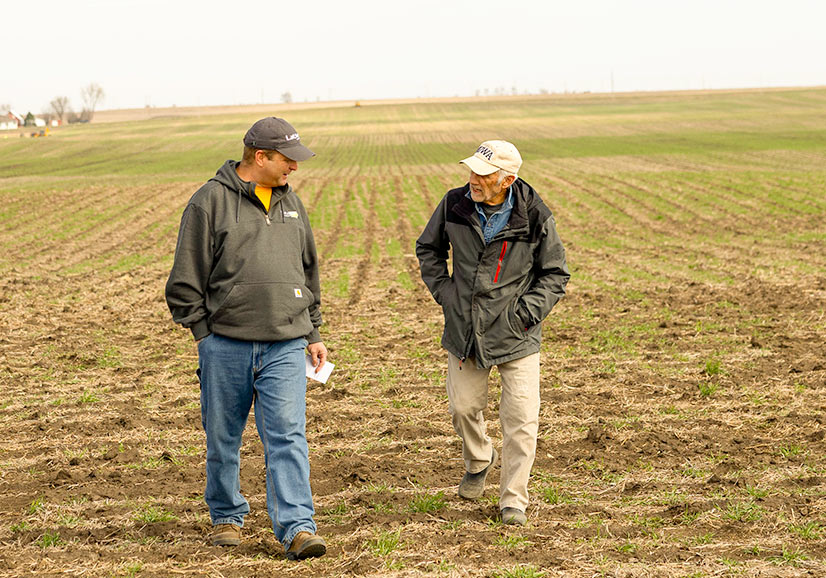
(Photo: Iowa Soybean Association / Joclyn Kuboushek)
45Z: What’s in it for farmers?
September 17, 2026 | Kriss Nelson
Cover crops, no-till and other conservation practices could make a farmer’s corn or soybeans worth more to the biofuel industry.
But getting from a practice in the field to a payment in a farmer’s pocket isn’t exactly simple.
The Iowa Soybean Association recently broke down what farmers need to know during its webinar, “45Z: How Might Your Farming Practices Be Worth More?”
View Webinar Recording
Matt Herman, ISA chief officer of demand and advocacy, and Adam Kiel, executive vice president of AgOutcomes, explained how the program works, where opportunities may exist and what farmers should consider before signing up.
First, what exactly is 45Z?
The 45Z Clean Fuel Production Credit is a federal tax credit designed to reward the production of fuels with a lower carbon footprint. The tax credit goes to the biofuel producer, such as an ethanol or biodiesel producer, not directly to the farmer.
Where farmers come in is through the crops they grow.
Certain farming practices can lower the carbon intensity, or CI, of corn and soybeans. That lower-CI grain can then help a biofuel producer lower the carbon intensity of its fuel and potentially qualify for additional tax credit value.
Some of that value could then make its way back to the farmer.
“The tax credit goes to the fuel producer,” Kiel says. “What ultimately goes to the farmer is going to be up to the fuel producer.”
That distinction is one of the most important things farmers should understand about 45Z.
The other thing to know: The program is still evolving. Herman says ISA continues to receive new information as federal guidance develops.
Follow the value
Think of 45Z as a chain.
A farmer implements an eligible practice. That practice may lower the carbon intensity of the crop. The crop moves through the supply chain to a fuel producer. The lower carbon intensity may increase the value of the tax credit available to that producer. The producer can then offer farmers an incentive for providing that lower-CI feedstock.
How much?
That’s where things get complicated.
Kiel says farmers shouldn’t expect every ethanol or biodiesel producer to offer the same program or payment. One plant may place greater value on certain practices than another. Payments, eligible practices, bushel requirements and contract terms could all vary.
Where a farmer sells grain could matter, too.
A corn farmer delivering directly to an ethanol plant has a relatively short path between the farm and fuel producer. Soybeans may first move through a crusher before soybean oil reaches a biofuel producer. Kiel says a less complex supply chain could provide more opportunity for value to make its way back to the farmer.
And there is no guarantee that all the tax credit value created by a farmer’s practices will come back to the farm.
That is one reason ISA is working to bring more greater clarity to the developing landscape.
“We think it’s really important that we figure out how to increase the transparency in this marketplace,” Herman says.
Practices count
No-till, cover crops and nutrient management are among the practices that could lower a crop’s carbon intensity.
But Kiel cautions farmers not to assume a practice will qualify simply because they consider themselves no-till or use another conservation practice.
Details matter.
Planter configuration, manure application, tillage and fertilizer use can all affect how a farm is classified and its resulting CI score.
For example, injecting liquid hog manure can place a field in the reduced-till category. Planter setup and the amount of soil disturbance can also affect whether a field qualifies as no-till or reduced till.
Soybean farmers also need to account for nitrogen contained in products such as MAP and DAP fertilizers.
Even the definition of no-till can get complicated. To qualify soybeans as no-till under the current system, Kiel says farmers face a four-out-of-five-year no-till requirement. That means tillage practices during the corn years of the rotation can affect the soybean calculation.
“Don’t assume anything,” Kiel says.
Start early
For farmers considering a 45Z program for the 2027 crop, one requirement deserves attention now: the nutrient budget.
Kiel says a nutrient budget is a prerequisite for participation and must be completed before nutrients are applied.
That means farmers interested in a 2027 program may need to make decisions before fall fertilizer applications rather than waiting until next spring.
Kiel expects limited opportunities tied to the 2025 and 2026 crops. He anticipates more activity around the 2027 crop, although he expects it will largely be a learning year as farmers and fuel producers work through program requirements. He expects opportunities to grow in 2028 and 2029.
Document it
For farmers considering 45Z, recordkeeping could be as important as the practices themselves.
Farmers may need to provide field boundaries, yield information, tillage records, fertilizer applications and records showing where grain was delivered.
Grain movement matters because the lower-CI feedstock must be accounted for as it moves through the supply chain to the fuel producer.
Kiel reemphasizes the importance of keeping records and being prepared for verification.
“If you can’t document it, assume you won’t get credit for it,” he says.
There is also a timing consideration. Farmers may pay for cover crops or other practices early in the crop year, while a 45Z-related payment may not arrive until after harvest, grain delivery and potentially verification.
In other words, the expense could come months before the payment.
What’s it worth?
There isn’t one answer.
Kiel presented several soybean scenarios using a 60-bushel yield in Story County to demonstrate how different practices affect carbon intensity.
A no-till soybean scenario with cover crops and no nitrogen produced about an 87% reduction from the national carbon-intensity baseline. But Kiel cautions against focusing only on the large reduction because that scenario also comes with the multi-year no-till requirement.
Other combinations produced smaller reductions. One reduced-till scenario with some nitrogen and no cover crop actually increased carbon intensity compared to the national baseline.
The lesson, Kiel says, is that practices and the details behind them matter. A practice doesn't automatically create a payment.
Under one Midwest 45Z program Kiel has seen, the soybean scenarios he presented would generate payments ranging from nothing to about $12 per acre.
Comparable corn scenarios under that same program could generate approximately $30 to $50 per acre.
Those numbers are examples from one program, not standard or guaranteed 45Z payments.
Soybean challenge
Why could the same types of practices be worth considerably less on soybean acres than corn acres?
Herman says part of the answer is how the carbon benefit is currently accounted for.
For corn ethanol, the low-carbon value created by farming practices is applied to ethanol. With soybeans, the benefit is divided between soybean meal and soybean oil.
Under the current accounting method, Herman says roughly 20% of the benefit created by a farmer’s practices is assigned to soybean oil, which can be used for biofuel. The remaining benefit is assigned to soybean meal and does not generate value through 45Z.
ISA is studying whether that accounting method could be changed so more of the carbon benefit associated with soybean production is recognized in biofuel production.
Herman presented an example showing the potential difference. Under an alternative accounting method ISA is studying, the value associated with no-till soybeans could increase from roughly $8 to $10 per acre under the current model to about $35 per acre at a 50-bushel yield.
That is not a payment farmers can expect today.
Herman says changing the methodology could take years and would require work through federal agencies.
ISA is also examining other changes to 45Z that could make it easier for farmers to understand what their practices are worth and how much of that value is making its way back to the farm.
Read the contract
For farmers who are offered a 45Z contract, the dollar amount shouldn’t be the only consideration.
Kiel says farmers should understand what practices they are agreeing to, when they will be paid, what data they will be required to provide and what happens if weather or another circumstance prevents them from meeting the program requirements.
Farmers should also determine whether participating affects their ability to receive payments from other conservation programs. Current guidance does not allow the same acres to be dual enrolled in a 45Z program and a private program such as the Soil and Water Outcomes Fund. Some public cost-share programs may be able to be combined with 45Z, but farmers need to understand the individual agreements and who is claiming the environmental benefits.
ISA is working with Iowa State University’s Center for Agricultural Law and Taxation and Center for Agricultural and Rural Development to better understand the contracts and bids being offered to farmers. Herman encourages farmers who receive a 45Z bid or contract to share that information with the Center for Agricultural Law and Taxation to help analyze the value and terms being offered to farmers.
“This is really the big call to action that I have for all the farmers on the call today,” Herman says. “I’m asking you to help us really help you this harvest and going forward on this.”
For Kiel, some of the most important questions come before a farmer signs.
“What are you agreeing to, how much, and when will you be paid?” he says. “What could cause me to lose my payment? I think that’s a pretty important one.”
Questions and contracts
Farmers who receive 45Z bids or contracts and are willing to share the language can contact Kristine Tidgren, director of Iowa State University’s Center for Agricultural Law and Taxation, at ktidgren@iastate.edu or John Crespi, director of the Center for Agricultural and Rural Development, at jcrespi@iastate.edu.
For general questions about 45Z and ISA’s work on the issue, contact Herman at mherman@iasoybeans.com.
Written by Kriss Nelson.
Back