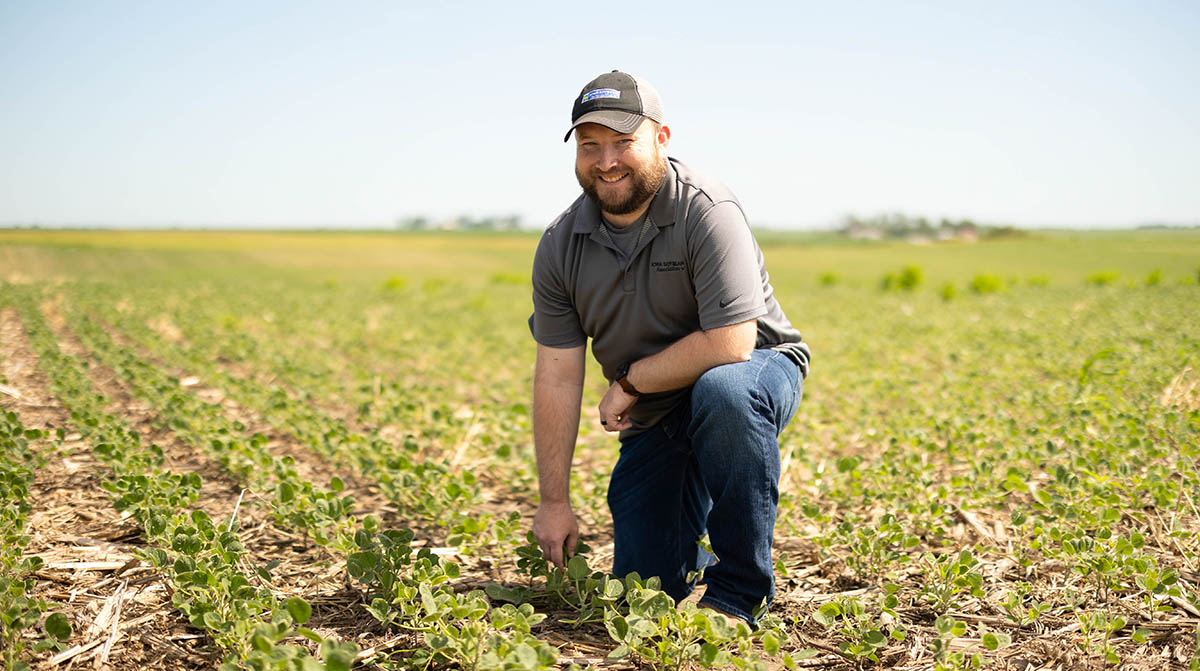
Shane Beck, ISA Research Agronomist (Photo: Iowa Soybean Association / Joclyn Kuboushek)
Seeding rate trials: A three-year perspective
March 11, 2026 | Shane Beck, CCA
Key takeaways
- Results show early planting key to achieving maximum yield potential.
- Fifteen-inch row spacing has a yield advantage over 30-inch spacing.
- The most profitable seeding rates are 80,000 and 110,000 seeds per acre depending on seed costs and sales price.
The Iowa Soybean Association (ISA) has completed its third year of seeding rate trials, compiling 47 trial sites during that period. This study compares four different rates — 80,000, 110,000, 140,000 and 170,000 seeds per acre — to find the most profitable seeding rate. These trials were randomized with either three or four replications and implemented with seeding rate prescriptions.
The data collected in these trials were stand counts and planter performance from planting as-applied data. This data helped determine the number of plants that emerged and contributed to yield, along with how well the planter performed when targeting different planting populations.
The 2025 growing season started off favorably with some great planting conditions early in April, allowing for early-season planting opportunities. The weather quickly turned sour with cold temperatures and rain, leading to crusting issues. This caused some poor stand establishment, forcing farmers to decide whether to replant or add seeds to existing populations in fields.
This problem was most prevalent in northern Iowa, where we saw about a 5-bushel-per-acre yield reduction due to crusting. The weather turned favorable again in early May. The trials that were implemented in the first week of May emerged great and had no stand quality issues. Our 2025 trial data shows a one- to two-week gap in establishment from late April to the second week of May due to poor weather and planting conditions.
Trial results from 2023-2025
When comparing stand counts for the last three years of trials, we see that as seeding rates increased there were fewer plants that emerged. This is most likely because of poor planter performance.
We have noticed that planters generally perform poorly with higher populations. Planters tend to under seed at the higher rates, which is most likely why we are seeing a greater reduction in stand from 170,000 seeds per acre and even 140,000 seeds per acre.
There is about a 20% stand reduction from the early season stand counts compared to targeted seeding rate at the two higher populations, and a 15% reduction in stand at the two lower populations.
Planting dates
Over the last three years, we’ve also observed a connection between planting date and the yield differences associated with different weeks of planting. According to the last three years of our data, the best time to plant soybeans is around the third to fourth week in April across the entire state. That is when we have seen maximum yield regardless of the planting population. We have also noticed that yield starts to decline when planted around that second week of May and is drastically reduced starting the third week of May. This emphasizes the importance of planting early to help achieve those peak growing conditions.
The robust dataset allowed us to compare the two most common row widths that are used across these trials: 15-inch and 30-inch. After comparing the yields over the last three years, there is a one to two bushel advantage of growing soybeans in rows spaced 15 inches apart compared to 30-inch row spacing. The data showed no significant difference among the four seeding rates in 15-inch row spacing, but there was a significant difference among the seeding rates planted in 30-inch rows (Figure 1). In the 30-inch rows, the significant difference was between the 80,000 seeds per acre rate, which yielded about 2.5 bushels per acre less than the other seeding rates.
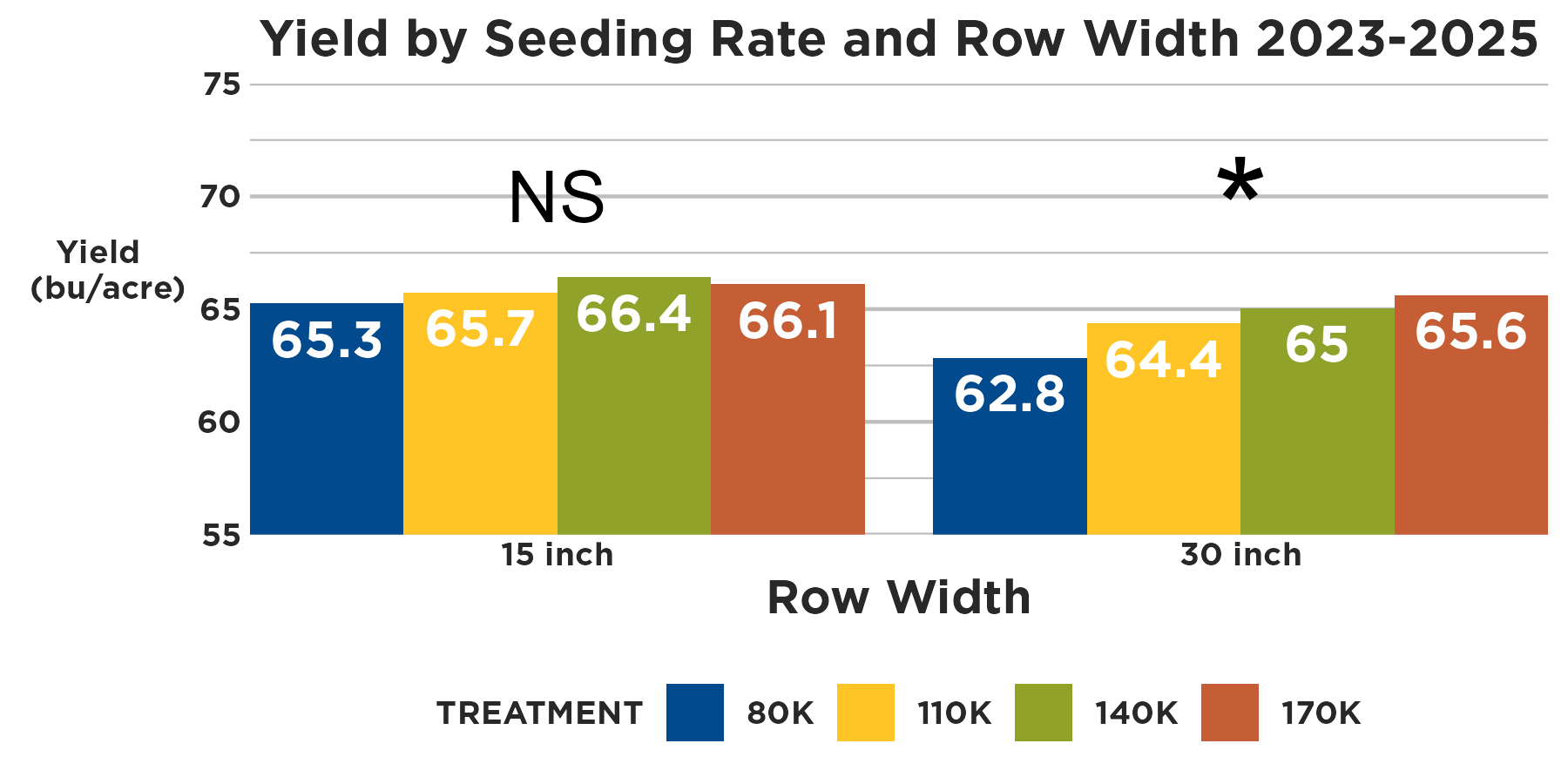
Figure 1: Compares 15-inch row spacing to 30-inch row spacing from seeding rate trials between 2023-2025. There is no significant differences in yield between the four different seeding rates in 15-inch rows. There is a significant difference in yield between the 80,000 seeds per acre and the rest of the seeding rates with 80,000 seeds per acre yielding about one to two bushels fewer than the other seeding rates.
Early matters
The data over the last three years has demonstrated the importance of planting early to achieve maximum yield potential. Even if stand quality is less than ideal, the soybeans will normally compensate for that if there is an early season stand count above 65,000 to 70,000 plants per acre.
Row spacing also adds a slight yield advantage when comparing 15-inch row spacing to 30-inch row spacing. Planters struggle to accurately plant higher populations and generally underseed at populations over 140,000 seeds per acre.
Overall, there is no statistically significant yield difference between the upper three populations and only a slight reduction in yield with the 80,000 population.
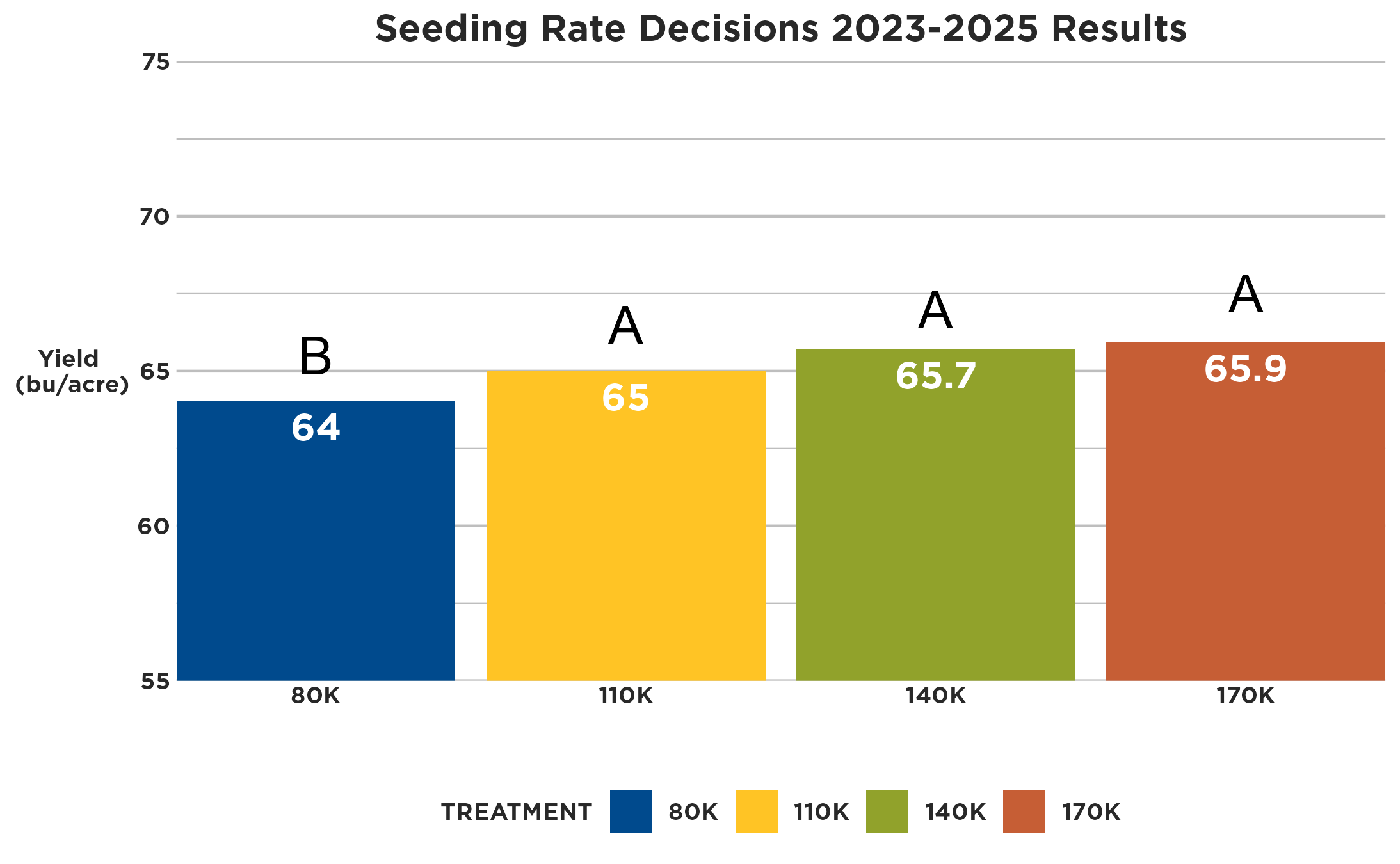
Figure 2: Soybean yields from 2023-2025 comparing different seeding rates. 80,000 and 110,000 seeds per acre are the most economical seeding rates depending on seed price and soybean sale prices.
Written by Shane Beck, CCA.
Back