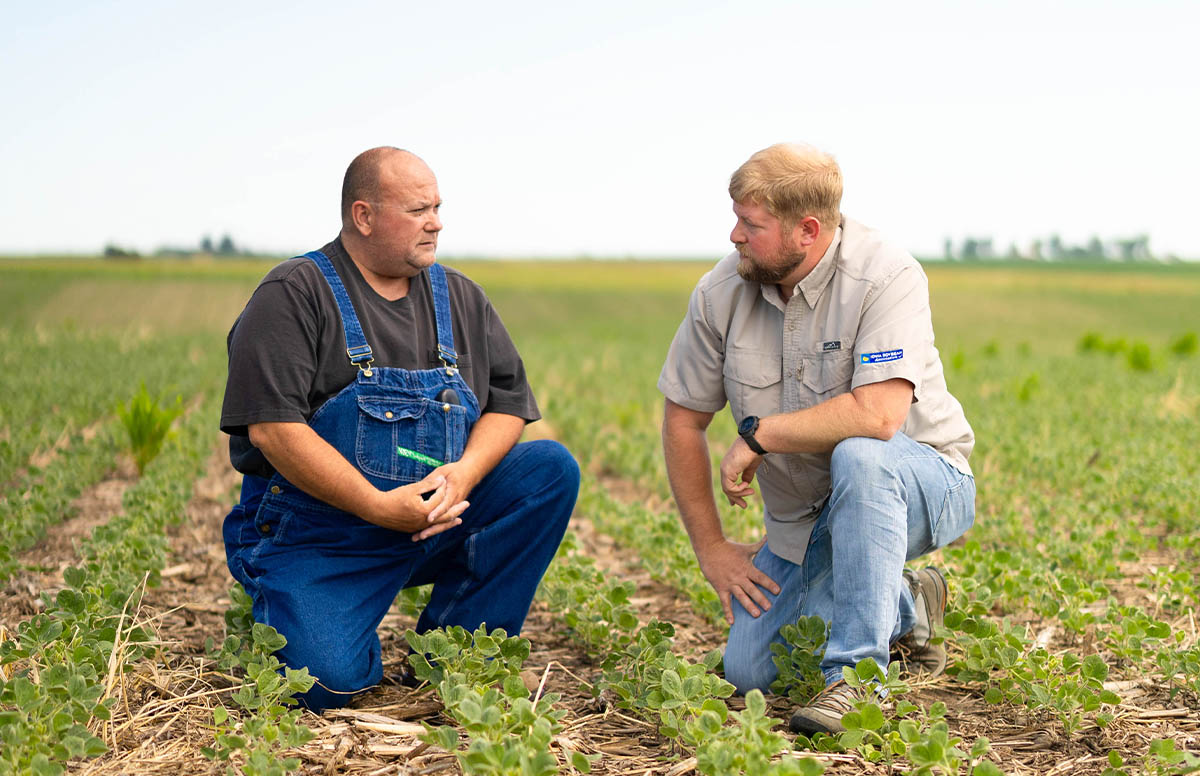
Iowa farmer Scott Clayton of Grinnell talks trial progress with ISA's Alex Schaffer (Photo: Iowa Soybean Association / Joclyn Kuboushek)
Evaluating fungicide return on investment in soybeans
March 11, 2026 | Alex Schaffer, CCA
Key takeaways
- In the absence of insect pressure on soybeans, insecticide does not have an effect on yield.
- There was not a significant yield difference between soybeans sprayed with fungicide and insecticide versus fungicide alone.
- We did not see a location where a biodefense product such as chitosan has shown a yield response.
In 2023 and 2024, the Iowa Soybean Association’s (ISA) Research Center for Farming Innovation (RCFI) conducted head-to-head fungicide product trials on soybean fields across the state. Similar to Dr. Mueller’s work at Iowa State University, we found that in the absence of disease pressure, fungicide application did not reliably produce a positive return on investment.
In talking about these results over the past couple of years, there was one question continually coming up with farmers: Was insecticide included with the fungicide? The answer was no, so we made plans in 2025 to implement a trial on soybeans to confirm or debunk the common belief that fungicide on soybeans needs an insecticide to work.
In 2025 we did this by designing a trial that was a comparison of fungicide alone, insecticide alone, the two products combined and an untreated plot as a control. For half of the plot area, we included a biostimulant chitosan product called Spectra, by Tidal Grow AgriScience. This allowed us to investigate the efficacy of these types of products both with the fungicide, insecticide and combination treatments as well as on its own. Across the state, 10 locations were implemented with product application done via drone at the R3 growth stage according to the product label and followed up with disease and insect severity ratings at R5.
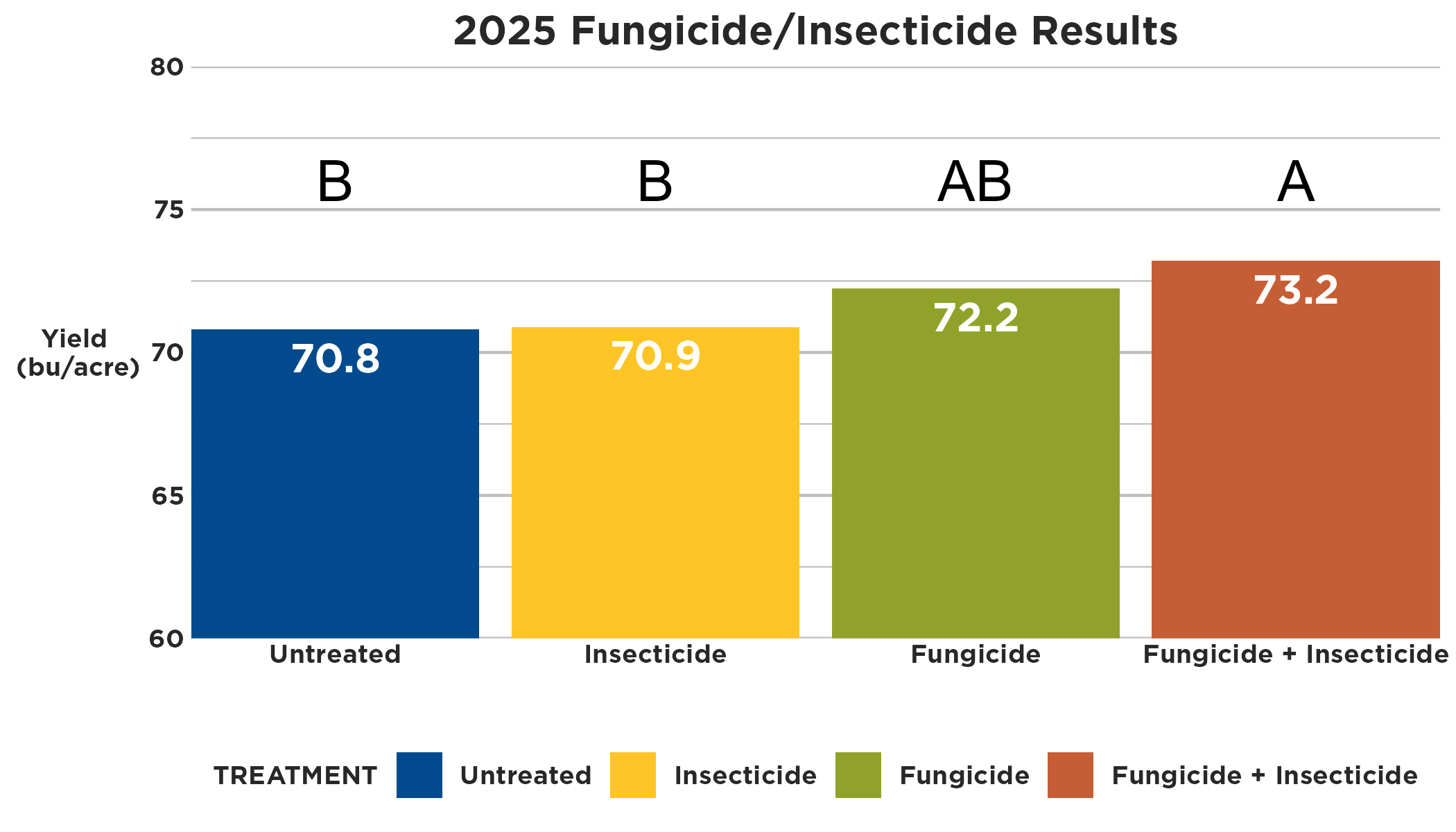
Figure 1 : Soybean yields were compared across different fungicide and insecticide combinations. A statistically significant yield difference was observed between fungicide plus insecticide and insecticide alone and untreated treatments. No significant yield difference was observed between fungicide plus insecticide and fungicide alone.
Trial results
With the frequent precipitation events through the early part of the growing season, we were optimistic about the potential for disease development in our plots. Soybean fungicides only help when certain diseases are likely to develop — and those diseases need wet leaves to spread and infect the plant. As we walked the trials in August at R5 we were surprised to find that diseases such as frogeye leaf spot and Septoria brown spot were largely not present, even in the untreated control plots. At six of the 10 locations, we found sudden death syndrome (SDS). SDS infects the soybean plant early in the growing season during the seedling stage, and foliar fungicides are not effective against the pathogen.
It was a similar story when we looked at insect pressure in the plots. While we found the usual suspects including stink bugs, grasshoppers and Japanese beetles, we didn’t find any aphids or spider mites. Moreover, the insects we found were not at a population level that would warrant an insecticide application.
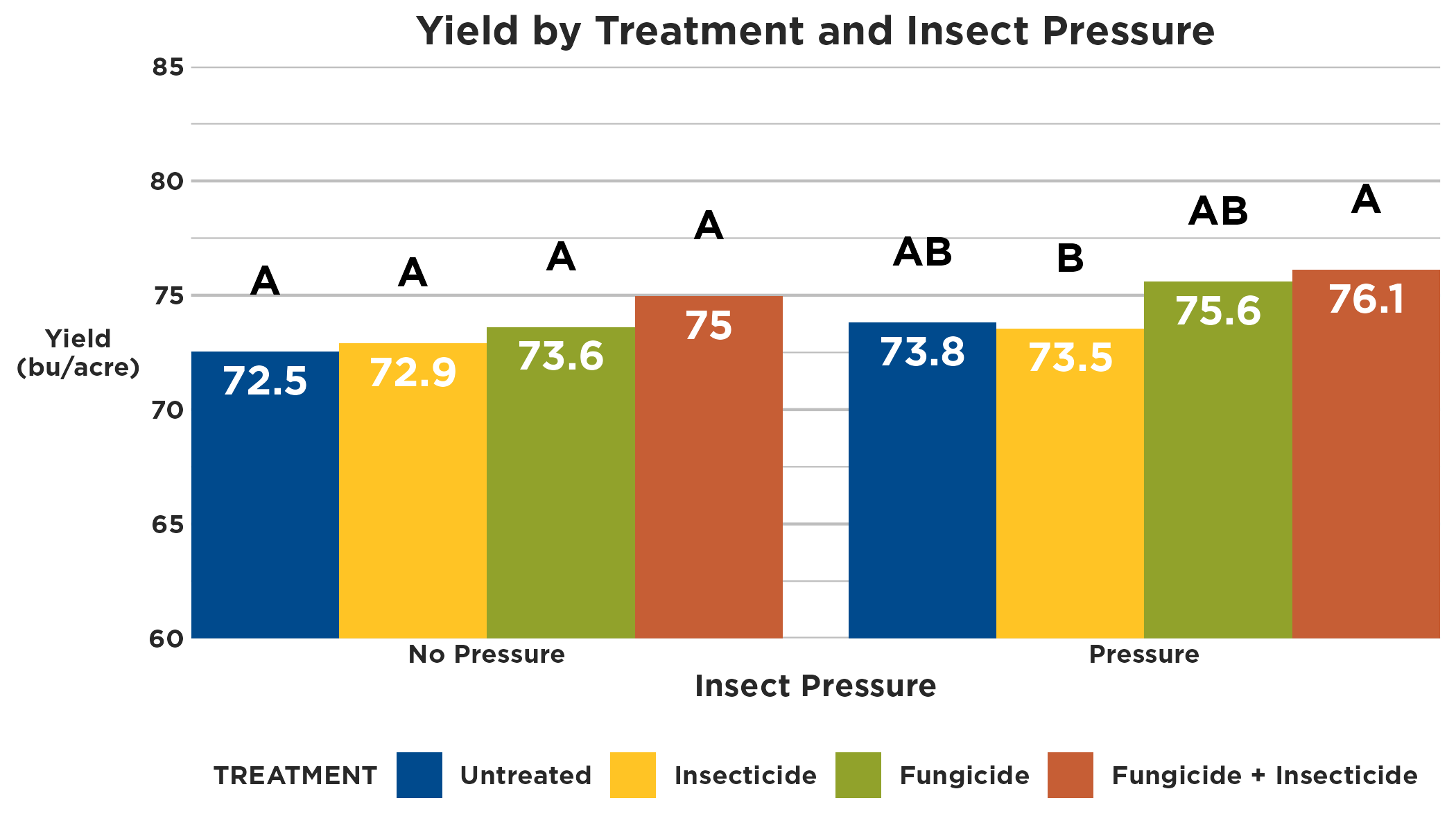
Figure 2: Soybean yields comparing different fungicide and insecticide combinations, grouped by whether or not insect pressure was observed at the R5 scouting. Overall, a significant yield difference was observed between fungicide plus insecticide and insecticide alone when there was insect pressure (four locations). There was no significant difference between treatments when no insect pressure was observed (six locations).
As we analyzed yield data coming from the combine last fall, we saw some key insights emerge from the project. First, when comparing fungicide plus insecticide versus fungicide alone, we did not see a significant yield difference between the two treatments. I attribute this to the fact that in the absence of significant insect feeding, insecticide does not have a noticeable benefit to overall plant health. This is not groundbreaking information, but there is a misconception in agriculture that if you are spraying fungicide, you might as well include insecticide because you are already making the pass. Through our trials, we have not found that to be the case, and we advise applying fungicide or insecticide when an economic injury level
has been achieved.
When fungicides pay
As I think about the past few years of fungicide trials and considering weather conditions, fungicide on soybeans should not be a standard part of the program. We’ve seen that without conditions conducive to disease development, fungicide application does not pay on soybeans. 2025 was a little different because we had the extended leaf wetness in some locations to allow for disease development. Overall, four of the locations showed a significant yield response to the combined fungicide and insecticide application.
Given the depressed soybean prices, and our estimate of $38 per acre to purchase and apply fungicide, it is as important as ever to make sound decisions when it comes to investing in the crop. That holds true with fungicide and insecticide. I have not seen a situation where a farmer by default should apply the products every July or August regardless of weather or pest pressure. My best advice is still to remember the disease triangle, scout your fields for pests and evaluate the result of any pesticides or products you apply to your crop.
Written by Alex Schaffer, CCA.
Back