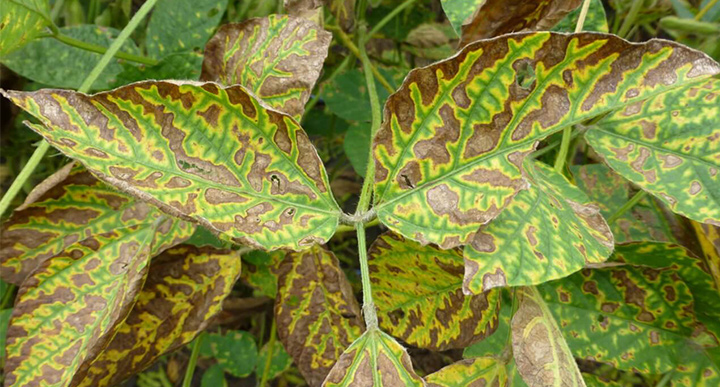
Red Crown Rot can look like SDS in soybeans (Image from Soybean Research & Information Network)
Red crown rot confirmed in Iowa
August 28, 2026 | Kriss Nelson
The soybean disease was confirmed in Des Moines County in southeast Iowa along the Mississippi River, marking its first known detection in the state. Under favorable conditions, red crown rot can reduce soybean yields by up to 60%.
The disease can closely resemble sudden death syndrome from the road, and farmers should take a closer look at suspicious areas before assuming SDS is the cause, says Alex Schaffer, Iowa Soybean Association research agronomy lead. “Farmers need to get into those affected areas, dig plants and inspect the base of the stem and roots. If something looks suspicious, they should get a sample submitted and confirm what is actually there,” Schaffer says.
What to look for
Red crown rot is a soilborne fungal disease. Like SDS, it can cause yellowing and browning between soybean leaf veins.
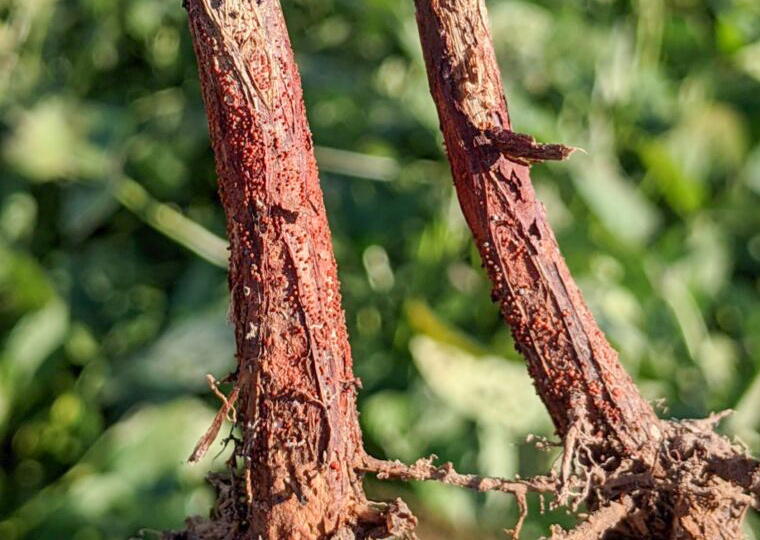
Red crown rot on soybean stems (Image from Soybean Research & Information Network)
The distinguishing feature is found closer to the soil line. Farmers should carefully dig plants rather than pull them, preserving the roots and lower stem. Look for tiny, brick-red, sphere-shaped fungal structures called perithecia on the lower stem near the soil surface and occasionally on the roots. Maroon to brick-red discoloration may also appear on the lower stem.
Because the red structures are not always present, laboratory testing is necessary to confirm the disease.
What farmers should do
There is no in-season treatment recommended for affected fields this year. Instead, farmers who see affected areas they believe to be SDS should confirm via sampling, particularly in southeast Iowa.
How to collect a red crown rot sample
- When to sample: Scout fields from R1 through R6 when foliar symptoms first appear. Remember, the diagnostic red perithecia may not always be visible.
- What you'll need: A spade or soil knife, plastic bags (not paper), a permanent marker and shipping materials.
- Dig, don't pull: Use a spade to loosen the soil to a depth of 6 to 8 inches around the plant, keeping the entire root system intact with soil attached.
- Collect three to five symptomatic plants from within or along the edge of the affected area.
- Document the field. Take photos of leaf symptoms, root discoloration and any visible red perithecia before bagging the plants.
- Bag samples loosely without adding water. Use one plastic bag per sampling area and remove excess air.
- Label each sample with the grower's name, county or GPS location, collection date, soybean growth stage, variety and treatment history.
- Keep samples cool and ship promptly. Use ice packs if needed. Refrigerate overnight if necessary, but do not freeze. Ship samples within four days.
- Clean tools between fields and wash hands after handling samples to avoid spreading pathogens.
How it spreads
Red crown rot was first identified decades ago in peanuts before moving into soybeans in southern regions. It wasn’t officially confirmed in the Midwest until 2018, but has since spread into multiple states, including Illinois and Indiana.
The disease survives in the soil as microscopic structures that can persist for years, even in the absence of a soybean crop. It can also survive on a wide range of host plants, making it difficult to eliminate once it’s established.
Next year’s crop
Joe McClure, chief officer of ISA’s Research Center for Farming Innovation, says the confirmation in Iowa reinforces the importance of scouting and staying ahead of emerging soybean diseases.
“Identifying red crown rot now gives farmers information they can use when making variety, seed treatment and other management decisions for the 2027 growing season,” he says.
Farmers who suspect red crown rot can contact Schaffer at aschaffer@iasoybeans.com or work with the Iowa State University Plant & Insect Diagnostic Clinic to submit samples for confirmation. Learn how to identify red crown rot and properly collect and submit samples here.
Written by Kriss Nelson.
Back