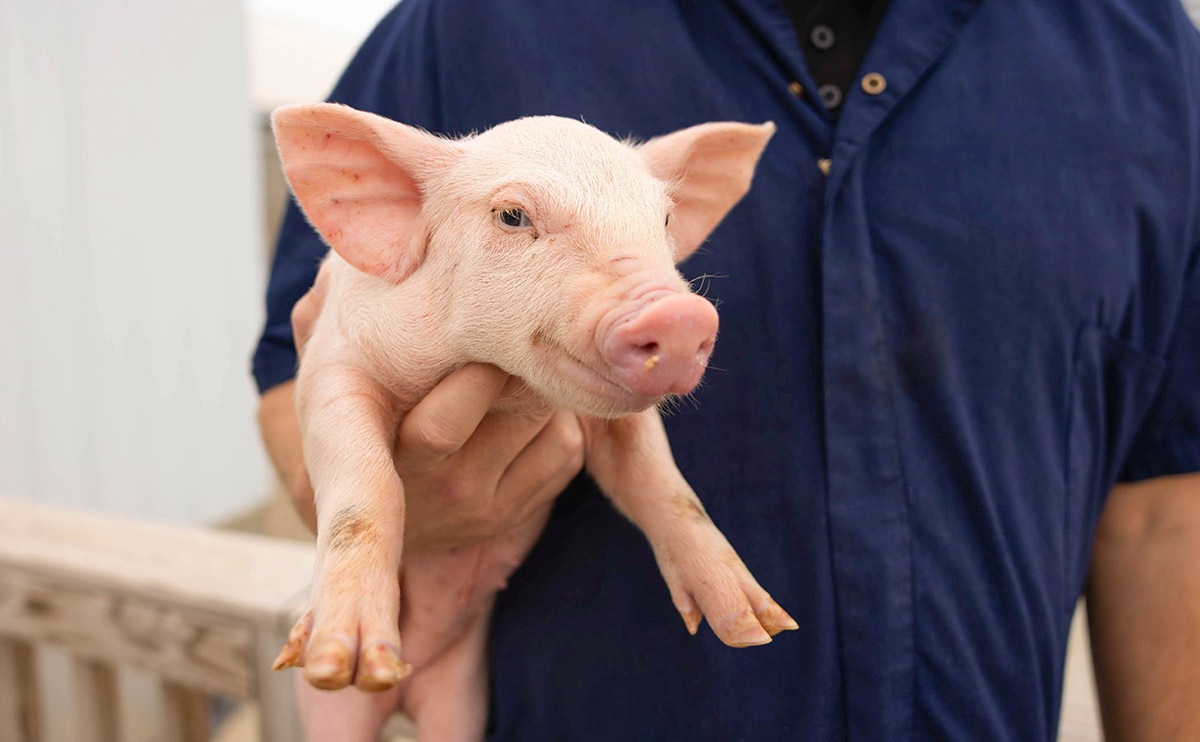
(Photo: Iowa Soybean Association / Joclyn Kuboushek)
Pork profitable, but demand key
February 12, 2026 | Bethany Baratta
Pork producers can expect profitable levels this year—at least until late 2026, says Lee Schulz, chief economist at Ever.Ag.
“Profitability for 2026 looks a lot like profitability for 2025,” Schulz told farmers during the Pork Congress in Des Moines recently.
Like every other commodity, prices are mostly the result of supply and demand. Supply isn’t a problem—the United States’ inventory of all hogs and pigs on Dec. 1, 2025, was 75.5 million head, including a market hog inventory of 69.6 million head, according to the U.S. Department of Agriculture’s (USDA) National Agricultural Statistics Survey (NASS) board.
Schulz says there is opportunity for growth in domestic pork demand in 2026. Prices of substitutes are a demand determinant and beef prices for consumers are expected to grow by 9.3% this year, according to USDA’s Food Price Outlook. They forecast pork prices rising by 1.1%.
“While we’ve seen other product prices outpace inflation, we've seen pork chops and bacon actually be slower than the rate of inflation. I think this, along with product availability, has started to matter for retailers' actions,” Schulz says. “We've started to see some opportunities for retailers to really lean in and feature pork because of this.”
It can bode well for business, Schulz says.
“However, keep in mind that great demand will come from both volume and price increasing. That will grow the whole pie for the pork industry and provide more dollars for everyone,” he says.
Building demand
The Pork Checkoff works to build demand and preference for U.S. pork domestically and abroad. Schulz says building consumer demand is usually a slow, multi-year process that requires focusing on the entire animal.
"As you think about investments in demand, realize that those don't happen overnight, that you're trying to change the behavior of consumers, and you have all these other factors that are out of your control,” Schulz says.
Around the world
Domestic demand is one side of the demand picture. Exports are also critical to prices and profits.
The United States has become the premier pork supplier to the world, officially overtaking the European Union’s position in 2024, Schulz says.
Mexico is the top destination for U.S. pork at 42% of the total volume exported. Japan, South Korea, China and Canada are among the top five export destinations. Canada and Brazil continue to grow in overall exports of pork to their customers, but they account for about half of what the U.S. routinely exports, Schulz says.
Expansion?
The U.S. Department of Agriculture’s (USDA) forecast for a 2.3% increase in pork supplies in 2026. Schulz says that’s probably in an ‘ideal health’ situation.
While the costs of soybeans and corn have stabilized for pork producers, costs of other inputs—labor, equipment and general supplies—have risen with inflationary pressures. Costs were 31% higher in 2025 versus 2020, Schulz notes.
Schulz estimates a $20.79 per head return on average to farrow to finish producers in 2026, with losses currently projected in late 2026 and early 2027.
Data important
Survey data compiled from farmers through the USDA NASS’s Hog Inventory Survey is vital, Schulz says. This data is summarized to publish inventory estimates in each Quarterly Hogs and Pigs report, which is used to help gauge expected hog supplies. Schulz encourages farmers to participate in the survey if they receive one.
“It's pretty difficult to substitute for the information that producers are giving—that USDA is using in providing estimates of hogs and pigs,” he says. “We can't just go find that data somewhere else.”
Want to hear more about the soybean outlook? Click on the button below:
Soybean Outlook
Written by Bethany Baratta
Back