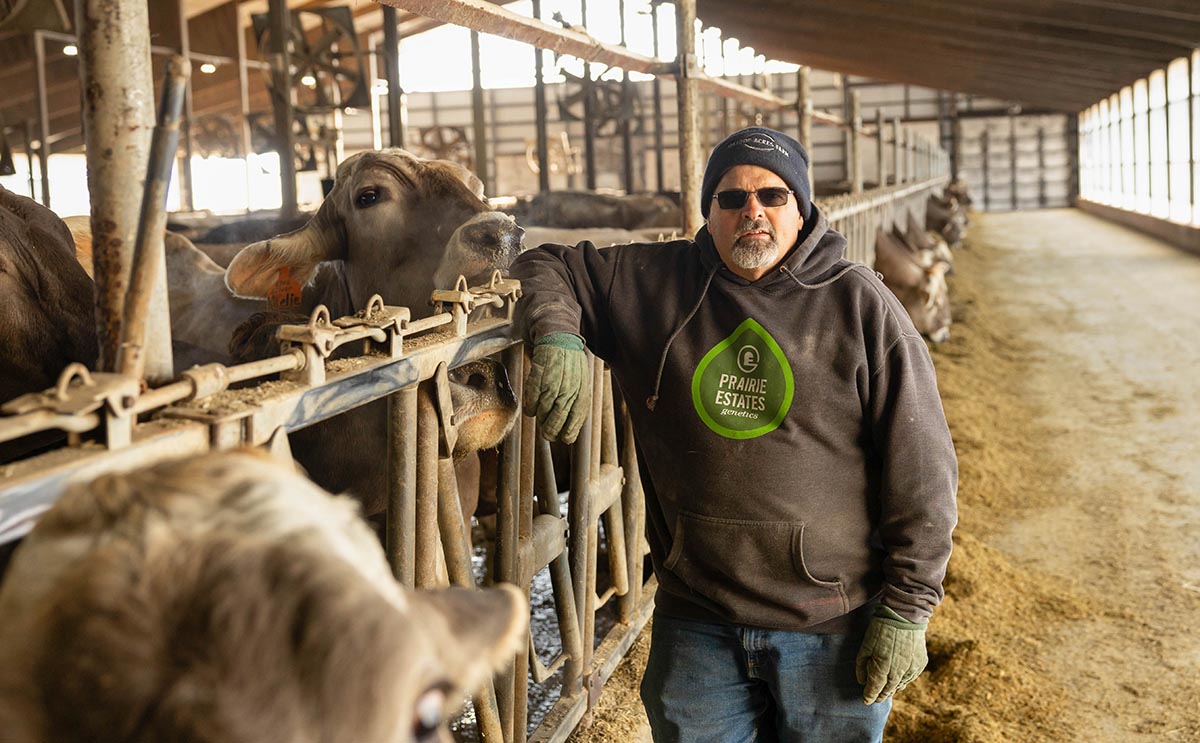
Dennis Mashek on his eighth-generation dairy farm near Calmar. (Photo: Iowa Soybean Association / Joclyn Kuboushek)
Soy's new dairy frontier
March 2, 2026 | Kriss Nelson
From planting decisions in the field to mixing feed rations, high oleic soybeans are changing how farmers can add value. After years of development, high oleic soybeans are finding their way back into more conversations as better-performing varieties and expanding herbicide-resistant traits make them a more competitive option for farmers.
On-farm results
For Calmar dairyman Dennis Mashek, feeding high oleic soybeans began as an experiment and quickly became a part of his ration program.
Mashek, along with his wife, Barb, and sons Tanner and Josh, owns Hilltop Acres Farm, an eighth-generation family farm in northeast Iowa.
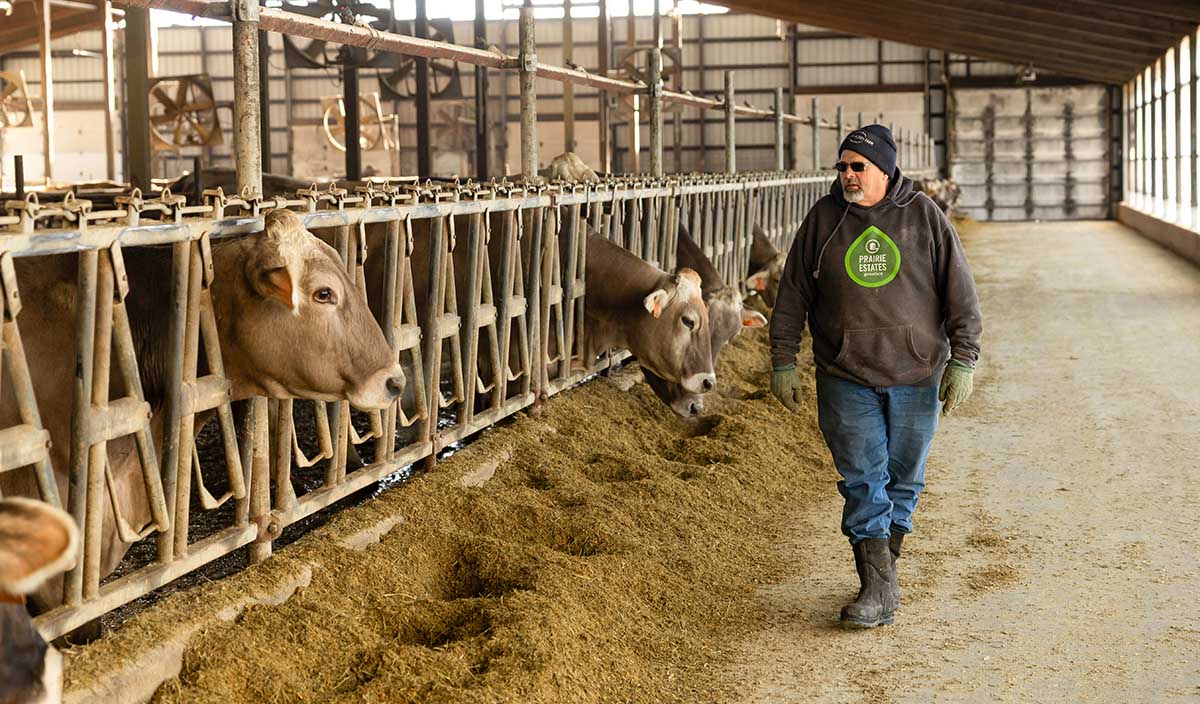
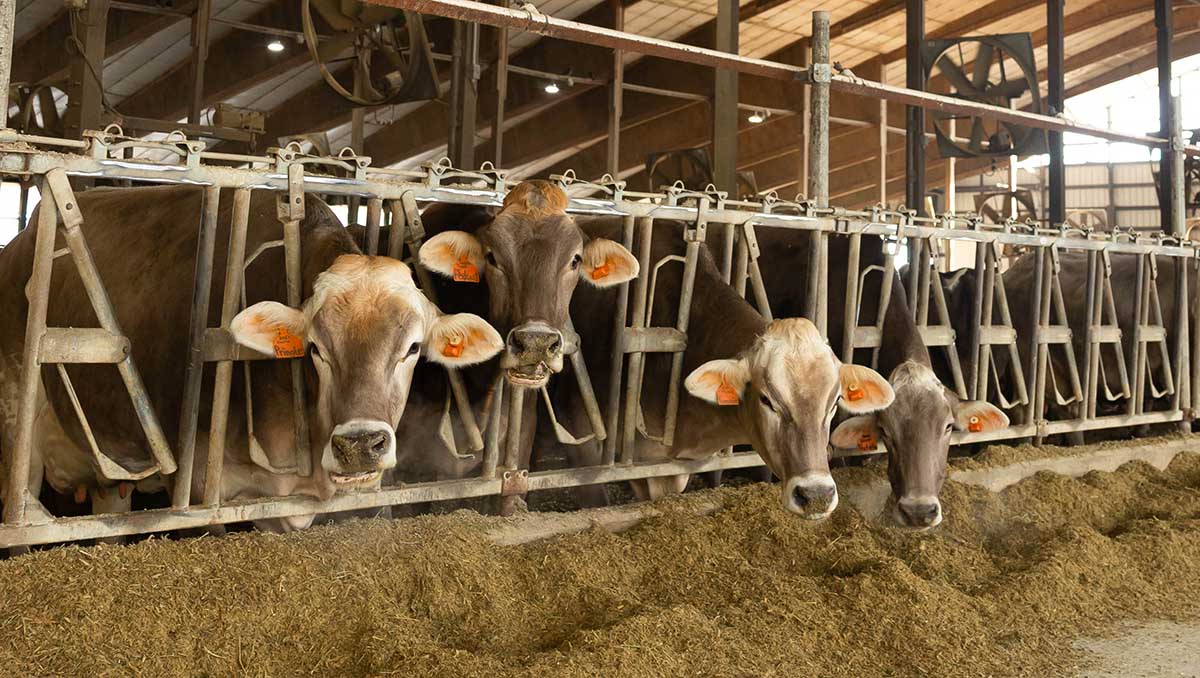
Four years ago, Mashek introduced his farm-raised high oleic soybeans into his Brown Swiss dairy herd after his nutritionist suggested roasted soybeans.
“My nutritionist told me high oleic soybeans could raise butterfat by a point to a point and a half, so I thought I’d give it a try, and it did,” he says.
Today, Mashek feeds six pounds of ration containing high oleic soybeans per head per day. Feeding his own high oleic soybeans has lowered feed costs, boosted components and helped him eliminate other ingredients.
Mashek grows Plenish soybeans from Corteva and says the system has allowed him to cut back on other ration inputs.
“I used to feed a roasted distiller’s grain called Novameal and I’ve completely taken that out,” he says. “I was also feeding palm fat, and I’ve cut that down to about one-third to a half of what I was feeding. Palm fat is all imported, and with tariffs it was getting expensive.”
Feed value
Mashek roasts and stores the beans on-farm, bringing in a roaster three times a year to heat them to 280 to 310 degrees before cooling, binning and grinding them through a hammer mill.
Serving on the Dairy Farmers of America board, Mashek has watched national butterfat levels climb.
“Feed can do amazing things,” he says, noting that his Brown Swiss herd maintains an ideal fat-to-protein ratio for cheesemaking.
For his operation, that balance matters.
“For me, I’m running a 4.9 fat and a 3.7 protein. You get a better yield when it’s more equal,” he says, adding that because of those results, he plans to keep high oleic soybeans in the rotation to supply his herd each year.
For dairy producers, the appeal comes down to improving income over feed costs, says Nathan Augspurger, vice president of animal nutrition and health for the United Soybean Board (USB).
“High oleic soybeans provide elevated oleic acid, which helps reduce the risk of milk fat depression and delivers a high-quality source of rumen-bypass protein,” Augspurger says. “This creates two routes to value generation for dairy farmers: the potential to increase milk fat production and the ability to replace the costly supplemental fats while maintaining milk fat levels at a lower feed cost.”

Whole-system approach
A new research project in Iowa is taking a closer look at how high oleic soybeans could fit into dairy rations.
Grant Kimberley, senior director of market development with the Iowa Soybean Association, says earlier research supported by USB has already shown strong potential in dairy herds using high oleic soybeans.
Building on that foundation, the new project is designed to verify those results closer to home by evaluating the entire system, from soybeans grown at the Iowa State University (ISU) Research Farm to roasting and processing at the ISU feed mill before being fed at the university’s dairy research farm.
“This project is about looking at the whole system,” Kimberley says. “We want to understand how growing, processing and feeding high oleic soybeans all fit together.”
Researchers will also evaluate seasonal performance, with the project spanning planting, harvest, processing and feeding across multiple seasons.
Building demand
Beyond the research phase, the work also ties directly into demand development. By creating a small-scale processing platform at ISU, the project fills a gap until commercial suppliers can meet demand. Kimberley says the dairy industry represents a major opportunity.
To help meet that demand, more seed options are coming, with companies like Corteva, Beck’s and Bayer all working on high oleic varieties.
“This isn’t all going to happen tomorrow,” Kimberley says. “It’s a forward-looking effort to create more value and more opportunity for Iowa farmers.”
USB leaders say high oleic soybeans are a growing demand opportunity that connects soybean farmers with food and livestock markets, especially dairy.
Augspurger says a “new value proposition for dairies” is creating diversified demand and strong market growth, helped by smaller-scale processing that tightens the connection between farmers and dairies.
USB sees major potential for domestic demand through dairy, particularly where soybean production overlaps with concentrated dairy regions.
“We’re focused on domestic use through dairy demand,” Augspurger says. “There is strong growth potential in regions like the Northeast and Upper Midwest, with early adoption already underway in New York.”
To sustain that growth, USB is targeting research and education to ensure product characteristics match what dairy producers need to capture full value on-farm.
“We’re investing in research and development to help dairy farmers understand how high oleic soybeans can benefit their operations,” says Augspurger. “Our goal is to show producers how to get the most value from these beans on their farms, which will build lasting demand for high oleic soybeans.”
Market evolution
While farmers are seeing results on-farm, seed companies are also watching the market evolve.
Roger Theisen says the story of Pioneer brand Plenish high oleic soybeans looks very different today than it did when commercial acres first went into the ground more than a decade ago.
Theisen, specialty crops manager with Pioneer, says Plenish acres were first grown in 2012. For much of that time, demand was tied primarily to the volatile edible oil market, a market where food companies can quickly shift between oil based on price and availability.
Global disruptions, including COVID-19, drought, war, and supply chain breakdowns, fueled volatility in the edible oil market, pushing Plenish past 1 million acres in 2023 while complicating long-term planning.
Theisen says timing is a major challenge, with seed decisions made years before oil reaches the market, requiring food companies to commit to ingredient choices far in advance, even as sudden influxes of lower-cost oils like sunflower can quickly shift purchasing decisions.
Feed momentum
That uncertainty has shifted attention to a new, fast-growing outlet for high oleic soybeans.
In the past five years, livestock feed has emerged as a significant downstream use, with dairy leading the way. Theisen calls it a welcome development for soybean growers, particularly in the Midwest.
“This other downstream use in feed, and specifically in dairy feed, has been really good for Iowa and U.S. soybean growers,” he says.
Dairy feed also provides a more reliable and domestic demand source. By sourcing high oleic soybeans grown in the U.S., dairies lower their risk of global supply chain disruptions that can impact both price and availability.
“You are reducing ration costs, increasing milk fat potential and relying on a domestically-grown ingredient,” Theisen says. “That stability matters.”
Scale opportunity
The opportunity is substantial, with more than 9 million U.S. dairy cows requiring roughly one-half to three-quarters of an acre of high oleic soybeans per cow each year to meet demand. Full adoption would approach roughly 7 million acres of high oleic soybeans annually.
For states like Iowa, the shift is especially meaningful.
“For Iowa, which does not have edible high oleic oil facilities close by, this dairy feed market has opened up a great opportunity,” Theisen says.
Augspurger says dairies account for about half of high oleic soybean demand currently, and he expects the overall opportunity to keep expanding.
Expanding traits
According to Augspurger, USB farmers began the investment into high oleic soybeans in 2010, with a focus on a very stable frying oil without trans fatty acids.
That work has expanded farmer options and market reach. Augspurger says soybean farmers now have access to 21 high oleic varieties, with maturity groups ranging from 1.9 to 4.8 across regions in the existing market. Those varieties include Plenish from Corteva, VistaGold from Bayer and SOYLEIC from the Missouri Soybean Merchandising Council.
The farmer’s value proposition has been clear.
“On average, farmers can earn premiums of 75 cents to $1.25 compared to conventional varieties, and through 2024, more than $320 million has been returned to farmers in premium payments from a $104 million investment made in partnership with Corteva and Bayer,” Augspurger says.
To support rising demand, Corteva is expanding its Plenish portfolio and aligning it with newer trait technologies. The company is transitioning Plenish high oleic soybeans to the Enlist E3® platform and broadening maturity offerings.
“We have moved all of our research into Plenish high oleic Enlist E3 soybeans,” Theisen says.
Corteva is also adding group 0 and group 1 maturities to better serve northern dairy regions and improve access to livestock markets in the western U.S.
New markets
Continued growth will depend on expanding processing partnerships, Theisen says. Roasting and extrusion capacity at feed mills or on-farm systems will be key to unlocking more acres and more demand. Corteva is actively working with feed mills and dairies to identify processing solutions, including on-farm roasters for operators who want to keep feed production in-house.
Beyond dairy, Theisen sees promise in other livestock sectors as well. Early research in swine diets has caught his attention, though he cautions the work is still developing.
“That could be a game changer for the state of Iowa,” Theisen says.
Augspurger says there is potential value as feed for pigs as either full-fat or mechanically-extracted soybean meal to maintain growth performance and improve bacon quality.
Looking ahead, the dairy channel could also help high oleic soybeans regain momentum in food service frying, where stability was the original focus.
“We fully expect the rapid advancement in dairy to act as a springboard for food service frying opportunities,” Augspurger says. “With new demand, varieties are now being grown as far west as South Dakota in 2026. The dairy success will provide incremental acres for the first time, allowing the food market to take advantage of spot delivery opportunities.”
Augspurger said the conversation and interest around high oleic beans has been building, particularly in early dairy growth markets, and USB wants that growth to work for both farmers and livestock customers.
“There’s lots of buzz around high oleic soybeans, especially in early dairy growth markets,” Augspurger says. “We are committed to a positive, win-win experience for soybean farmers and dairies.”
Written by Kriss Nelson.
Back