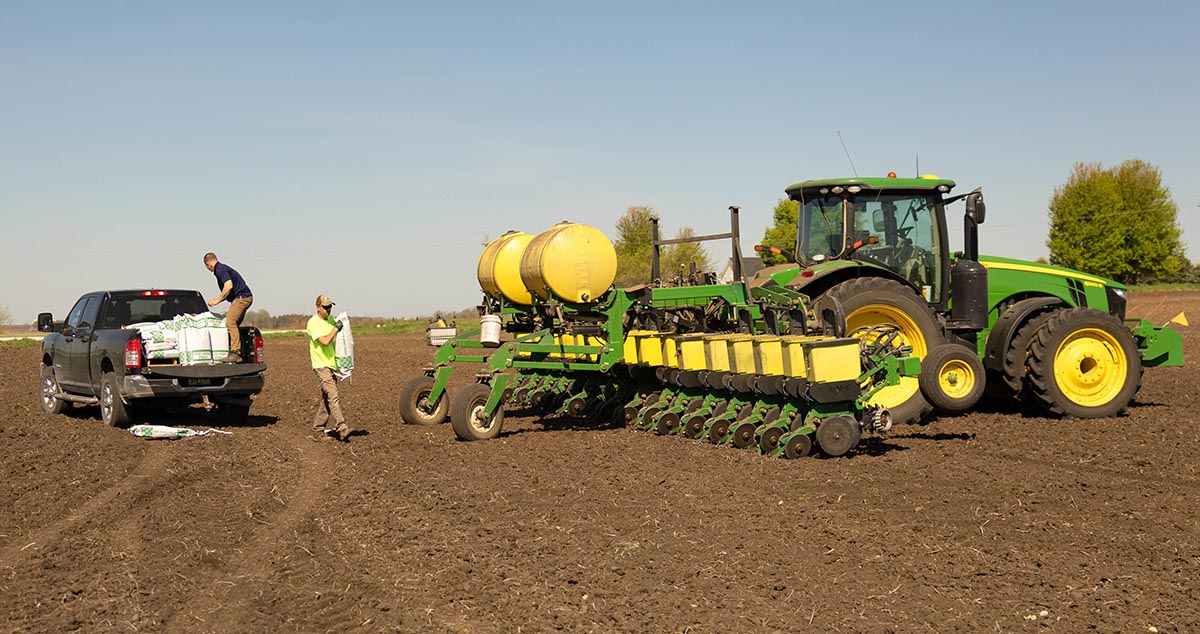
(Photo: Iowa Soybean Association / Joclyn Kuboushek)
How planting decisions and grain marketing collide in the spring
March 2, 2026 | Kriss Nelson
As spring fieldwork ramps up, farmers are making decisions that shape the season long before the crop emerges — from when and how seed goes into the ground to when grain gets priced. Agronomy and marketing may feel separate, but spring is when both demand attention.
Conditions over calendar
Alex Schaffer, Iowa Soybean Association’s (ISA) research agronomy lead, says soil temperature and short-term forecasts matter just as much as the calendar.
“We really like to see soil temperatures at 50 degrees and rising,” Schaffer says. “But it’s not just today’s temperature. You have to look a few days ahead.”
One key risk farmers should avoid is imbibitional chilling, which occurs when a soybean seed absorbs cold water immediately after planting.
“You don’t want that seed’s first drink of water to be a cold one,” Schaffer says. “If soils are around 50 degrees but a cold rain is coming on day three, I’d wait. That first moisture the seed takes up should ideally be above 50 degrees.”
Despite those cautions, Schaffer says the data strongly support early soybean planting. Research consistently shows soybeans planted in April, beginning around crop insurance planting dates, tend to outyield soybeans planted in May.
“The yield advantage is there almost every year,” he says. “Early planting really pays.”
That said, Schaffer cautions against pushing early planting without the right protection. He strongly recommends using a seed treatment, especially one with sudden death syndrome (SDS) activity.
“In 2025, we saw soybeans sit in cool, wet soils for nearly three weeks,” Schaffer says. “That led to more SDS showing up later in the season. The yield reward is worth the risk, but not without a premium seed treatment, especially if there is a history of SDS pressure.”
Temperature also plays a major role in herbicide performance, particularly for burndown and contact herbicides.
“Weeds and cover crops need to be actively growing to metabolize herbicide,” Schaffer says. “Around 50 degrees and above is a good target.”
He also warns against cutting herbicide rates when conditions are borderline.
“Don’t try to save money here,” Schaffer says. “Use full rates, add AMS first to condition the water, include surfactants as the label calls for, and follow the label closely. Cutting corners leads to weed escapes, and that’s a problem you’ll fight all season.”
Spring nitrogen stabilizer trial
ISA is taking a closer look this spring at a question many farmers ask but rarely get clear answers to: how effective are nitrogen stabilizers when applied with spring nitrogen?
The trial will compare strips of spring ammonia treated with NSERV to strips without a stabilizer. What sets the project apart is the level of monitoring. Over an eight-week period, researchers will collect soil samples every other week, resulting in four sampling events from each treatment.
“We’re really focused on measuring the conversion rate from ammonium to nitrate,” Schaffer says. “Ammonium stays put. Nitrate moves, and that’s where leaching losses happen.”
Nitrogen stabilizers are designed to slow the activity of soil bacteria that convert ammonium into nitrate. By tracking how quickly that conversion happens in treated versus untreated strips, ISA hopes to better understand not just whether the product works, but how long it works.
“This gives us a way to measure the length of efficacy,” Schaffer says. “How many weeks is that product actually influencing soil biology and slowing down that conversion process?”
With spring nitrogen applications often exposed to variable weather and soil conditions, understanding when and where stabilizers provide value can help farmers make more informed decisions.
Sulfur and cover crop effects on soybeans
ISA is launching a trial this spring to better understand how sulfur management interacts with cover crops in soybean systems, particularly fields following cereal rye.
The trial is designed to answer a question ISA agronomists are hearing more often from farmers: are cover crops changing early-season sulfur availability for soybeans, and could that be limiting yield?
Schaffer says sulfur has become a bigger point of discussion as more acres move to no-till and cover crops.
“When you have cereal rye ahead of soybeans, there’s a good chance some of that available sulfate is being tied up early,” Schaffer says. “At the same time, cooler soil temperatures can slow mineralization. That combination can put soybeans in a tight spot right when they’re trying to get established.”
The concern goes beyond early growth. One theory is sulfur plays a key role in helping rhizobium bacteria colonize soybean roots. Those bacteria are responsible for nitrogen fixation later in the season.
“If sulfur is limited early, nodulation can suffer,” Schaffer says. “That can show up much later in the season as nitrogen stress and ultimately lost yield.”
To study the issue under Iowa conditions, ISA is enrolling 10 fields with 100% cover crop acres going to soybeans. Each field will receive four sulfur treatments, including a zero-rate check. A granular gypsum product will be applied ahead of planting to supply sulfur and evaluate whether added sulfur improves nodulation and yield.
“We want to know when sulfur makes sense and when it doesn’t,” Schaffer says. “This isn’t about adding another input everywhere. It’s about understanding where the response is and what that return looks like.”
The goal is to generate practical, Iowa-specific data farmers can trust.
“Cover crops bring a lot of benefits,” Schaffer says. “Our job is to make sure fertility management keeps pace so farmers can capture those benefits without sacrificing yield.”
Beyond the field
Many of the decisions Schaffer highlights involve risk management. That same mindset applies beyond the field. As spring fieldwork ramps up, grain marketing decisions often carry just as much long-term impact, even though they’re easier to put off.
Sharon Chism, an at-large director for the Iowa Soybean Association, says the weather uncertainty of spring planting is a critical window for forward pricing new-crop grain to meet fall cash flow needs, even as farmers focus on getting crops in the ground.
“It’s easy to focus on spring fieldwork and let marketing get set aside,” Chism says. “It is helpful to have reminders built in, like on the shop calendar or even the calendar taped inside the planter tractor cab, with goal dates of having grain priced.”
That timing matters since spring markets tend to be driven by weather uncertainty. Jacob Kleinberg, COO
of publications for Roach Ag, says markets during this period often react to U.S. planting progress and production outcomes in South America.
“Seasonally, markets tend to focus on any hiccups with planting progress here in the States and the production numbers coming out of South America during their soybean and early corn harvest,” Kleinberg says. “Some of the best selling opportunities of the year occur during these spring months.”
Those seasonal drivers are layered this year with broader global considerations, including negotiations with China, the Russia-Ukraine war and developments in South America, which could influence markets through the spring and early summer.
Despite those opportunities, timing remains one of the biggest challenges for farmers.
“One of the biggest challenges with grain marketing is that the best opportunities tend to come during the planting and growing seasons,” Kleinberg says. “We hear all the time that farmers miss opportunities either because they were too busy to make a decision or because they were uneasy about their crop conditions.”
Chism says understanding seasonality helps bring structure to her decision-making. She encourages farmers to watch the U.S. Department of Agriculture’s spring World Agricultural Supply and Demand Estimates (WASDE) reports and set target dates to price a portion of new-crop grain, ideally around Mother’s Day and certainly by Father’s Day.
“A seasoned farmer at an Iowa Soybean Association meeting once told me to accept that it can be more profitable to price grain after it drops a dime than to sit and watch it fall a quarter or more while waiting for a bounce,” she says.
Incremental sales remain one of the simplest tools for managing uncertainty.
“Grain marketing involves risk,” Chism says. “Volatility humbles even the most seasoned grain marketers.”
Kleinberg agrees that having a clear marketing structure is critical, especially when margins are tight.
“Having a plan in place makes executing sales during these times easier,” he says. “There’s no perfect marketing plan but having a structure matters.”
At Roach Ag, that structure often includes setting clear targets for selling portions of both old and new crop during the spring and summer months, rather than waiting until harvest.
“We want producers pricing the grain they need sold before harvest,” Kleinberg says. “The goal is to avoid being handcuffed into selling at harvest because of cash flow needs or limited bin space.”
Chism adds that even small habits can help keep marketing top of mind. She suggests picking a day early in the week to review grain charts and observe trends.
“The visual increase or decrease in the market trends may be a better decision-making tool than what a farmer reads or listens to,” she says.
Back