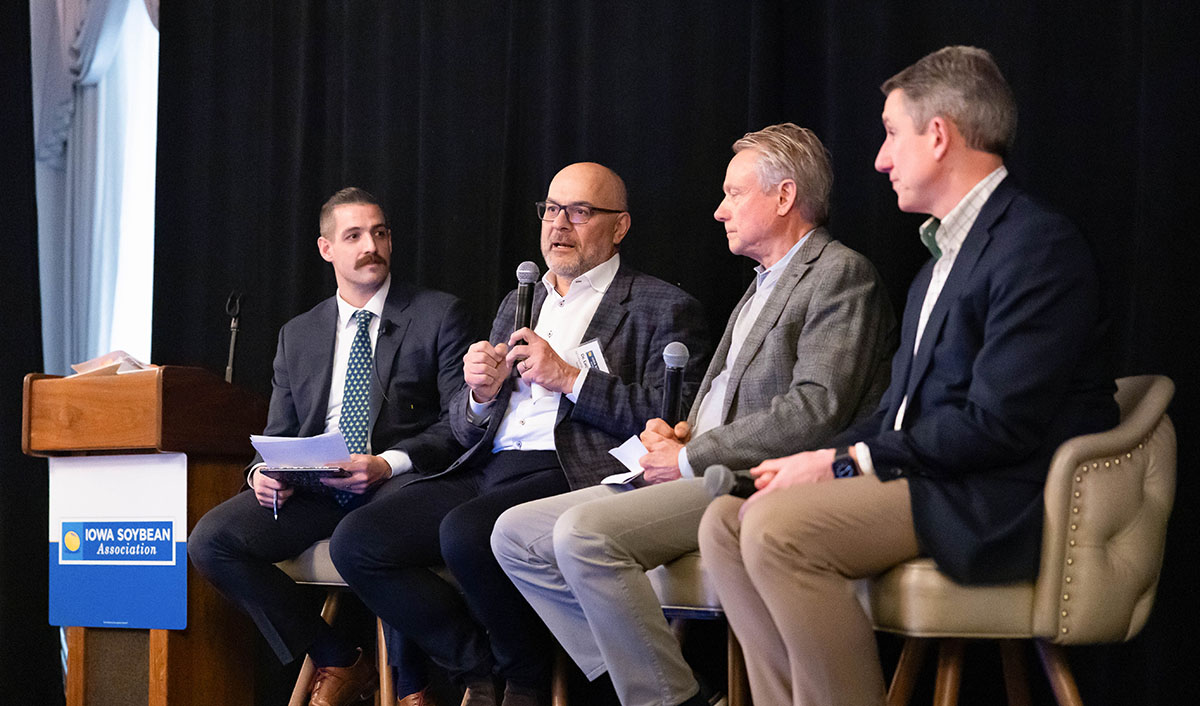
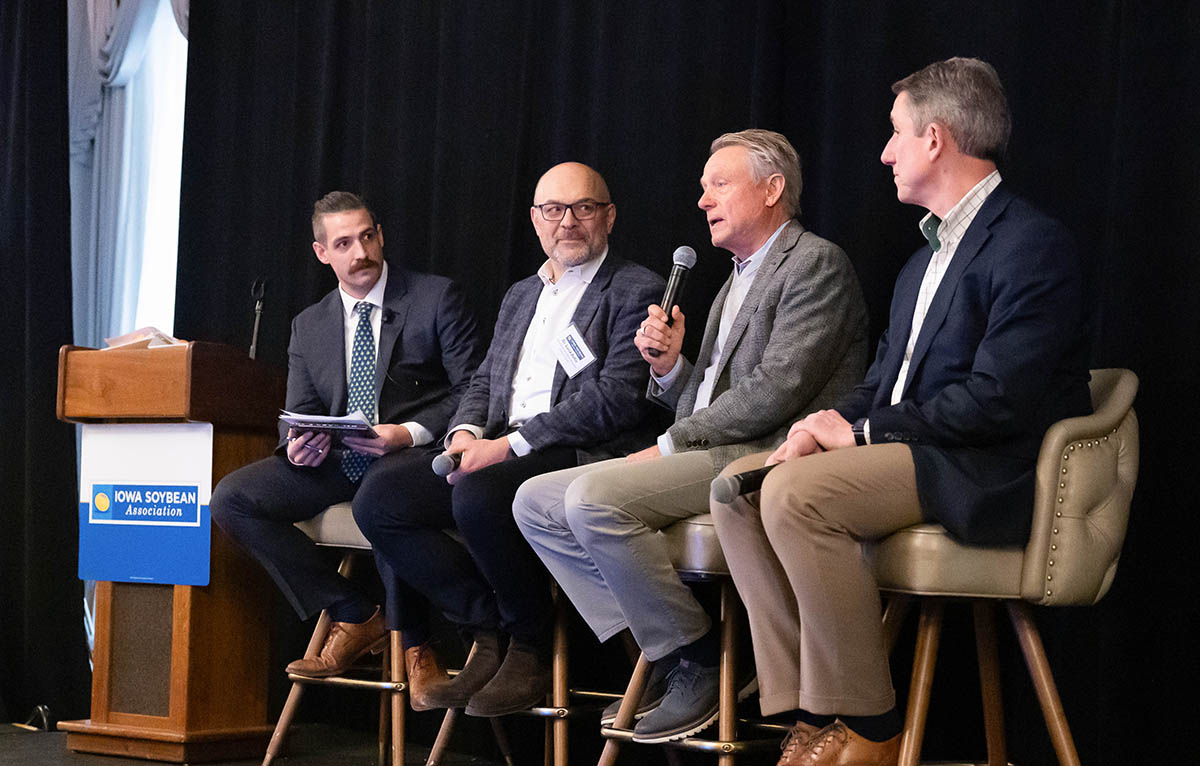
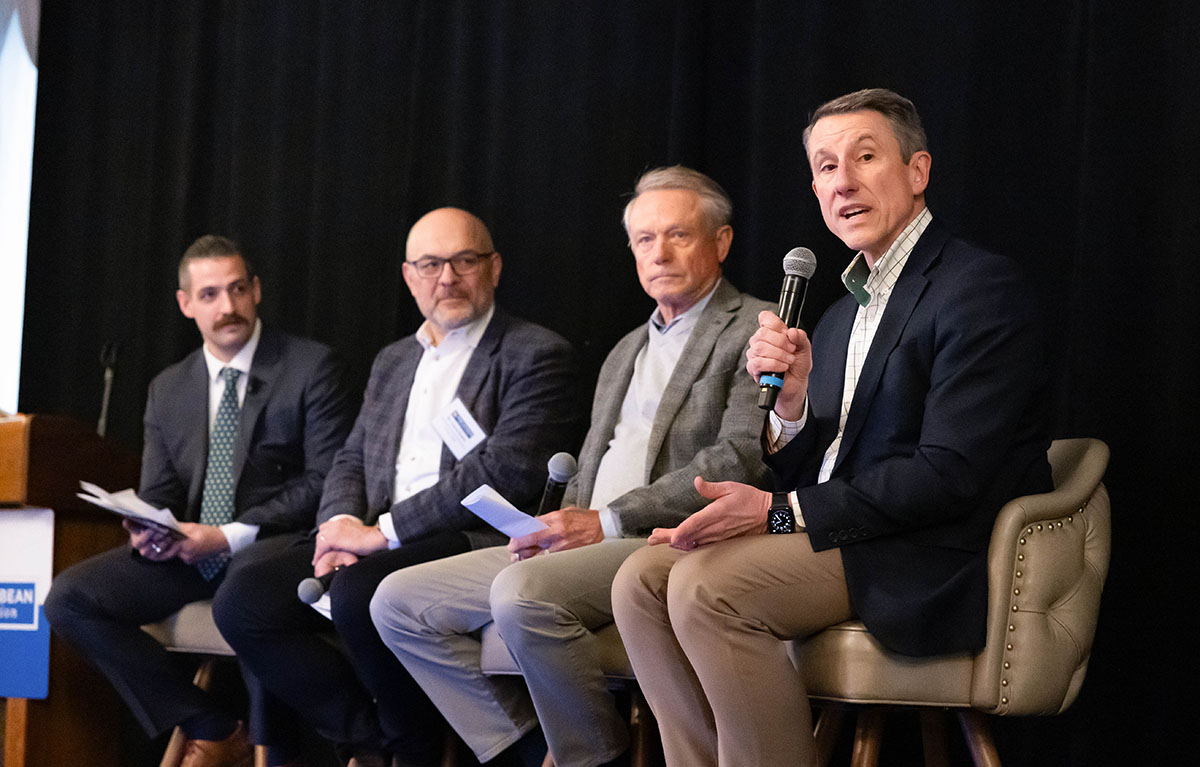
Matt Herman, ISA chief officer of advocacy and demand, moderated a panel on innovation and demand within the soybean industry that included Dr. Luca Zullo, senior director of science and technology at the Agricultural Utilization Research Institute; Paul Schickler, owner of Third Ag and former president of DuPont Pioneer and Kevin Kimle, chair for Ag Startup Engine. (Photo: Iowa Soybean Association / Joclyn Kuboushek)
Looking beyond exports at Farm Forward
February 12, 2026 | Kriss Nelson
Last week, Iowa farmers and ag leaders packed the Hotel Fort Des Moines in Des Moines for the Iowa Soybean Association’s (ISA) Farm Forward conference, a day focused on what comes next for farmers as markets, policy and consumer expectations keep shifting.
Matt Herman, ISA chief officer of advocacy and demand, moderated a panel on innovation and demand within the soybean industry that included Dr. Luca Zullo, senior director of science and technology at the Agricultural Utilization Research Institute; Kevin Kimle, chair for Ag Startup Engine and Paul Schickler, owner of Third Ag and former president of DuPont Pioneer.
Innovation and Demand Panel
With exports getting more competitive, what’s the path forward for growing domestic demand, and how should we think about supply?
Zullo: Trade will still exist, but we should think about relying a bit less on it. The opportunity is to build more regional markets, meaning at the level of states or counties. That can absorb material that previously relied on major export markets, and it can also help buffer shocks from international markets. I do not think there is one secret bullet that moves millions of tons. It is more about developing many opportunities that may be small individually but, taken together across the United States, they add up.
Can our current commodity supply position support that kind of shift, or do we need more innovation, especially around adding value?
Zullo: We need more innovation. Think about a refinery. Out of a barrel of oil comes hundreds of products. Fuels are still the bulk, but chemicals may be only about 10% of the barrel, but may represent as much as 47% share of total value. That industry started with one simple product, lamp oil, and they threw other components away until they learned to capture value. When I look at ethanol plants and crush plants, I see something similar. This is where we start. Today, an ethanol plant has a few products like ethanol and distillers grains, and then CO2 is a big one. There are better uses for that CO2 than putting it in the ground.
Schickler: On international markets, we still need to protect what we have. That has become harder due to barriers and due to the expansion of agriculture in other regions. At the same time, we need to get more value from the crops we continue to produce. That can mean increasing oil content, increasing protein content and improving other characteristics so the value becomes more than commodity price alone. We also need to make sure a portion of that value flows back to the farmer. I think about who wants what, where, and how? If we answer that, we can create opportunities beyond competing solely on commodity value.
Kevin, you have studied the history of these cycles. How do you view today’s external challenges?
Kimle: American agriculture has always faced external challenges, going back before the U.S. was even a country. We have floated in and out of those pressures, and a big part of how we respond is through innovation and the creation of new products. There are major population centers in the world that cannot be fully self-sufficient. Others will fill some of that gap, but if we make better and more unique products at a good price, we will find a way to sell them.
If innovation is needed, it also takes capital. Historically it has been difficult to raise capital and bring these businesses to life in the Midwest. How can we overcome that? What role do public-private partnerships play?
Kimle: I see the next generation already doing this in smaller ways. For example, I have former students who are selling meat directly to consumers, hosting farm-to-table dinners, and building relationships that open markets. A chef from outside the region shows up, discovers Iowa beef, and suddenly buys significant volumes for a restaurant. That is one example of how markets develop. It does not always scale the same way, but it shows how value can be found and expanded.
Schickler: Investment capital is challenging. We have to be honest and realistic about agriculture versus industries like fintech (financial technology) or medical. There are fewer potential acquirers in agricultural, and the market caps are smaller. Technology adoption is also slower. We should not try to mirror other industries. We should highlight the strengths of agriculture and target investors who value a differentiated portfolio and have realistic expectations for timelines and returns.
Zullo: Some investors want to hear a $10 billion opportunity, and they are not interested if the story is a really profitable $300 million company. But in agriculture, we may have many opportunities that are strong $300 million companies, not many that become the next Google. Another issue is time to market, especially for materials and industrial products. It can be about 10 years, so you need patient money. There is also a second valley of death for us: commercialization. You can have a product that works, but then a customer wants a truckload for testing, and you may need to spend $10 million to produce that scale. That is where public-private partnerships matter.
Scale-up centers like the Department of Energy BioMADE at Iowa State University can change that equation. If a facility exists where the capital cost is treated as sunk by government and users pay operating costs, you might spend $500,000 instead of $10 million to make that truckload. That is a conversation an investor can have. Public-private partnerships can provide infrastructure and commercialization support, including market outreach, business planning and helping entrepreneurs make sure they are solving the right problem.
Another policy and consumer trend is Make America Healthy Again (MAHA). Some see it as a threat, some as an opportunity. How should commodity groups think about it?
Zullo: It is both opportunity and threat. Right now, there is regulatory confusion, including contradictions. MAHA also conflates legitimate concerns with unclear definitions. Processed food does not have a scientific definition that everyone agrees on. There is also risk of ignoring science. For example, some claims about vegetable oils have no grounding in science. The key is to focus on things rooted in science, like integrated pest management, and not shy away from rejecting claims that have no scientific basis.
Schickler: You will not overcome emotions with facts alone. I would not fight the movement. Learn about it and find ways to participate. For example, biological products can support integrated management, potentially reduce the amount of chemistry used, and help slow resistance by adding different modes of action. You do not have to be against a movement. Understand the trend and see where agriculture can complement it.
Kimle: I think consumer curiosity about what is in food and how it is grown can work in our favor. Whole foods and higher-protein trends can benefit Midwestern agriculture and soybeans, even if the public sometimes talks about agriculture in ways that feel inaccurate or incomplete.
Written by Kriss Nelson
Back